


Demystifying the 24V 100Ah Lithium Ion Battery Price: A Smart Buyer's Guide
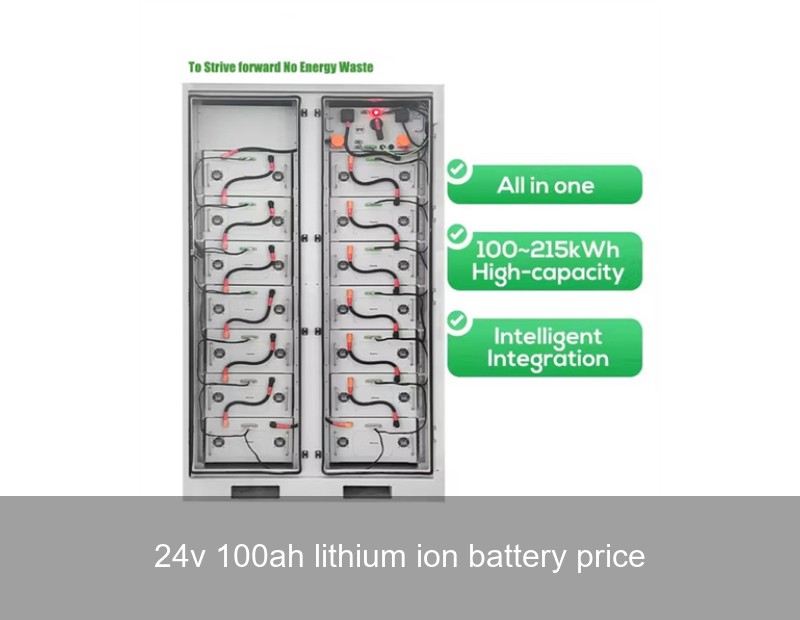
So, you're in the market for a reliable energy storage solution and keep seeing "24V 100Ah lithium-ion battery" pop up. It's a popular choice for caravans, marine applications, off-grid solar systems, and backup power. But when you start looking, the price range can be dizzying. Why does one 24V 100Ah battery cost $800 while another seems similar at $1,500? As a seasoned expert in the renewable energy and storage sector with Highjoule, I'm here to peel back the layers. The true cost of a battery isn't just its sticker price; it's about value, safety, longevity, and the intelligence behind the power. Let's navigate this together and understand what you're really paying for.
Table of Contents
- What Drives the 24V 100Ah Lithium Ion Battery Price?
- The Heart of the Matter: Cell Chemistry & Quality
- The Brain: Battery Management System (BMS) Intelligence
- Beyond Purchase Price: Understanding Total Cost of Ownership
- Real-World Application: A Case Study from Bavaria
- The Highjoule Difference: Engineering for Long-Term Value
- Making Your Choice: Key Questions to Ask Before You Buy
What Drives the 24V 100Ah Lithium Ion Battery Price?
Think of a battery like a car. Two sedans might have four wheels and an engine, but the performance, comfort, and safety differ vastly. The price of a 24V 100Ah lithium-ion battery is a sum of its core components:
- Cell Chemistry & Grade: Lithium Iron Phosphate (LiFePO4 or LFP) is now the dominant, safer chemistry for stationary storage. Prices vary if manufacturers use premium A-grade cells or lower-grade B-cells.
- Battery Management System (BMS): This is the onboard computer. A basic BMS protects from overcharge. An advanced, UL-certified BMS manages cell balancing, temperature, depth of discharge, and communicates with your inverter.
- Construction & Safety: This includes robust casing, internal mounting, thermal management systems, and safety certifications like UL 1973, IEC 62619, or UN38.3 for transport.
- Brand, Warranty & Support: Reputable brands investing in R&D, offering a 10-year warranty with high throughput, and providing local technical support inherently add value.
Cutting corners on any of these reduces the upfront 24v 100ah lithium ion battery price but introduces risk and hidden long-term costs.
The Heart of the Matter: Cell Chemistry & Quality
Not all lithium is created equal. For stationary energy storage, Lithium Iron Phosphate (LFP) has become the gold standard, and for good reason. It offers superior thermal and chemical stability, meaning a much lower risk of thermal runaway compared to older NMC chemistries. This safety is non-negotiable for homes and businesses.
Furthermore, premium A-grade LFP cells from established manufacturers (like CATL, EVE, or BYD) guarantee consistent capacity, low internal resistance, and will reliably deliver their rated 100Ah over thousands of cycles. Off-brand or lower-grade cells may initially test at 100Ah but degrade rapidly, leaving you with less usable capacity year after year. When evaluating price, always ask: "What is the specific cell chemistry and who is the cell manufacturer?"
The Brain: Battery Management System (BMS) Intelligence
If cells are the heart, the BMS is the brain and nervous system. A cheap BMS is a liability. A high-quality BMS is your investment's guardian. It ensures each cell within the 24V pack charges and discharges evenly (balancing), preventing premature failure. It monitors temperature, disconnecting power if unsafe conditions arise. Crucially, a smart BMS communicates via protocols like CAN-BUS or RS485, integrating seamlessly with hybrid inverters from brands like Victron, SMA, or Solaredge for optimized system performance.
At Highjoule, our proprietary Adaptive BMS goes beyond protection. It includes algorithms that learn usage patterns and optimize charge/discharge cycles to maximize lifespan. This level of intelligence, often found in our Highjoule H-Stack commercial series and Residential S Series, is a key differentiator that justifies a higher initial investment for exponentially greater returns.
Beyond Purchase Price: Understanding Total Cost of Ownership
The smartest financial analysis looks at Total Cost of Ownership (TCO). Let's break it down with a simple table comparing a low-cost battery to a premium offering over a 10-year period.
| Cost Factor | Budget Battery (e.g., $750) | Premium Battery (e.g., $1,200) |
|---|---|---|
| Purchase Price | $750 | $1,200 |
| Warranty Coverage | 3 years, pro-rated | 10 years, performance-based |
| Expected Cycle Life (to 80% capacity) | 2,000 cycles | 6,000+ cycles |
| Effective Cost per Cycle* | $0.375 | $0.20 |
| Risk of Early Failure | Higher | Very Low |
| Integration & Support | Limited | Full system design & tech support |
*Simplified calculation: Purchase Price / Cycle Life. Assumes one full cycle per day.
As you can see, the premium battery, while 60% more expensive upfront, costs nearly half per cycle over its lifespan. It's the difference between buying a tool that wears out and investing in a lasting asset.
Real-World Application: A Case Study from Bavaria
Let's move from theory to practice. A small, family-run hotel in the Bavarian Alps wanted to increase energy independence and reduce grid costs. Their existing solar panels were underutilized, exporting excess power for minimal feed-in tariffs.
Challenge: They needed a compact, safe battery system that could fit in a limited basement space, handle daily deep cycling, and integrate with their existing German-made inverter. Initial quotes for a 24V 100Ah system ranged from €700 to €1,300 per battery unit.
Solution & Data: After consultation, they chose a system built around two parallel Highjoule H-Reserve 24V 100Ah batteries. Key decision factors were the robust UL-certified BMS, the ability for seamless parallel connection up to 8 units for future expansion, and the 10-year warranty. 
- Self-consumption of solar power increased from 35% to 78%.
- Grid electricity consumption reduced by approximately 2,400 kWh annually.
- Projected payback period: 5.2 years, based on local energy prices and savings.
- The system automatically provides backup power during brief grid outages, a critical feature for hospitality.
This case illustrates that the right battery is an income-generating asset, not just an expense. The higher initial 24v 100ah lithium ion battery price was justified by tangible, measurable returns and peace of mind. For more on calculating solar ROI, reputable sources like the U.S. Department of Energy provide excellent frameworks.
The Highjoule Difference: Engineering for Long-Term Value
Since 2005, Highjoule's philosophy has been to build storage solutions that last. We don't compete on the lowest sticker price; we compete on the highest lifetime value. Our 24V solutions, whether in our modular residential units or integrated into larger commercial Highjoule Microgrid Controllers, are built with this ethos.
Every Highjoule battery system is engineered with:
- Military-Grade LFP Cells: We source exclusively from tier-1 suppliers, ensuring traceability and quality.
- Predictive BMS: Our cloud-connected systems can provide health reports and pre-emptively flag maintenance needs, a feature especially valued by our commercial and industrial clients.
- Scalable Architecture: Start with a single 24V 100Ah unit and expand effortlessly as your needs grow, protecting your initial investment.
- Global Support Network: With technical hubs in Europe and North America, we provide localized support and warranty service, a critical factor often overlooked when buying commodity batteries online.
This integrated approach transforms a simple battery into a smart, future-proof energy node. Independent testing, such as that highlighted by the Fraunhofer Institute for energy storage, consistently shows that system design and integration are as important as the cells themselves.
Making Your Choice: Key Questions to Ask Before You Buy
Armed with this knowledge, you can become a discerning buyer. Before you fixate on the 24v 100ah lithium ion battery price, ask your supplier these questions:
- Can you provide the cell manufacturer's datasheet and confirm the use of Grade-A LiFePO4 cells?
- What are the specific safety certifications (UL, IEC, UN) for this complete battery pack, not just the cells?
- What is the detailed warranty terms? Is it 10 years at 70% retained capacity, or simply a "10-year warranty"?
- How does the BMS communicate? Will it integrate with my existing or planned inverter/charger?
- What is the promised cycle life at 80% Depth of Discharge (DoD), and what testing standard is that based on?
 Image: Professional evaluation of a battery storage system. Credit: Unsplash
The answers will quickly separate cost-effective quality from a risky bargain.
Your Next Step
The journey to energy independence is exciting. You now understand that the quest for the perfect 24V 100Ah battery isn't about finding the cheapest option—it's about finding the right partner for your energy journey. With the true cost of ownership in mind, what project will you power first, and how can a intelligently engineered storage system make it more resilient and efficient?
 Inquiry
 Online Chat