


3 Phase Energy Storage Cabinet: The Industrial Powerhouse for Modern Grids
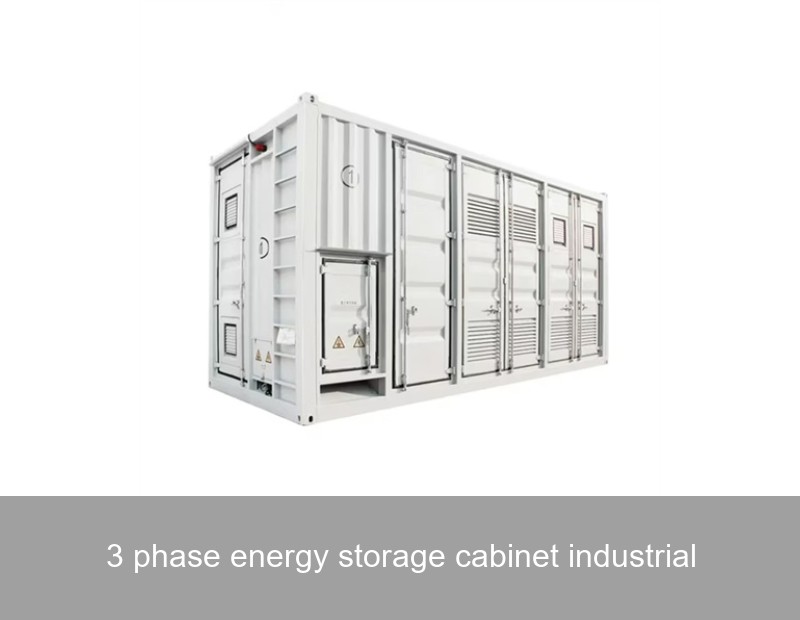
Imagine your factory floor humming with activity, machines drawing massive power in surges, and your monthly electricity bill showing a hefty "demand charge" that seems untouchable. This is the daily reality for industrial energy managers. The quest for resilience, cost control, and sustainability is pushing industries to look beyond the grid. Enter the 3 phase energy storage cabinet—a robust, industrial-grade solution designed to handle the rigorous, high-power demands of manufacturing plants, data centers, and large commercial facilities. Unlike residential single-phase systems, these three-phase cabinets integrate seamlessly with industrial electrical infrastructure, providing balanced power, peak shaving, and critical backup. As grid instability and energy costs rise, this technology is transitioning from a niche option to a core component of industrial energy strategy.
Table of Contents
- The Industrial Power Problem: More Than Just Bills
- What is a 3 Phase Energy Storage Cabinet?
- Key Benefits Unlocked for Industry
- Real-World Case Study: A German Manufacturing Plant
- Choosing the Right System: What to Look For
- Highjoule's Industrial Energy Solutions
- The Future of Industrial Energy Management
The Industrial Power Problem: More Than Just Bills
Let's break down the pain points. Industrial facilities don't just consume energy; they consume it in a volatile, unpredictable manner. A large press starting, an arc furnace firing, or a data center's cooling system kicking in can create instantaneous spikes in power demand. Utilities charge for this peak demand—sometimes accounting for 30-50% of a commercial bill. Furthermore, grid outages or voltage sags, even milliseconds long, can halt production lines, spoiling product and costing tens of thousands per hour. The push for decarbonization adds another layer: how to integrate on-site solar when your machines need stable, 24/7 power? The traditional grid connection alone is no longer sufficient.
What is a 3 Phase Energy Storage Cabinet?
Think of it as a massive, smart, industrial-grade battery bank. A 3 phase energy storage cabinet is a containerized system comprising lithium-ion battery modules (like LiFePO4 for safety and longevity), a 3-phase power conversion system (PCS), a sophisticated thermal management system, and a built-in energy management system (EMS). It's called "3 phase" because it connects directly to the industrial three-phase electrical supply, ensuring balanced power distribution across all phases—a critical requirement for heavy machinery. These cabinets are often modular, allowing capacity to scale from hundreds of kilowatt-hours (kWh) to multiple megawatt-hours (MWh).

Image Source: Unsplash - Representative image of industrial energy storage equipment.
Key Benefits Unlocked for Industry
Deploying a 3-phase system isn't just about having a backup. It's an active financial and operational asset.
- Peak Shaving (Demand Charge Management): The system intelligently discharges during short periods of peak demand, flattening the load curve. This can lead to direct savings of 20-30% on demand charges.
- Energy Arbitrage: Store cheap electricity from the grid during off-peak nights (or from solar during the day) and use it during expensive peak periods.
- Backup Power & Power Quality: Provides seamless transition to backup power during outages, protecting processes. It also smooths voltage fluctuations and frequency variations, protecting sensitive equipment.
- Renewable Integration: Soaks up excess solar or wind generation for use when production is high but renewable generation is low, maximizing self-consumption.
- Grid Services: In some markets, facilities can generate revenue by providing frequency regulation or capacity services to the local grid operator.
Real-World Case Study: A German Automotive Parts Manufacturer
Let's look at concrete data. A mid-sized automotive supplier in Bavaria, Germany, faced annual electricity costs exceeding €1.2 million, with demand charges and grid fees being significant contributors. Their production involved high-precision CNC machines and robotic welding stations, causing erratic power draws. They also had a 500 kW rooftop solar PV system that was often curtailed during weekends.
The Solution: In 2023, they installed a containerized 3 phase energy storage cabinet system with a total capacity of 840 kWh and a power output of 420 kW. The system was integrated with their existing solar and building management system.
The Results (12-month period):
| Metric | Result | Impact |
|---|---|---|
| Peak Demand Reduction | 28% | Direct reduction in monthly demand charges |
| Solar Self-Consumption Increase | From 55% to 89% | Dramatically reduced grid purchases |
| Overall Energy Cost Savings | €185,000 annually | Simple payback period under 5 years |
| CO2 Emission Reduction | Estimated 210 tonnes/year | Strengthened sustainability reporting |
Furthermore, the system provided ride-through capability during several brief grid disturbances, preventing an estimated €80,000 in potential production line stoppages. This case, documented in a Fraunhofer ISE industry report, highlights the multi-faceted ROI of modern industrial storage.
Choosing the Right System: What to Look For
Not all cabinets are created equal. For industrial applications, reliability and safety are non-negotiable. Key selection criteria include:
- Battery Chemistry & Safety: LiFePO4 (LFP) is often preferred for its thermal stability, long cycle life (6,000+ cycles), and lower fire risk compared to some NMC chemistries.
- Power Conversion Efficiency: Look for round-trip efficiency above 95%. Every percentage point lost is wasted energy on an industrial scale.
- Scalability & Modularity: Can you start with 500 kWh and easily expand to 2 MWh as needs grow?
- Software & Intelligence: The EMS must be capable of advanced, forecast-based control, integrating weather, production schedules, and tariff structures.
- Thermal Management: Robust liquid cooling is often essential for high-power, continuous cycling in varied ambient temperatures.
Highjoule's Industrial Energy Solutions
At Highjoule, we've been engineering solutions for these exact challenges since 2005. Our H-IEC Series (Industrial Energy Cabinet) is purpose-built for the demands of facilities like yours. These are not repurposed residential units; they are engineered from the ground up for industrial duty cycles.
Our H-IEC cabinets feature:
- Standardized, containerized designs from 500 kWh to 3+ MWh, using ultra-safe LFP battery cells.
- Advanced liquid cooling and climate control ensuring optimal performance from -30°C to 50°C.
- Our proprietary OptiGrid EMS, which uses AI-driven forecasting to optimize every charge/discharge cycle for maximum financial return, not just simple time-of-use switching.
- Seamless integration with existing distributed energy resources (solar, wind, gensets) and microgrid controllers.
We provide a full turnkey service—from initial energy audit and financial modeling to system design, installation, grid connection support, and remote monitoring. For a large food cold storage facility in the Netherlands, for instance, our system not only manages peak loads but also provides critical backup to prevent spoilage, turning a cost center into a resilience asset.

Image Source: Unsplash - Representative image of industrial control systems.
The Future of Industrial Energy Management
The trajectory is clear. Industrial energy systems are becoming dynamic, interactive, and intelligent. The 3 phase energy storage cabinet is the central hardware enabling this shift. As virtual power plants (VPPs) become more prevalent, your facility's storage system could become an automated revenue stream, bidding capacity into regional energy markets. Furthermore, with evolving standards like IEEE 1547-2018 for grid interconnection, these systems will play a key role in maintaining grid stability as renewable penetration grows.
The question is no longer if industrial storage is viable, but how to best implement it for your specific load profile, tariff structure, and sustainability goals. What would a 25% reduction in your annual energy costs and complete protection from short-term outages mean for your operational budget and risk profile this coming year?
 Inquiry
 Online Chat