


Unlocking Grid Resilience: The Strategic Role of a 3.5 MW Hybrid Energy Storage Cabinet
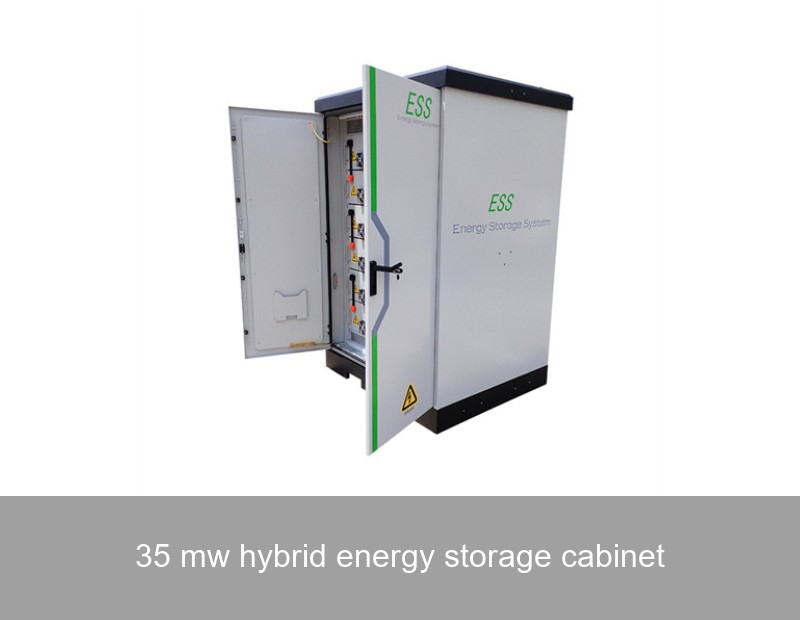
a sleek, container-sized unit quietly humming on the edge of a factory yard or a solar farm. Within its robust cabinet lies not just a battery, but an intelligent brain orchestrating multiple energy streams. This is the modern 3.5 MW hybrid energy storage cabinet—a cornerstone technology transforming how businesses and communities manage power. For facility managers, energy developers, and sustainability officers across Europe and the U.S., this isn't just backup power; it's an active financial and operational asset. As a product technology expert at Highjoule, I've seen firsthand how this specific capacity has emerged as a game-changer for commercial, industrial, and utility-scale applications. Let's delve into why.
The Intermittency Challenge: When the Sun Sets and the Wind Stops
Our energy landscape is undergoing a profound shift. Renewable sources like solar PV and wind are now the most cost-effective new-build power in many regions. But they bring a fundamental challenge: variability. A cloud passes over a 10 MW solar array, and output can plummet in seconds. Evening demand peaks just as solar generation fades—a dilemma often called the "duck curve." This intermittency strains the grid, causing frequency fluctuations and potentially leading to costly demand charges for large energy users.
Traditional solutions, like diesel generators, are increasingly seen as polluting and inefficient stopgaps. The market is demanding something smarter, cleaner, and more versatile. This is where advanced hybrid energy storage systems step in, acting as a buffer, a shock absorber, and a strategic controller for on-site energy assets.

Image: Solar farms increasingly pair with battery storage to mitigate intermittency. Source: Unsplash
Why 3.5 MW is the Sweet Spot for Commercial & Industrial Power
Power ratings in energy storage aren't arbitrary. The prevalence of the 3.5 MW hybrid energy storage cabinet is a direct response to market needs and grid infrastructure. Let's break down the numbers:
- Grid Connection Compatibility: Many commercial and industrial (C&I) sites have medium-voltage connections that can readily accommodate a 3-4 MW addition without requiring prohibitively expensive grid upgrades.
- Demand Charge Management: For large facilities, utility bills often include "demand charges" based on the highest 15-30 minute power draw in a month. A 3.5 MW system can effectively shave these peaks, leading to dramatic savings. A study by NREL highlights the significant economic potential of peak shaving for C&I customers.
- Modular Scalability: 3.5 MW serves as a powerful building block. For larger projects, multiple cabinets can be linked in parallel to create 10 MW, 20 MW, or even larger systems, providing incredible flexibility for growth.
At Highjoule, our H-Cube 3500 series is engineered precisely for this sweet spot. It's a fully integrated, containerized solution that combines high-density lithium-ion battery racks with a built-in Power Conversion System (PCS) and our proprietary Energy Management System (EMS). This all-in-one hybrid energy storage cabinet simplifies deployment and ensures optimal performance, whether it's paired with existing solar, new wind installations, or used for standalone grid services.
Key Components of a High-Performance Hybrid Cabinet
| Component | Function | Highjoule's Approach in the H-Cube 3500 |
|---|---|---|
| Battery Bank | Stores electrical energy | UL-certified LiFePO4 cells for safety & long cycle life, with advanced thermal management. |
| Power Conversion System (PCS) | Converts DC battery power to AC grid power and vice versa | Bi-directional inverter with >98.5% efficiency, capable of rapid grid response. |
| Energy Management System (EMS) | The "brain" that controls charging/discharging based on algorithms | AI-driven platform that can optimize for self-consumption, peak shaving, or grid revenue streams. |
| Safety & Environmental Control | Ensures safe operation in all conditions | Integrated fire suppression, HVAC, and ingress protection (IP54) for outdoor durability. |
A Real-World Case: Stabilizing a German Industrial Park
Let's move from theory to practice. In 2023, Highjoule deployed a 3.5 MW / 7 MWh H-Cube 3500 system at an industrial park in North Rhine-Westphalia, Germany. The site hosted several manufacturing tenants and a 2 MW rooftop solar array. The challenge was twofold: reduce the park's reliance on the volatile spot market and provide grid stability services to the local distribution network operator (DNO).
The Solution & Results: Our hybrid storage cabinet was installed as a turnkey solution. Highjoule's EMS was configured for multi-mode operation:
- Solar Self-Consumption Optimization: Storing excess midday solar generation for use during evening production hours, increasing on-site renewable usage from 35% to over 60%.
- Peak Shaving: Automatically discharging to cap grid power draw at a predefined level, reducing monthly demand charges by an estimated €18,000 annually.
- Frequency Regulation (FFR): The system participates in the German primary control reserve market, with its 3.5 MW capacity responding to grid frequency dips or surges in milliseconds, creating a new revenue stream. Data from the German grid regulator shows the growing volume and importance of such flexibility services.
Within the first year, the project achieved a return on investment (ROI) timeline significantly ahead of projections, showcasing the tangible financial logic behind a well-engineered 3.5 MW hybrid energy storage investment.
Beyond Backup: The Multi-Revenue Future of Energy Assets
The German case study illustrates a crucial evolution. The modern hybrid energy storage cabinet is a multi-tool. It's no longer a single-purpose asset. For a business, it can simultaneously:
- Reduce energy costs (via arbitrage and demand charge management).
- Generate revenue (via grid services).
- Enhance sustainability (by enabling more renewables).
- Provide emergency backup power (ensuring operational continuity).
This "value stacking" is what makes the business case so compelling. In the U.S., markets like CAISO (California) or ERCOT (Texas) have established mechanisms for storage to participate in capacity and ancillary services markets. A Highjoule system's EMS is designed to navigate these complex market rules, automatically switching modes to maximize economic return 24/7.

Image: Modern EMS platforms allow remote monitoring and optimization of storage assets. Source: Unsplash
Is Your Energy Strategy Ready for the Next Decade?
The transition to a resilient, decarbonized energy system is not a distant future—it's happening now. The 3.5 MW hybrid energy storage cabinet represents a mature, proven, and financially savvy technology to anchor that transition for large energy users. It turns passive consumption into active, intelligent energy management.
So, I leave you with this question: As you look at your facility's energy bills, sustainability goals, and operational resilience, have you evaluated what a strategic, multi-functional asset like a hybrid storage system could do for your bottom line and your environmental impact? The data and the case studies are here. The technology, from providers like Highjoule with nearly two decades of deep system integration expertise, is ready and waiting.
 Inquiry
 Online Chat