


What You Need to Know About a 40kWh Per Day Solar System
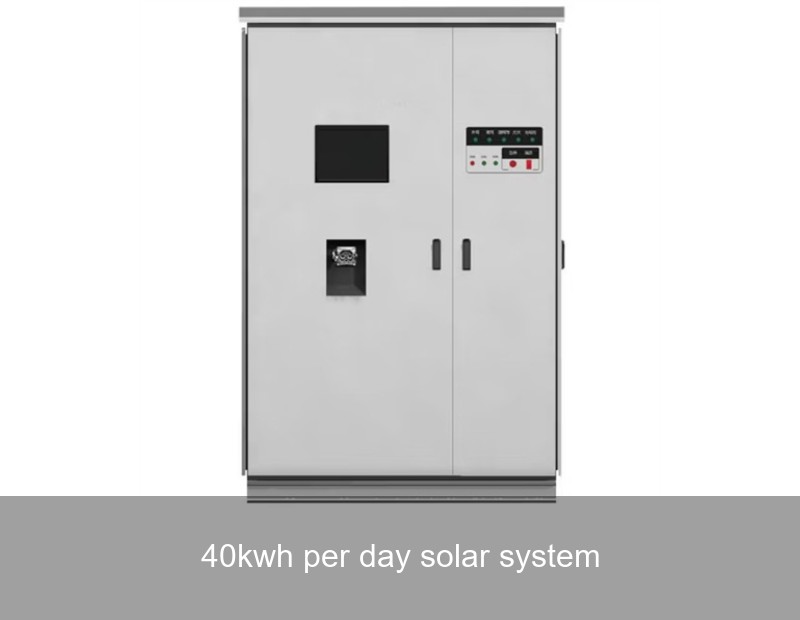
So, you're thinking about going solar. Not just a few panels to trim your electricity bill, but a serious energy solution. You've likely come across the term "40kWh per day solar system" in your research. It sounds impressive, but what does it really mean for your home or business? Is it overkill, or is it the perfect match for a modern, energy-intensive lifestyle? Let's demystify this powerful system size, explore who it's for, and how pairing it with the right battery storage transforms it from a daytime generator into a full-fledged energy independence powerhouse.
Table of Contents
- Understanding the 40kWh Per Day Benchmark
- Is a 40kWh/Day System Right for You?
- The Critical Piece: Moving Beyond Solar Panels to Storage
- The Highjoule Solution: Intelligent Storage for Maximum Return
- A Real-World Case Study: From High Bills to Energy Security
- Making the Leap: Key Considerations
Understanding the 40kWh Per Day Benchmark
First, let's break down the unit. A kilowatt-hour (kWh) is a measure of energy consumption. Think of it as the fuel your home uses. A system designed to produce 40kWh per day is engineered to generate that amount of usable electricity under optimal conditions over a 24-hour period.
To put this in perspective, the average U.S. household consumes about 29 kWh per day. In energy-conscious Europe, that figure can be lower, but it's rising with electrification. A 40kWh/day system is, therefore, a robust setup designed for above-average consumption or for ensuring surplus production.
Image Source: Unsplash - A home with a substantial solar array capable of high daily output.
The Components: More Than Just Panels
This output typically requires a solar array of around 10-12 kilowatts (kW) in capacity, depending on your location's sunlight (or "solar insolation"). For example, the same system in sunny Arizona will produce more consistently than one in Germany, though modern panels perform well in diffuse light. This array is the factory, but without a way to manage its product—electricity—you're limited to using power only when the sun shines.
Is a 40kWh/Day System Right for You?
This system size isn't for every home. It's a strategic choice for specific profiles. Consider it if you fall into one of these categories:
- Large or All-Electric Homes: Homes with electric heating (heat pumps), cooling (AC), pools, hot tubs, or extensive square footage.
- Home-Based Businesses or Workshops: Running power tools, servers, 3D printers, or other equipment significantly increases daily draw.
- Electric Vehicle (EV) Households: Charging one or more EVs at home can add 10-30+ kWh per day to your load. A 40kWh system can cover both your home and your "fuel."
- Proactive Energy Planners: Those preparing for future electrification (switching from gas to induction cooking, adding an EV) or seeking near-total grid independence.
Essentially, if your current electricity bill consistently shows high usage, or you're planning a sustainable electrification project, a system of this scale is a forward-thinking investment.
The Critical Piece: Moving Beyond Solar Panels to Storage
Here's the pivotal insight: a 40kWh per day solar system without storage is like having a reservoir that fills only at noon and drains by sunset. You send excess power to the grid for minimal credits (or feed-in tariffs) and draw expensive power back at night. This limits your self-consumption and financial return.
The true potential is unlocked with a battery energy storage system (BESS). A BESS allows you to:
- Maximize Self-Consumption: Store your daytime surplus for use in the evening and overnight, drastically reducing grid purchases.
- Provide Backup Power: Keep essential loads running during grid outages—a growing concern in many regions.
- Optimize for Time-of-Use (TOU) Rates: In markets like California or parts of Europe, store solar energy when rates are low and use it during peak price periods.
For a 40kWh/day producer, a battery with a usable capacity of 15-30 kWh is often the perfect partner, capturing a large portion of your surplus for round-the-clock use.
The Highjoule Solution: Intelligent Storage for Maximum Return
This is where Highjoule's expertise becomes critical. Since 2005, we've moved beyond simply supplying batteries to providing integrated, intelligent energy management systems. Pairing your 40kWh/day solar array with a Highjoule storage system transforms your property into a resilient, smart energy asset.
Our HPS Series (Home Power Solution) is ideally suited for large residential and light commercial applications. With modular designs scalable from 10 kWh to over 30 kWh of storage, it can be tailored to match your specific solar production and consumption profile. What sets Highjoule apart is our Energy Management System (EMS) software. It doesn't just store and release energy; it learns your patterns, weather forecasts, and utility rate structures to autonomously optimize when to charge, discharge, or hold, ensuring every kilowatt-hour you produce delivers maximum value.
For larger commercial or microgrid applications, our C&I and Microgrid Solutions offer utility-grade storage that can manage the consistent, high output of a massive solar installation, providing both economic savings and critical grid services.

Image Source: Unsplash - A modern, wall-mounted battery storage system in a garage.
A Real-World Case Study: From High Bills to Energy Security
Let's look at a concrete example from Northern California, a market with high electricity rates and frequent grid reliability issues.
The Challenge: A family living in a 3,500 sq. ft. all-electric home with two EVs was facing monthly electricity bills averaging $450-$600, even with a 8kW existing solar system that was too small for their expanded needs (EVs and a heat pump added post-installation).
The Solution: They upgraded to a 12kW solar array (designed to produce ~45kWh on a good day) and installed a Highjoule HPS-25 system (25 kWh usable storage). The Highjoule EMS was configured to prioritize charging the battery with solar excess, then schedule EV charging during the sunniest afternoon hours, and finally power the home through the evening peak and overnight.
The Data-Driven Outcome: In the first year post-installation:
| Metric | Before Upgrade | After Upgrade |
|---|---|---|
| Grid Energy Import | ~1,200 kWh/month | ~180 kWh/month* |
| Monthly Bill (Avg.) | $525 | $22 (basic service fee) |
| Self-Consumption Rate | ~35% | ~92% |
*The remaining import occurred during a short sequence of rainy winter days.
Furthermore, during three brief public safety power shutoffs (PSPS), the home maintained power for lights, refrigeration, and internet, demonstrating the resilience component. This case, documented in a NREL report on solar-plus-storage value, illustrates the compound benefits of correctly sizing and intelligently managing a large solar + storage system.
Making the Leap: Key Considerations
If a 40kWh per day system with storage sounds like your path to energy independence, here are the essential steps:
- Audit Your Energy: Review 12 months of utility bills. Calculate your average daily kWh use and identify your peak usage. An energy monitor can provide detailed circuit-level data.
- Assess Your Site: A professional installer will evaluate your roof space, orientation, shading, and local climate to model precise production for a system of this size.
- Plan for Storage from the Start: Design your solar and storage as one integrated system. Ensure your inverter is storage-ready (hybrid or AC-coupled) and that your battery has sufficient capacity and power rating to handle your home's critical loads.
- Understand Incentives: In the U.S., the federal Investment Tax Credit (ITC) now applies to standalone storage and solar-storage pairs. In Europe, various national and EU-level grants exist, like those in EU renewable energy programs. These can significantly improve ROI.
The Highjoule Advantage in Your Project
Choosing Highjoule means partnering with a global leader with nearly two decades of experience. Our systems are designed for longevity, safety, and seamless integration. We provide comprehensive support from design through commissioning and ongoing monitoring via our customer portal. For a project of this significance, that peace of mind is invaluable.

Image Source: Unsplash - A technician commissioning a residential solar and battery system.
Your energy future is not just about generating power; it's about controlling it intelligently. A 40kWh per day solar system paired with robust storage is a statement of that control. What would you power first if you could guarantee your own clean, affordable, and reliable electricity, day and night?
 Inquiry
 Online Chat