


Decoding the 50 kW Solar System Price: A Smart Investment for Your Business
So, you're exploring a 50 kW solar system for your business. That's a fantastic move towards energy independence and cost control. But when you start searching for that all-important "50 kw solar system price", you're likely met with a wide range of figures that can be confusing. Is it $75,000 or $150,000? The truth is, both could be accurate, depending on what's included. Think of it like asking for the "price of a commercial vehicle" – the cost varies immensely between a basic van and a fully-equipped refrigerated truck. This article will demystify the real costs, showcase the tangible returns, and explain why pairing your solar array with a modern battery system, like those from Highjoule, is the key to maximizing your investment.
The Real 50 kW Solar System Price: A Detailed Breakdown
A 50 kW solar system is a significant commercial or industrial-scale installation, typically for small to medium businesses, farms, or large residential properties. The headline "50 kw solar system price" usually refers to the photovoltaic (PV) modules and installation labor. However, the total project cost encompasses much more. Let's break it down.
| Cost Component | Description | Estimated Cost Range (USD) | Percentage of Total |
|---|---|---|---|
| Solar Panels & Hardware | High-efficiency monocrystalline panels, racking, mounting systems. | $25,000 - $40,000 | ~30-40% |
| Inverter System(s) | Central inverter or string inverters to convert DC to AC power. | $7,000 - $12,000 | ~10-15% |
| Installation & Labor | Engineering, permitting, electrical work, installation. | $15,000 - $25,000 | ~20-30% |
| Balance of System (BOS) | Wiring, conduit, combiner boxes, safety disconnects. | $5,000 - $10,000 | ~5-10% |
| Battery Energy Storage (Optional) | Lithium-ion battery bank, hybrid inverter, and integration. | $20,000 - $50,000+ | Variable |
| Total Project Cost (Without Storage) | $52,000 - $87,000 | 100% |
As you can see, the average gross price for a 50 kW solar installation in markets like the US and Europe typically falls between $1.00 to $1.75 per watt, leading to a total of $50,000 to $87,500 before incentives. Crucially, this is before applying tax credits, rebates, or accelerated depreciation benefits, which can slash the net cost by 30-50%.

Image Source: Unsplash - A professional commercial solar installation.
Key Factors That Influence Your Final Cost
Why such a broad range? Several factors directly impact your final quote:
- Location & Market: Labor costs, permit fees, and local incentives vary greatly between, say, Germany and Texas.
- Roof Type & Complexity: A simple, flat commercial roof is cheaper than a sloped, tile roof requiring specialized mounts.
- Panel & Inverter Quality: Premium Tier-1 panels with 25+ year performance warranties and high-efficiency string inverters cost more upfront but yield better long-term returns.
- Grid Connection Fees: Your utility may charge for interconnection studies or transformer upgrades.
- The Storage Question: Adding a battery system increases initial cost but unlocks greater savings and resilience.
From Cost to Return: A Real-World ROI Case Study
Let's move beyond price to value. Consider a real-world scenario for a small manufacturing facility in Southern California.
Phenomenon: The facility faced high daytime energy costs due to peak demand charges and time-of-use rates from the utility.
Data & Solution: They installed a 50 kW solar system with a 40 kWh integrated battery storage system. The total gross project cost was $125,000. After the 30% federal Investment Tax Credit (ITC) and a local rebate, the net investment was approximately $80,000.
- Annual Electricity Bill Savings: Reduced from $18,000 to $2,500, saving $15,500 per year.
- Demand Charge Mitigation: The battery discharges during peak grid demand periods, slashing monthly demand charges by over 60%.
- Simple Payback Period: Net Investment ($80,000) / Annual Savings ($15,500) = ~5.2 years.
- ROI & Lifetime Savings: With a system life of 25+ years, the post-payback savings are substantial, effectively generating "free" power and providing a hedge against rising utility rates.
This case highlights that the true metric isn't just the "50 kw solar system price", but the cost of energy over the system's lifetime. Adding storage transforms solar from a cost-saving tool into a strategic energy asset.
Beyond the Panels: The Critical Role of Energy Storage
A solar-only system exports excess power to the grid, often for a low feed-in tariff. When the sun sets, you buy power back at retail rates. This is where the modern energy equation changes. A Battery Energy Storage System (BESS) captures your surplus solar energy for use later, maximizing self-consumption.
For a business, this means:
- Peak Shaving: Avoid drawing expensive grid power during peak evening hours.
- Backup Power: Maintain critical operations during grid outages.
- Energy Arbitrage: Store cheap solar or off-peak grid energy, use it during expensive peak times.

Image Source: Unsplash - A modern battery storage system installation.
Highjoule's Smart Solutions for Commercial Solar+Storage
This is where Highjoule's expertise becomes pivotal. Since 2005, we've evolved from a component provider to a global leader in integrated, intelligent storage solutions. For a 50 kW solar project, we don't just sell a battery; we provide a system engineered for commercial performance.
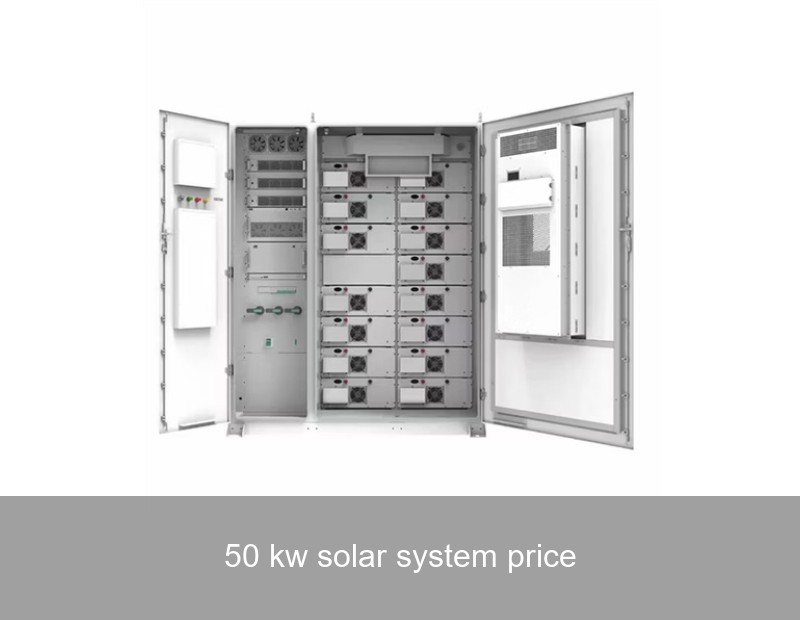
Our H-Series Commercial ESS is designed to seamlessly integrate with new or existing solar arrays. With scalable capacities from 30 kWh to over 1 MWh, it features:
- High-Energy Density Lithium Iron Phosphate (LFP) Cells: Renowned for safety, longevity (6,000+ cycles), and stable performance.
- Advanced Hybrid Inverter Platform: Manages solar production, battery charging/discharging, and grid interaction with high efficiency.
- AI-Powered Energy Management System (EMS): This is the brain. It learns your load patterns and electricity rates, automatically optimizing energy flow to minimize costs and maximize ROI. It can even participate in grid services where available.
- Modular & Future-Proof Design: Start with what you need and expand capacity as your business grows.
By choosing a unified solution like Highjoule's, you ensure all components communicate perfectly, are covered by a single warranty, and are managed by one intuitive platform. This reduces complexity and hidden integration costs, making the total 50 kw solar system price with storage more predictable and valuable.
Making Your Decision: Key Questions to Ask
As you evaluate quotes and partners, move the conversation beyond price per watt. Ask potential providers:
- Can you model my ROI with and without battery storage, using my specific utility rate schedule?
- How does your proposed system (and its EMS) specifically address demand charges and time-of-use rates?
- What is the projected degradation and guaranteed end-of-life capacity of the solar panels and battery system?
- Can you provide a detailed scope of work that clearly separates hardware, software, installation, and long-term service?
For authoritative information on solar costs and trends, you can reference reports from the National Renewable Energy Laboratory (NREL) or the Solar Energy Industries Association (SEIA).
Given the strategic advantage a solar-plus-storage system offers for your business's resilience and bottom line, what specific operational cost or risk are you most eager to eliminate with your own clean energy system?
 Inquiry
 Online Chat