


Demystifying the 800 Watt Solar Panel Price: A Smart Buyer's Guide
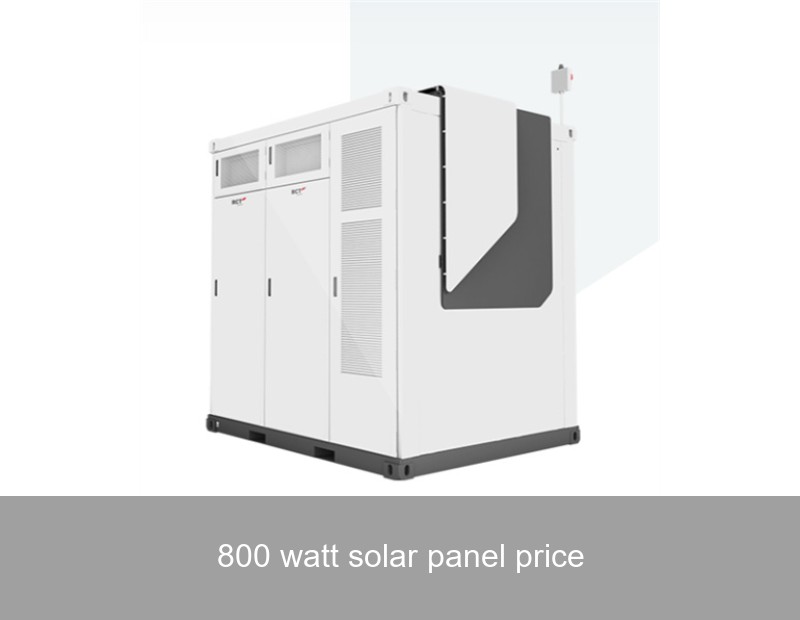
So, you're looking into solar power and have your eyes set on a robust 800-watt solar panel system. It's a fantastic choice for significantly offsetting your energy bills. But when you start searching for that magic number—the 800 watt solar panel price—you quickly find it's not as straightforward as a price tag on a shelf. The figure you see for the panel itself is just the beginning of the story. As a renewable energy specialist, I'm here to guide you through what you're really investing in, why context matters more than a standalone cost, and how pairing it with the right technology unlocks its true potential.
The Real Price Breakdown: More Than Just a Panel
Let's cut to the chase. An individual high-efficiency 800-watt solar panel module might have a wholesale price range, but for a homeowner or business, the relevant figure is the installed system cost. Why? Because solar panels don't work in isolation.
Think of it like buying a high-performance car engine. The engine (solar panel) is crucial, but you need the transmission, wheels, and chassis (the balance of system) to make it drive. Your total investment includes:
- Solar Panels (Modules): The 800W rating typically refers to the combined capacity of multiple panels (e.g., two 400W panels or four 200W panels). Panel efficiency directly impacts price—higher efficiency models (22%+) cost more but produce more power in the same roof space.
- Inverter(s): This critical component converts the DC electricity from your panels into usable AC power for your home. You'll need a suitably sized string inverter or microinverters.
- Mounting System & Hardware: The racking that securely attaches your panels to your roof or ground, designed to withstand decades of weather.
- Permitting, Installation, & Labor: This is a significant portion of the cost, covering site assessment, engineering, permits, and professional installation by certified technicians.
- Monitoring System: Smart technology that lets you track your system's production in real-time.
According to the National Renewable Energy Laboratory (NREL), soft costs like permitting, inspection, and customer acquisition now make up a major share of the total price. So, focusing solely on the panel's per-watt cost can be misleading.
What Influences Your Final Cost?
| Factor | Impact on 800W System Price |
|---|---|
| Your Geographic Location (USA/EU) | Labor rates, local incentive programs, and permit fees vary widely by state and country. |
| Roof Type and Complexity | A simple, composite shingle roof is cheaper to install on than a tile or metal roof with multiple angles. |
| Panel Technology and Brand | Monocrystalline panels (most efficient) cost more than polycrystalline. Tier-1 manufacturers often command a premium for reliability. |
| Inverter Choice | Microinverters (panel-level optimization) are more expensive upfront than a central string inverter but can offer better long-term yields, especially in shaded conditions. |
| Local Incentives & Tax Credits | The U.S. federal ITC (Investment Tax Credit) and similar European subsidies can reduce your net cost by 30% or more. |
A Real-World Case: The ROI of an 800W System in Texas
Let's move from theory to practice. Consider a case study from a residential customer in Austin, Texas, who installed an 800W system alongside a battery in early 2023.
- System Configuration: 4 x 200W high-efficiency monocrystalline panels, paired with a 5kWh Highjoule HomePower battery and an integrated hybrid inverter.
- Total Installed Cost (Pre-Incentive): ~$7,500 (covering the solar array, battery, inverter, and full installation).
- Key Driver: The homeowner wasn't just seeking to reduce bills; they wanted critical backup power during the grid's increasingly common instability.
- Performance Data: The system generates an average of 900-1000 kWh annually. In Texas's volatile energy market, with peak prices sometimes exceeding $0.50/kWh, the ability to use stored solar power during those peaks is where the real savings occurred.
- Financial Outcome: After the 30% federal tax credit, the net investment fell to ~$5,250. Combining bill savings (from self-consumption) and value from avoided outages, the homeowner projects a payback period of 6-8 years. More importantly, they now have peace of mind during summer heatwaves and storms.

Image: A modern residential solar installation. Source: Unsplash
The Highjoule Advantage: Maximizing Your Solar Investment
This is where the conversation evolves. At Highjoule, we view a solar panel not as an endpoint, but as the first component in a smarter, more resilient energy ecosystem. An 800-watt array produces valuable energy, but what happens when the sun isn't shining, or when grid power fails?
This is the core of our expertise. Simply chasing the lowest 800 watt solar panel price can lead to a suboptimal system. Our focus is on total energy value. We integrate premium solar generation with our intelligent, software-driven battery storage systems to ensure every kilowatt-hour you produce is used optimally.
For instance, our Highjoule HomePower series for residential applications doesn't just store energy; its AI-powered energy management system learns your consumption patterns, weather forecasts, and utility rate schedules. It automatically decides when to store solar energy, when to power your home from the battery to avoid peak tariffs, and when to provide seamless backup power. This turns your solar investment from a simple bill-reducer into a dynamic financial and resilience asset.
For commercial and industrial clients, our Highjoule GridMax solutions take this further, enabling participation in grid services and demand charge management, transforming energy costs into a controllable expense.
Future Trends: What's Next for Solar Panel Efficiency and Cost?
The solar industry is dynamic. While panel costs have fallen dramatically, the future is about value engineering, not just cheap panels. We're seeing:
- Perovskite-Silicon Tandem Cells: Lab prototypes are smashing efficiency records, promising even higher output from the same roof area in the coming years (Source: ScienceDaily).
- Integrated Solar-Storage "Appliances": The trend is towards seamless, all-in-one units that combine inverter, battery, and management—simplifying installation and improving aesthetics.
- Virtual Power Plants (VPPs): This is the ultimate value unlock. Companies like Highjoule are aggregating distributed home batteries (like those paired with 800W solar systems) to form a virtual power plant that supports the grid during stress, creating a new revenue stream for homeowners.

Image: Innovation in solar and battery technology labs drives future efficiency. Source: Unsplash
Is Your Home Ready for an 800W Solar Power Boost?
So, the question isn't just "What is the 800 watt solar panel price?" The more powerful questions are: What is the value of energy independence to you? How much could you save by intelligently managing every watt you produce? And what is the cost of not having power during the next grid outage?
Your next step isn't to find the cheapest panel online. It's to have a conversation with an expert who can analyze your energy usage, your home's solar potential, and your resilience goals to design a system—likely centered around a solar array and intelligent storage—that delivers the highest lifetime value. What's the one appliance or system in your home that you would prioritize powering during an outage?
 Inquiry
 Online Chat