


AccuRe Battery: How Much Does a Truly Reliable Energy Storage System Cost?
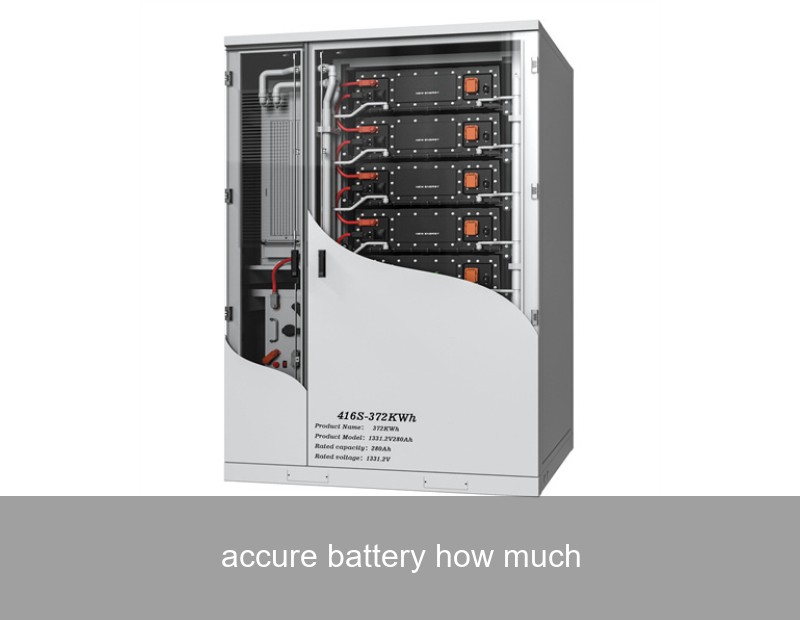
If you're researching energy storage, you've likely asked the question: "AccuRe battery how much?" It's a smart starting point. But here's the insight we share with our clients at Highjoule: the most critical cost isn't the initial invoice—it's the total cost of ownership over the system's lifetime. An AccuRe battery system, renowned for its predictive safety and analytics, represents a premium investment in long-term reliability and risk mitigation. Let's unpack what goes into that cost and how it translates to value for your home or business.
What is an AccuRe Battery and How Much Does It Cost?
First, a quick clarification. "AccuRe" refers to a sophisticated battery analytics and monitoring platform, not a battery cell brand. Developed by Accure Battery Intelligence, it's a software layer that uses advanced algorithms and data analysis to predict failures, prevent fires, and optimize performance of lithium-ion battery systems. Think of it as a highly trained doctor constantly monitoring your battery's vital signs.
When you ask "AccuRe battery how much," you're typically asking about the cost of an energy storage system (ESS) that integrates this premium safety and management intelligence. For a commercial or industrial-scale system, prices can range significantly based on capacity and configuration. A rough benchmark for a complete, AccuRe-enabled system can start from $150,000 to $500,000+ for medium-scale installations. For residential applications, the premium for an AccuRe-monitored system might add 10-20% to the cost of a high-end battery backup solution. But why consider this? Because the hidden cost of a cheaper, unmonitored system can be catastrophic.

Image: Advanced monitoring is key to battery safety and ROI. Source: Unsplash
The Real Cost Breakdown: More Than Just a Price Tag
To understand the value, we need to look beyond the kW/h price. The total cost encompasses:
- Capital Expenditure (CapEx): The hardware (battery racks, inverters, thermal management), software (AccuRe platform license), installation, and grid connection.
- Operational Expenditure (OpEx): Ongoing costs like energy for cycling, maintenance, and software subscriptions.
- Risk Cost: The potential financial impact of unplanned downtime, reduced lifespan, or in extreme cases, thermal runaway and fire. A study by DNV highlights that battery failures can lead to losses millions of times greater than the cost of advanced monitoring.
- Opportunity Cost: Lost revenue from not being able to participate in grid services (like frequency regulation) or not maximizing self-consumption of solar power.
An AccuRe system directly targets and reduces the Risk and Opportunity costs. Its predictive maintenance can extend battery lifespan by up to 20-30%, fundamentally altering the cost-per-cycle equation.
Case Study: A German Logistics Center's Real-World Data
Let's ground this with a real example. A major logistics company in North Rhine-Westphalia, Germany, installed a 2 MWh battery storage system to manage peak shaving and provide emergency backup for its refrigerated warehouses. Initially, they used a standard BMS (Battery Management System).
After 18 months, they began experiencing unexplained capacity fade in several modules. The standard BMS provided only basic voltage/temperature alerts, failing to diagnose the root cause. The potential cost? Unscheduled downtime during peak summer, risking spoilage of goods, and a premature battery replacement estimate of over €200,000.
They partnered with Highjoule to retrofit the AccuRe monitoring platform. Within weeks, AccuRe's algorithms identified a specific, slow-progressing anomaly in the cell interconnection of one rack—a manufacturing defect the BMS missed. The data allowed for targeted repair, avoiding a full replacement. The result: They averted the €200k replacement cost, scheduled the repair during low season, and gained full visibility into their asset's health. The AccuRe integration cost was a fraction of the savings, securing their operation and providing a clear, long-term performance forecast.
| Cost Factor | Standard BMS | AccuRe-Enabled System |
|---|---|---|
| Upfront System Cost | Base Price | Base Price + 10-15% |
| Predictive Maintenance | Reactive (High Cost) | Proactive (Lower Cost) |
| Risk of Catastrophic Failure | Higher | Dramatically Reduced |
| Expected Lifespan Increase | Baseline | +20-30% |
| ROI from Grid Services | Limited by Safety Margins | Optimized by Accurate Health Data |
The Highjoule Approach: Maximizing Your AccuRe Battery Investment
At Highjoule, we don't just sell battery systems; we deliver intelligent, resilient energy assets. Our partnership with Accure Battery Intelligence is core to this philosophy. We integrate AccuRe's predictive analytics into our HPS (Highjoule PowerStack) for commercial sites and our HRS (Highjoule Residential Suite).
For a business owner asking "AccuRe battery how much," we demonstrate how our solution bundles top-tier hardware with unparalleled software intelligence. This means your storage system isn't a passive cost center but a dynamic, revenue-generating asset you can trust. Our microgrid controllers can safely push the system to its actual (not conservative) limits for arbitrage, knowing its real-time health, maximizing your payback period.
For homeowners, especially in areas like California or Southern Europe with high solar adoption and fire safety concerns, the peace of mind is invaluable. Our HRS with AccuRe monitoring provides detailed insights via an app, showing not just energy flow, but battery wellness, ensuring your family's safety and protecting your investment.

Image: Integrated solar and storage for residential energy independence. Source: Unsplash
How to Make the Right Decision for Your Needs
So, how do you navigate this decision? Start by defining your primary goal: Is it pure backup power, maximizing solar self-consumption, or participating in grid service programs? The complexity of your goal dictates the level of intelligence you need.
- For Critical Infrastructure (Hospitals, Data Centers): The AccuRe premium is non-negotiable. It's insurance for your insurance.
- For Commercial & Industrial (Peak Shaving, Demand Charge Management): The financial case is strong. Enhanced safety allows for more aggressive cycling strategies, directly boosting savings.
- For Residential: It depends on your risk tolerance, local regulations, and the size of your solar+storage investment. In fire-prone regions or for large whole-home systems, it's a highly recommended safeguard.
Getting an Accurate Quote
To move beyond "how much" to a precise quote, be prepared to discuss:
- Your average and peak power demand (in kW).
- Desired backup duration (hours).
- Existing solar PV system details.
- Your utility rate structure (look for demand charges or time-of-use rates).
With this information, a specialist from Highjoule can model your energy profile and provide a detailed proposal that shows the value of an intelligent system over its lifetime, not just its upfront price. The U.S. Department of Energy provides excellent resources on the benefits of paired solar and storage.
Given that the true cost of a battery encompasses safety, longevity, and performance, what specific energy challenge or financial goal would you want a predictive system like this to solve for you first?
 Inquiry
 Online Chat