


Understanding Your Solar Panel Battery Datasheet: A Practical Guide to Key Specifications
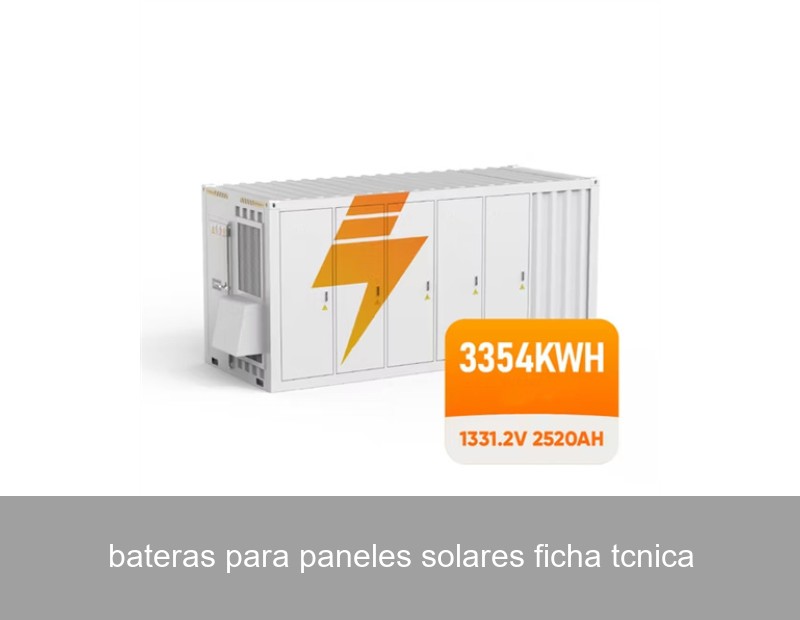
So, you've decided to invest in a solar energy system for your home or business. You've researched the panels, but now you're staring at the technical specifications—the ficha técnica—for the battery. Terms like "usable capacity," "depth of discharge," and "round-trip efficiency" can feel like a foreign language. Don't worry, you're not alone. This guide is here to translate that critical document, empowering you to make an informed choice that maximizes your energy independence and return on investment.
Table of Contents
Why the Battery Datasheet is Your Most Important Document
Think of the battery datasheet as the blueprint for your energy resilience. While marketing materials highlight benefits, the ficha técnica contains the hard, standardized data that allows for true comparison. Two batteries might both be labeled as "10 kWh," but their actual performance, lifespan, and value can differ dramatically based on the finer details in their specs. Understanding this document is the key to avoiding undersizing your system, overpaying for unnecessary features, or facing unexpected costs down the line.
Decoding Key Specifications in Your Batería para Paneles Solares Ficha Técnica
Let's break down the most critical parameters you'll encounter, moving from basic to more nuanced.
Capacity & Usable Energy: The Heart of the System
This is where most people start, but it's often misunderstood.
- Nominal Capacity (e.g., 10 kWh): The total energy the battery can store, similar to the size of a fuel tank.
- Usable Capacity (e.g., 9.5 kWh): The actual energy you can use. The difference is governed by the Depth of Discharge (DoD). A 10 kWh battery with a 90% DoD offers 9 kWh of usable energy. Highjoule's H-Joule Home series, for instance, is engineered for a 100% DoD, meaning the nominal and usable capacities are virtually identical—you get to use what you pay for.
- Depth of Discharge (DoD): Expressed as a percentage, this indicates how much of the battery's total capacity can be safely used. A higher DoD (like 95% or 100%) is generally better, offering more usable energy from the same physical unit.
Power Rating & Round-Trip Efficiency: The Muscle and Smarts
Capacity tells you "how much," power tells you "how fast."
- Continuous Power (e.g., 5 kW): The steady load the battery can support—running your fridge, lights, and TV.
- Peak/ Surge Power (e.g., 10 kW for 10 seconds): The short-term burst to start demanding appliances like air conditioners or well pumps.
Round-Trip Efficiency (RTE) is a crucial but overlooked metric. If you feed 10 kWh of solar energy into a battery with 94% RTE, you get 9.4 kWh back out. The 6% is lost as heat. A higher RTE, like the 96%+ typical of Highjoule's lithium iron phosphate (LFP) systems, means more of your precious solar energy powers your home, not wasted as system loss.

Image Source: Unsplash (Representative image of a residential battery system)
Lifespan, Cycles, and Warranty: Your Long-Term Peace of Mind
This section defines the battery's economic life. Two key metrics are intertwined:
- Cycle Life (e.g., 6,000 cycles at 90% DoD): The number of complete charge-discharge cycles a battery can perform before its capacity degrades to a specified threshold (often 60-70% of original).
- Throughput Warranty (e.g., 10 years or 30 MWh): A more comprehensive guarantee. It promises the battery will deliver a certain total amount of energy over its warranty period, whichever comes first. This accounts for both cycles and usage intensity.
For example, Highjoule's commercial H-Joule C&I battery systems often come with a robust 10-year, unlimited cycle warranty, reflecting confidence in the long-term stability of their LFP chemistry and thermal management systems.
Safety & Operational Specifications
Never gloss over these details:
| Specification | What It Means | Why It Matters |
|---|---|---|
| Battery Chemistry | e.g., Lithium Iron Phosphate (LFP), NMC | LFP is renowned for superior thermal stability, safety, and long cycle life, making it a preferred choice for residential and commercial storage. |
| Operating Temperature Range | e.g., -10°C to 50°C | Defines the climate conditions the battery can operate in without damage or significant performance loss. Proper installation location is key. |
| Ingress Protection (IP) Rating | e.g., IP65 | Measures protection against dust (6=total) and water (5=low-pressure jets). Critical for garage or outdoor installation. |
From Paper to Reality: A Real-World Case Study
Let's contextualize these specs with a project in Southern Spain, a region with high solar irradiation but also significant grid volatility for a local winery.
The Challenge: A family-owned winery needed to stabilize energy costs and ensure uninterrupted cooling for its fermentation tanks during peak tariff periods and occasional grid outages.
The Solution & Data: A system integrating 85 kWp of solar PV with a 120 kWh Highjoule H-Joule C&I battery storage unit was installed. Key datasheet specs that drove the decision:
- Usable Capacity: 120 kWh (100% DoD).
- Continuous Power: 50 kW, sufficient to cover the entire critical cooling load.
- Chemistry & Warranty: LFP with a 10-year/ unlimited cycle warranty, ensuring longevity aligned with the asset's life.
The Result: In the first year of operation, the system provided 98% backup coverage during critical processes and reduced the winery's grid energy consumption during peak hours by 87%. The project payback period was calculated at under 6 years, heavily influenced by the battery's high round-trip efficiency and cycle life, which minimized "energy loss" and replacement risk. (IRENA) reports highlight how such tailored storage is key to decarbonizing industrial sectors.

Image Source: Unsplash (Representative image of agrivoltaics at a winery)
The Highjoule Approach: Engineering Beyond the Datasheet
At Highjoule, we believe a datasheet is a promise, and our engineering philosophy is about ensuring our products not only meet but exceed those promises in real-world conditions. Our H-Joule Home and C&I product lines are built on three pillars:
- Intelligent Integration: Our batteries are not just storage tanks; they are smart grid assets. With advanced software, they can optimize for self-consumption, time-of-use arbitrage, and even provide grid services in some markets.
- Passive Safety: By standardizing on LFP chemistry and incorporating robust, passive thermal management, we design for inherent safety, reducing complex cooling dependencies.
- Scalable Architecture: From a single residential unit to multi-megawatt hour commercial systems, our modular design allows for seamless expansion as your energy needs grow.
This holistic approach ensures that when you read a Highjoule ficha técnica, you're seeing the foundation of a system designed for decades of reliable, high-performance service. For more on battery safety standards, you can refer to resources from The U.S. Department of Energy.
Questions to Ask Your Installer
Armed with this knowledge, you can now have a more productive conversation with your solar installer. Don't just ask for the datasheet—interrogate it:
- "Based on my energy audit, what usable capacity do I truly need for my desired backup goals?"
- "Can you show me the real round-trip efficiency curve under partial load, not just the peak number?"
- "How does the warranty handle degradation? Is it pro-rated, and what is the guaranteed end-of-warranty capacity?"
- "For my installation location, is the IP and temperature rating of this battery sufficient?"
What specific energy challenge in your home or business—be it peak shaving, backup power, or maximizing renewable use—will you use your solar battery's technical specifications to solve?
 Inquiry
 Online Chat