


Powering Progress: The Rise of Solar Equipment in South Africa and Its Global Lessons
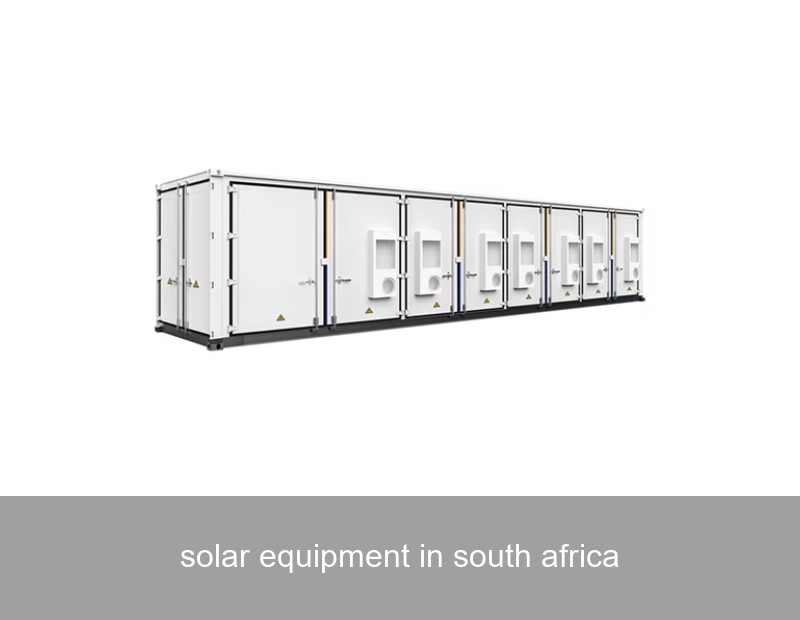
Look at a global solar radiation map, and one country consistently shines bright: South Africa. Blessed with some of the world's highest irradiation levels, it's a natural powerhouse for solar energy. Yet, for years, this potential was largely untapped. Today, that story is changing dramatically. The demand for solar equipment in South Africa is soaring, driven by a perfect storm of necessity and innovation. This isn't just a local trend; it's a compelling case study for energy markets in Europe, the US, and beyond, showcasing how intelligent storage transforms renewable potential into reliable, resilient power. Let's explore this electrifying journey.
The Spark: Why South Africa Turned to the Sun
For over a decade, South Africans have faced an acute and persistent challenge: "load-shedding." This controlled, rolling blackout, implemented by the national utility Eskom to prevent total grid collapse, has become a disruptive part of daily life. It halts production lines, disrupts businesses, and darkens homes. This reality created an undeniable problem. The agitation grew as economic losses mounted and the desire for energy independence intensified. The solution became clear: generate your own power. With abundant sunshine and falling photovoltaic (PV) panel costs, solar emerged as the most logical and accessible answer. This triggered a boom in imports and installations of solar equipment in South Africa, from rooftop PV modules to inverters and, most crucially, battery storage systems.
The Data: A Market Illuminated
The numbers tell a story of explosive growth. According to the South African Photovoltaic Industry Association (SAPVIA), the country installed over 2.8 GW of new rooftop solar PV capacity in 2023 alone—more than in the previous ten years combined. To put that in perspective, that’s roughly equivalent to three large traditional power plants being added by private citizens and businesses in a single year. The market for solar equipment in South Africa is now one of the most dynamic globally. This surge isn't just about keeping the lights on; it's a fundamental shift towards a decentralized, resilient energy model.
The Critical Challenge: Beyond the Panels
Here's where the narrative gets technically interesting. Installing solar panels is only half the battle. The sun doesn't shine at night, and load-shedding often occurs during peak evening hours. Without a way to store the daytime surplus, a solar system's value is limited. This is where advanced Battery Energy Storage Systems (BESS) become the indispensable component. The modern conversation about solar equipment in South Africa is incomplete without discussing smart, integrated storage solutions. A simple lead-acid battery bank won't suffice for demanding commercial and industrial applications; it requires high-cycle life, deep discharge capability, and sophisticated energy management.

Credit: Photo by American Public Power Association on Unsplash - Rooftop solar installations are a growing sight in South African cities.
Highjoule's Role: Intelligent Storage for a Complex Grid
This is precisely where a global leader like Highjoule enters the picture. Since 2005, we've specialized in turning renewable energy potential into stable, controllable power. For the South African market, and for similar grid-challenged regions worldwide, our products provide more than just backup.
Highjoule's H-series Commercial & Industrial (C&I) energy storage systems are engineered for high throughput and longevity. They feature lithium iron phosphate (LFP) battery chemistry, renowned for its safety and exceptional cycle life—perfect for the daily charge-discharge cycles demanded by load-shedding. More importantly, our integrated Energy Management System (EMS) is the true brain. It doesn't just store energy; it optimizes it. The system can be programmed to:
- Prioritize solar self-consumption, maximizing the use of free energy.
- Provide seamless backup power during grid outages in milliseconds.
- Perform "peak shaving," using stored energy during expensive utility peak tariff periods, slashing demand charges.
- Enable future participation in grid services as markets evolve.
For residential and microgrid applications, our HomePower+ solutions offer similar intelligence in a scalable package, allowing communities and homeowners to build energy independence. By integrating Highjoule's smart storage, the value proposition of solar equipment in South Africa is transformed from basic generation to a comprehensive, cost-saving, and resilient power asset.
Case Study: A Johannesburg Manufacturing Plant
Let's look at a real-world example. A mid-sized automotive parts manufacturer in Johannesburg was experiencing 4-6 hours of load-shedding daily, causing severe production delays and equipment damage from unscheduled shutdowns. They had installed a 500 kW solar array, but it only powered operations during the day.
The Solution: They partnered with a local integrator to deploy a Highjoule H-500 C&I BESS (500 kWh capacity, 250 kW power). The system was integrated with their existing solar PV and factory load.
| Metric | Before Highjoule BESS | After Highjoule BESS Integration |
|---|---|---|
| Production Downtime from Load-shedding | ~40 hours/month | 0 hours/month |
| Grid Electricity Consumption | ~80,000 kWh/month | ~35,000 kWh/month |
| Peak Demand Charges | Consistently high | Reduced by over 60% |
| Energy Cost Savings | N/A | ~ZAR 280,000/month |
The system was configured to use solar energy first, charge the batteries with excess solar, and then discharge during both load-shedding slots and the evening peak tariff period. The result was uninterrupted production, massive cost savings, and a return on investment achieved in under 4 years. This case perfectly illustrates the multiplier effect of pairing quality solar equipment in South Africa with advanced storage intelligence.
Global Lessons: What Europe and the US Can Learn
While the drivers in Europe and the US may differ—focusing more on energy security, carbon reduction, and volatile gas prices—the South African experience offers crucial insights. It's a real-time laboratory for a decentralized energy transition.
First, resilience is paramount. Whether from extreme weather events, grid congestion, or geopolitical instability, the value of self-sufficient energy systems is universal. Second, intelligence is non-negotiable. Dumb storage is a cost; smart storage, like Highjoule's systems, is an investment that actively manages energy flows for optimal economic and operational outcomes. Finally, the South African market proves that when the economic and reliability case is clear, adoption can accelerate at a breathtaking pace. Markets in California, Texas, Germany, and the UK, all grappling with grid transitions, should take note: the future is not just renewable, it's smartly stored.

Credit: Photo by Michael Fousert on Unsplash - Advanced BESS units, like those from Highjoule, are key to modern energy resilience.
The Future of Solar Equipment in South Africa
The journey is far from over. The next phase for solar equipment in South Africa will involve greater grid integration, virtual power plants (VPPs) aggregating thousands of distributed systems, and more sophisticated energy trading. Companies like Highjoule are at the forefront of this evolution, developing software and hardware that can participate in these future markets. The goal is to move from isolated pockets of resilience to a stable, interactive, and cleaner national energy ecosystem.
The story of solar equipment in South Africa is one of pragmatism, innovation, and empowerment. It demonstrates that the right technology, applied to acute challenges, can catalyze a faster and more democratic energy transition. As a global provider, Highjoule is proud to contribute to this resilience, not just in South Africa, but by applying these hard-won lessons to build smarter, more sustainable power solutions for commercial, industrial, and residential customers worldwide.
Is your business or community simply generating renewable energy, or are you strategically storing and optimizing it to build true energy independence and economic advantage? What would the South African model of integrated solar and smart storage look like in your context?
 Inquiry
 Online Chat