


Batteriespeicher Kraftwerk: The Cornerstone of a Modern, Resilient Energy Grid
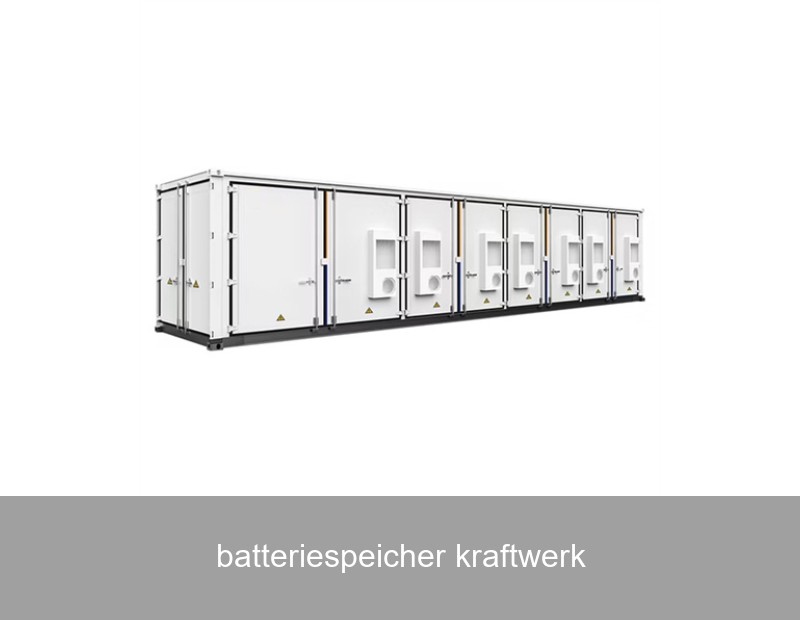
Imagine a power plant. What comes to mind? Perhaps towering smokestacks, humming turbines, or vast fields of solar panels. Now, imagine a power plant that is silent, emits nothing, can be deployed anywhere, and reacts to grid demands in milliseconds. Welcome to the era of the batteriespeicher kraftwerk – the battery storage power plant. This isn't science fiction; it's the critical infrastructure reshaping how Europe and North America generate, store, and consume electricity. As we integrate more variable renewable energy like wind and solar, the grid's stability hinges on one key solution: large-scale, intelligent battery energy storage systems (BESS).
Table of Contents
- The Phenomenon: Renewables Boom, Grid Stability Questions
- The Data: Why Grid-Scale Storage is Non-Negotiable
- The Case Study: Stabilizing the German Grid in Real-Time
- The Insight: More Than Just a Battery
- Highjoule's Role: Engineering the Battery Power Plants of Tomorrow
- What Does Your Ideal Future Grid Look Like?
The Phenomenon: Renewables Boom, Grid Stability Questions
Across Europe and the United States, the energy transition is in full swing. Wind farms dot coastlines and plains, while solar panels cover rooftops and fields. This is fantastic for decarbonization. However, it introduces a fundamental challenge: intermittency. The sun doesn't always shine, and the wind doesn't always blow, but our demand for electricity is constant and often unpredictable. This mismatch can lead to frequency fluctuations, grid congestion, and even the need to curtail (waste) perfectly good renewable energy when production exceeds demand.
Traditional grids rely on fossil-fuel "peaker plants" that ramp up quickly to meet demand spikes. But these are inefficient, polluting, and increasingly expensive. The modern grid needs a cleaner, faster, and more intelligent buffer. This is precisely the role a batteriespeicher kraftwerk is designed to fill.

Image Source: Unsplash - A visual representation of a modern battery storage installation.
The Data: Why Grid-Scale Storage is Non-Negotiable
Let's look at the numbers. According to the U.S. Energy Information Administration (EIA), battery storage capacity in the United States is projected to nearly double in 2024 alone. In Europe, the European Association for Storage of Energy (EASE) estimates that the EU will need nearly 200 GW of energy storage by 2030 to meet its climate targets. The economic and technical drivers are clear:
- Frequency Regulation: A BESS can respond to grid frequency drops within fractions of a second, providing a service far faster than any conventional plant.
- Renewable Integration: Storage absorbs excess solar and wind generation during peak production and discharges it during peak demand, smoothing the "duck curve."
- Grid Deferral: Strategically placed storage can postpone or eliminate the need for costly upgrades to transmission lines and substations.
- Price Arbitrage: Store energy when wholesale electricity prices are low (even negative) and sell it when prices are high.
| Grid Service | Response Time (Traditional Plant) | Response Time (Battery Plant) | Key Benefit |
|---|---|---|---|
| Frequency Regulation | Seconds to Minutes | Milliseconds | Unmatched Grid Stability |
| Peak Shaving | 10-30 Minutes | Instantaneous | Cost Reduction & Congestion Relief |
| Backup Power | Minutes to Hours (Start-up) | Seamless Transition (Zero Lag) | Enhanced Resilience |
The Case Study: Stabilizing the German Grid in Real-Time
Let's make this concrete with a real-world example from Germany, a leader in renewable energy adoption. The German grid, managed by transmission system operators (TSOs) like TenneT, frequently faces massive fluctuations due to its high penetration of wind energy in the north.
The Challenge: During stormy periods, northern wind farms produce more power than the local grid can consume or transmit southward. Conversely, on calm days, generation can plummet. This volatility threatens grid frequency stability (which must be maintained at 50 Hz in Europe).
The Solution: A 50 MW / 50 MWh batteriespeicher kraftwerk was deployed in a strategic location. This facility, utilizing advanced lithium-ion technology and a sophisticated energy management system (EMS), is contracted to provide "primary control reserve" (FCR).
The Data & Outcome: The battery system constantly monitors grid frequency. If the frequency deviates from 50 Hz, the plant automatically and instantaneously injects or absorbs power to correct it. In one documented year of operation, the plant responded to over 200,000 frequency deviations, with an availability rate of over 99%. It helped prevent potential blackouts and reduced the reliance on fossil-fuel-based balancing power. This project exemplifies how a battery storage power plant acts as the central nervous system's rapid-response unit, ensuring the entire grid remains healthy and stable.
The Insight: More Than Just a Battery
A common misconception is that a batteriespeicher kraftwerk is simply a giant version of a home battery. While the core chemistry might be similar, the complexity lies in the system integration and intelligence. A true grid-scale power plant comprises:
- Advanced Battery Modules: Engineered for thousands of deep cycles and long-duration performance.
- Power Conversion System (PCS): The "heart" that manages AC/DC conversion and grid connection.
- Thermal Management: A critical safety and longevity system to keep batteries at optimal temperature.
- Energy Management System (EMS): The "brain." This sophisticated software platform forecasts energy prices, grid demand, and renewable output to optimize every charge/discharge cycle for maximum economic and grid-support value.
It is this holistic, system-level approach that transforms a collection of battery cells into a reliable, revenue-generating grid asset.
Highjoule's Role: Engineering the Battery Power Plants of Tomorrow
At Highjoule, with nearly two decades of experience since 2005, we don't just supply components; we deliver turnkey, intelligent batteriespeicher kraftwerk solutions. Our expertise lies in designing systems that are as economically viable as they are technically robust, tailored for the specific market rules of Europe and North America.
Our flagship product line, the H-Series GridStack, is engineered for utility and large commercial applications. What sets it apart?
- Adaptive Cell Technology: We configure systems using best-in-class LFP (Lithium Iron Phosphate) cells, balancing energy density, safety, and lifecycle cost based on the project's specific duty cycle (e.g., daily arbitrage vs. fast frequency response).
- JouleBrain AI EMS: Our proprietary EMS is the differentiator. It doesn't just operate the plant; it maximizes its value by continuously analyzing multiple revenue streams—from frequency regulation markets to capacity auctions and wholesale trading—executing the most profitable strategy automatically.
- Modular & Scalable Design: From a 2 MW containerized unit to a 500 MW+ phased power plant, our modular architecture allows for seamless expansion as your storage needs grow.
- Full Lifecycle Support: We provide long-term performance guarantees, remote monitoring, and predictive maintenance services, ensuring your storage asset delivers returns for its entire 15-20 year lifespan.
For instance, for a large industrial client in Texas facing demand charge spikes and intermittent on-site solar, Highjoule deployed a 10 MWh GridStack system. Our JouleBrain EMS actively predicts the facility's load and solar generation, charging the batteries during low-cost periods and discharging precisely to "shave" peak demand from the grid. The result? A projected 25% reduction in annual electricity costs and a significantly reduced carbon footprint.

Image Source: Unsplash - Representing the advanced control systems behind a battery power plant.
Beyond Megawatts: The Highjoule Partnership
We partner with developers, utilities, and large energy consumers through every phase: feasibility studies and financial modeling, system design and grid compliance, installation, and ongoing optimization. Our deep understanding of markets like FERC Order 2222 in the U.S. or the various ancillary service markets in Europe (FCR, aFRR, mFRR) ensures your project is not just built right, but also registered and operated correctly to capture every possible value stream.
What Does Your Ideal Future Grid Look Like?
The transition is underway. The batteriespeicher kraftwerk has evolved from a pilot novelty to a mainstream grid asset, recognized by policymakers and grid operators alike as essential for a secure, clean, and affordable energy future. The question is no longer if we will need them, but how quickly and how intelligently we can deploy them.
As you consider the resilience of your community's power, the sustainability goals of your corporation, or the stability of a national grid increasingly powered by renewables, the solution is clear. It's time to think beyond generation and think about orchestration. It's time to think about storage as infrastructure.
Is your organization ready to explore how a tailored battery storage power plant can future-proof your energy strategy, create new revenue, and contribute to a more stable grid?
 Inquiry
 Online Chat