


Battery ESS High Voltage: The Power Behind Modern Energy Resilience
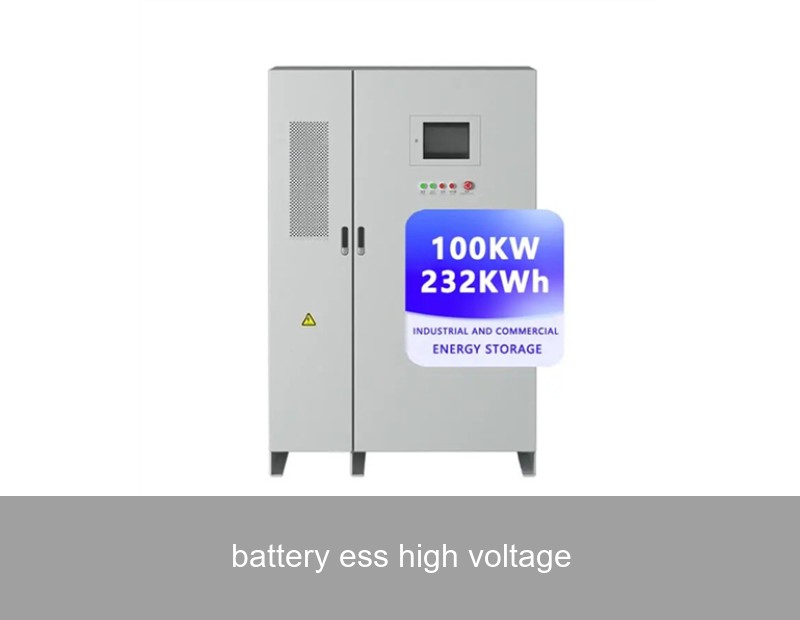
Have you ever wondered what keeps a large factory running smoothly during a grid outage, or how a solar farm continues to deliver power after the sun sets? The answer increasingly lies in a sophisticated technological backbone: the high-voltage battery energy storage system (ESS). Moving beyond the familiar low-voltage batteries in our homes, these high-voltage systems are becoming the cornerstone for commercial, industrial, and utility-scale energy independence. This article dives into why high-voltage architecture is a game-changer and how it's shaping a more resilient and efficient energy future.
Table of Contents
- The Voltage Shift: Why High Voltage is Dominating Large-Scale Storage
- Data Deep Dive: The Efficiency and Economic Advantage
- Case in Point: A German Manufacturing Plant's Journey to Resilience
- Highjoule's Approach: Intelligent High-Voltage ESS Solutions
- Key Components of a Robust High-Voltage Battery ESS
- Is a High-Voltage Battery ESS Right for Your Operation?
The Voltage Shift: Why High Voltage is Dominating Large-Scale Storage
Let's start with a basic principle: for transmitting the same amount of power, a higher voltage means a lower electrical current. Why does this matter for battery storage? Lower current translates directly into reduced energy losses as heat within cables and components. Think of it like a water pipe: to move a large volume of water, you can either use a small pipe with extremely high pressure (high current, low voltage) or a wide pipe with lower pressure (low current, high voltage). The wider pipe experiences less friction and loses less water along the way.
In the context of a battery ESS high voltage system, this typically means battery stacks configured to operate at voltages of 600V, 800V, or even 1500V DC. This architecture is a natural fit for medium to large-scale applications where the sheer volume of energy is substantial. It allows for simpler, more efficient integration with high-power inverters and the existing electrical infrastructure of factories, data centers, and solar parks. Companies like Highjoule have pioneered these systems, recognizing early that to deliver truly sustainable and cost-effective power solutions for business and industry, elevating the system voltage was not just an option—it was a necessity.

Image Source: Unsplash - Professional installation and monitoring are key for high-voltage systems.
Data Deep Dive: The Efficiency and Economic Advantage
The theoretical advantage of high voltage becomes concrete when we look at the numbers. Studies and field data consistently show that a well-designed high-voltage battery ESS can achieve system-level efficiencies (AC-to-AC) exceeding 94%, compared to roughly 89-91% for some lower-voltage topologies. This 3-5% difference is monumental at scale.
Consider a 2 MWh system performing one full cycle daily. A 4% efficiency gain saves approximately 80 kWh of energy every single day. Over a year, that's nearly 29,200 kWh of previously wasted energy now available for use. For a commercial entity, that's direct savings on their energy bill or additional revenue from grid services. Furthermore, high-voltage systems often use fewer, but larger, power conversion units and thinner cabling, leading to:
- Lower Balance-of-System (BOS) Costs: Reduced material and installation expenses for cables, conduits, and switchgear.
- Reduced Footprint: More compact systems free up valuable real estate.
- Enhanced Safety & Control: Advanced battery management systems (BMS) designed for high-voltage strings offer superior cell monitoring and protection, a critical factor for long-term reliability.
As the U.S. Department of Energy's Energy Storage Grand Challenge has highlighted, driving down costs while improving performance and safety is paramount for widespread adoption (Source: U.S. DOE).
Case in Point: A German Manufacturing Plant's Journey to Resilience
Let's move from theory to a real-world example. A prominent automotive parts manufacturer in Bavaria, Germany, faced a dual challenge: volatile energy prices and the need for uninterrupted power to protect sensitive robotic assembly lines. Their goal was to maximize self-consumption from their existing 1.5 MW rooftop solar array and provide backup power for critical loads.
The solution was a containerized battery ESS high voltage system. Here are the key project data points:
| Parameter | Specification |
|---|---|
| System Power / Energy | 1 MW / 2.2 MWh |
| DC System Voltage | 1500V |
| Primary Function | Solar Self-Consumption Optimization, Peak Shaving, Backup Power |
| Annual Solar Self-Consumption Increase | From 35% to over 80% |
| Peak Demand Reduction | Up to 40%, resulting in significant grid fee savings |
| Backup Autonomy | 2+ hours for critical manufacturing lines |
By opting for a high-voltage architecture, the project achieved a more compact container solution, minimizing on-site construction time. The system's high efficiency ensures that nearly all captured solar energy is utilized on-site. According to the European Association for Storage of Energy (EASE), such sector-coupling applications are vital for industrial decarbonization (Source: EASE). For this manufacturer, the high-voltage ESS wasn't just an energy project; it was a strategic investment in competitive advantage and operational continuity.
Highjoule's Approach: Intelligent High-Voltage ESS Solutions
As a global leader founded in 2005, Highjoule has been at the forefront of this high-voltage transition. Our philosophy is that a battery ESS high voltage system must be more than just a collection of battery racks; it must be an intelligent, integrated power asset.
Our HVS Series for commercial and industrial applications embodies this. Built around a native high-voltage DC bus, these systems are engineered for seamless integration with high-power PV inverters and demanding industrial loads. What sets them apart is the Highjoule Energy Operating System (EOS), an AI-driven platform that manages not only the battery's health but also its economic performance. EOS can automatically switch between operational modes—like peak shaving, load shifting, and participating in grid response programs—to maximize the owner's return on investment.
For larger-scale needs, such as microgrids or utility-side applications, our MegaJoule Utility solutions offer modular, containerized high-voltage battery ESS platforms that can be scaled from multi-megawatt to gigawatt-hour levels. Safety is engineered into every layer, from cell-level fusing and active thermal management within our proprietary battery packs to system-level isolation monitoring and fire suppression.

Image Source: Unsplash - Containerized systems enable scalable, deployable high-voltage storage.
Key Components of a Robust High-Voltage Battery ESS
Understanding the core building blocks can help in evaluating solutions. A reliable system integrates several advanced components:
- High-Voltage Battery Packs: These are series-connected lithium-ion (often LFP chemistry for safety and longevity) modules designed to operate reliably at the system's elevated DC voltage.
- High-Voltage Power Conversion System (PCS): This bidirectional inverter is the heart, converting DC from the batteries to AC for the grid/load and vice versa. Its efficiency is critical.
- Master Battery Management System (BMS): This is the system's nervous system. A high-voltage BMS must provide precise voltage, temperature, and current monitoring for every cell string, ensuring balance and preventing dangerous conditions.
- Energy Management System (EMS): This is the brain. It dictates when to charge or discharge based on algorithms, weather forecasts, electricity prices, or grid signals.
- Thermal Management System: A liquid-cooling system is often standard in high-voltage ESS to maintain optimal battery temperature, ensuring performance, safety, and extending lifespan.
Is a High-Voltage Battery ESS Right for Your Operation?
So, how do you know if stepping up to a high-voltage battery ESS is the next logical step for your business or community? The suitability often hinges on scale and need. If your facility has a demand charge over 500 kW, significant solar generation you want to better utilize, or a critical need for backup power, a high-voltage system likely offers the most efficient and economical path forward. The higher the power and energy requirements, the more compelling the high-voltage argument becomes.
It's also a question of future-proofing. Are you planning to expand your solar capacity? Do you anticipate electrifying fleet or process heat in the coming years? A scalable high-voltage storage system can be designed to accommodate this growth, turning your energy infrastructure into a flexible platform for the future.
What specific energy challenge—be it soaring demand charges, renewable integration, or grid instability—is most pressing for your organization, and how might an intelligent storage system be configured to address it?
 Inquiry
 Online Chat