


Battery Lithium 60V 20Ah: The Powerhouse for Modern Energy Independence
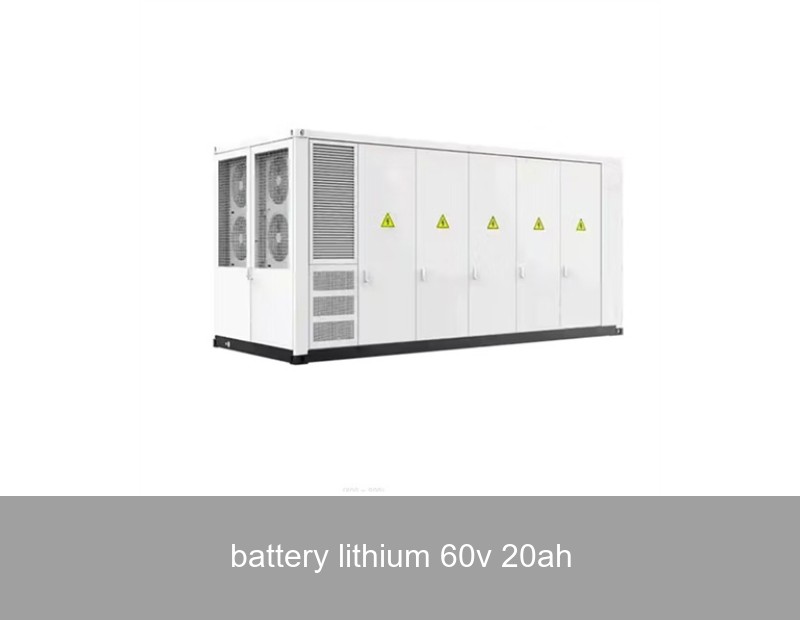
You've likely heard the buzz about lithium batteries. But when you see a specification like Battery Lithium 60V 20Ah, what does it really mean for your home or business? This isn't just a part number; it represents a specific class of high-capacity energy storage, a sweet spot for powering everything from robust commercial equipment to sophisticated home backup systems. In an era of volatile energy prices and a push for sustainability, understanding the potential of a 60-volt, 20-amp-hour lithium battery system is the first step toward true energy resilience. Let's demystify this technology and explore how it's becoming the backbone of a smarter, more self-sufficient power grid.
Table of Contents
- Understanding the Specs: Voltage, Capacity, and Energy
- Why 60V 20Ah? The Sweet Spot for Performance
- A Real-World Case: The German Bakery's Rise to Energy Resilience
- Beyond the Battery: The System Makes the Difference
- The Highjoule Solution: Engineered for Reliability and Intelligence
- Future Trends and Your Next Steps
Understanding the Specs: Voltage, Capacity, and Energy
Think of a battery like a water tank. Voltage (V) is analogous to water pressure—it determines the "force" with which electricity flows. A 60V system is powerful enough to run high-demand appliances and motors efficiently, often found in industrial tools, electric vehicles, and substantial off-grid power systems. Amp-hours (Ah) represent the tank's size. A 20Ah battery can deliver 20 amps of current for one hour, or 10 amps for two hours, and so on.
The real magic is when you multiply voltage and amp-hours to get watt-hours (Wh)—the true measure of energy storage. A Battery Lithium 60V 20Ah stores 1,200 watt-hours (60V x 20Ah = 1,200Wh). To put that in perspective, that's enough energy to run a 100-watt light bulb for 12 hours, a modern efficient refrigerator for about a day, or critically power essential circuits in your home during an outage.

Image Source: Unsplash (Representative image of lithium battery technology)
Why 60V 20Ah? The Sweet Spot for Performance
This configuration isn't arbitrary. It sits in a crucial performance bracket:
- Efficiency & Cable Sizing: Higher voltage (like 60V) reduces current for the same power output. Lower current means less energy lost as heat in wiring, allowing for thinner, less expensive cables—a significant factor in large installations.
- Scalability: 60V 20Ah modules are ideal building blocks. They can be connected in parallel to increase capacity (Ah) for longer runtime, or in series to increase voltage for specialized applications, offering immense design flexibility.
- Application Versatility: This energy density and power output make it perfect for:
- Commercial/Industrial: Floor cleaning machines, material handling equipment, and telecom backup.
- Residential Energy Storage: The core module for whole-home or critical-load backup systems when paired with solar.
- Microgrids & Off-Grid: A stable, rechargeable foundation for remote power systems.
A Real-World Case: The German Bakery's Rise to Energy Resilience
Let's move from theory to practice. Consider "Brot & Mehr," a mid-sized artisan bakery in Bavaria, Germany. Their challenge was twofold: soaring electricity costs for their ovens and refrigeration, and the risk of spoilage during grid outages. Their goal was to reduce grid dependence and ensure uninterrupted operation.
The Solution: They installed a 25kW rooftop solar array paired with a modular battery storage system centered on 60V 20Ah lithium iron phosphate (LFP) battery packs. The system was designed to store excess solar generation from the day for use during peak evening baking hours and as a seamless backup.
The Data-Driven Outcome (12-month period):
| Metric | Result | Impact |
|---|---|---|
| Grid Energy Consumption | Reduced by 68% | Substantial cost savings, less exposure to price spikes |
| Self-Consumption of Solar | Increased from 30% to 85% | Maximized return on solar investment |
| Backup Power During Outages | 18 hours of full operation | Zero spoilage, continued business |
| Estimated CO2 Reduction | Approx. 16.2 tonnes | Strong sustainability marketing story |
This case, echoed by many in the EU and US, shows that a well-sized system built around reliable battery packs isn't an expense—it's a strategic investment with clear ROI. You can read more about the EU's push for energy independence in businesses via the European Commission's energy platform.
Beyond the Battery: The System Makes the Difference
A Battery Lithium 60V 20Ah is a superb component, but its performance, safety, and lifespan are dictated by the system that houses and manages it. This is where expertise matters most. A superior Battery Energy Storage System (BESS) includes:
- Advanced Battery Management System (BMS): The "brain" that monitors each cell for voltage, temperature, and state of charge, ensuring safety, balance, and longevity.
- Robust Thermal Management: Active cooling/heating to keep batteries in their ideal temperature range, crucial for performance in both Texas heat and Scandinavian winters.
- Intelligent Inverter/Charger: The "interpreter" between DC battery power, AC grid/appliances, and renewable sources like solar. Its efficiency defines your system's overall efficiency.
The Highjoule Solution: Engineered for Reliability and Intelligence
At Highjoule, with nearly two decades of experience since 2005, we understand that a battery is only as good as its ecosystem. Our HPS Series for commercial and industrial applications and HRS Series for residential use are built around the principles of safety, intelligence, and durability.
Our systems often utilize high-grade 60V 20Ah LFP battery modules as core building blocks. LFP chemistry is renowned for its safety (thermal runaway stability), long cycle life (often 6000+ cycles), and performance across a wide temperature range. These modules are integrated with our proprietary Adaptive BMS and high-efficiency hybrid inverters.

Image Source: Unsplash (Representative image of a clean home battery installation)
What sets a Highjoule system apart is its predictive energy management software. It doesn't just react; it learns your energy patterns, considers weather forecasts, and can automatically optimize when to store solar energy, draw from the grid, or dispatch power to maximize savings and comfort. For microgrid projects, this intelligence is scaled to manage complex distributed energy resources seamlessly. Learn about battery safety standards from a trusted source like UL Solutions.
Future Trends and Your Next Steps
The landscape is evolving. We see integration with smart home ecosystems, vehicle-to-grid (V2G) capabilities, and AI-driven grid services becoming standard. The core, however, remains a dependable, high-performance battery pack. Choosing a system based on specifications like 60V 20Ah is about selecting a platform that balances power, capacity, and scalability for the long term.
The question is no longer if battery storage is viable, but how to select the right partner and system for your specific needs. Is your primary driver financial savings, uninterrupted power for critical operations, achieving sustainability targets, or a combination of all three?
What energy challenge in your home or business could a scalable, intelligent energy storage system solve for you today?
 Inquiry
 Online Chat