


Battery Management System Suppliers: The Unsung Heroes of the Energy Revolution
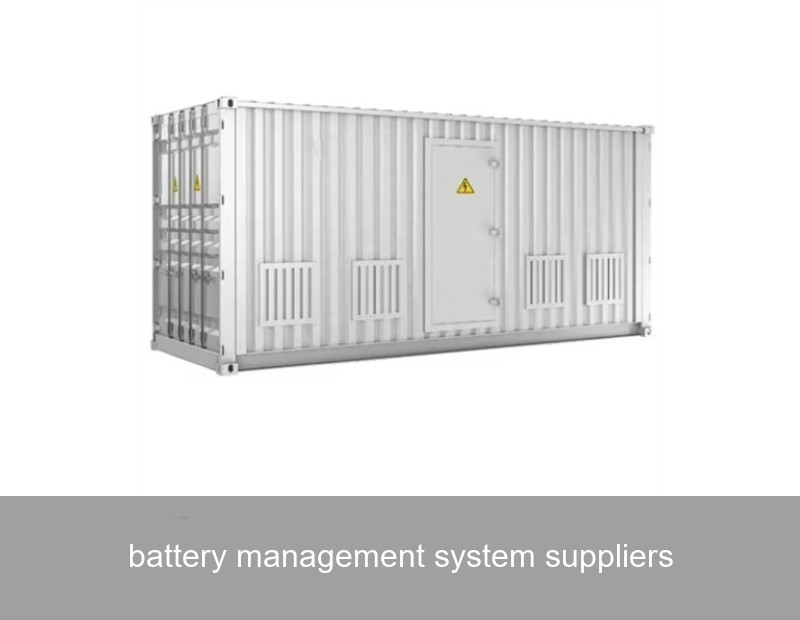
Imagine a world where your electric car's range suddenly plummets, your home battery fails after a few years, or a grid-scale storage project becomes a safety hazard. What's the common culprit? Often, it's not the battery cells themselves, but the invisible brain that manages them: the Battery Management System (BMS). As the demand for reliable energy storage soars in Europe and the US, the choice of battery management system suppliers has become a critical, yet frequently overlooked, decision for businesses and homeowners alike. This isn't just about buying a component; it's about partnering for the long-term health, safety, and profitability of your energy investment.
What is a Battery Management System (BMS)?
Think of a BMS as the central nervous system for any battery pack. Whether it's in an EV, a residential Powerwall, or a massive containerized storage unit, the BMS is the intelligent guardian that constantly monitors, protects, and optimizes performance. It ensures all individual cells work in harmony, preventing any single cell from being overcharged, over-discharged, or overheated—the primary causes of degradation and, in worst-case scenarios, thermal runaway. For anyone investing in storage, understanding the BMS is as crucial as understanding the battery chemistry.
Key Functions of a Modern BMS
Leading battery management system suppliers provide solutions that go far beyond basic protection. Here are the core pillars of a sophisticated BMS:
- Cell Monitoring & Voltage/Temperature Balancing: Continuously measures the voltage and temperature of each cell. Active balancing redistributes energy between cells to maintain uniformity, which is key for longevity.
- State Estimation (SOC, SOH, SOP): The BMS calculates the State of Charge (SOC - "how full is it?"), State of Health (SOH - "how worn out is it?"), and State of Power (SOP - "how much power can it safely deliver right now?"). Accurate estimation is vital for user confidence and system planning.
- Thermal Management Control: It interfaces with cooling or heating systems to maintain the battery within its ideal temperature window, crucial for performance in Scandinavian winters or Arizonan summers.
- Safety Protection & Fault Diagnostics: The first line of defense against over-current, short circuits, and insulation faults. It logs data for diagnostics, enabling predictive maintenance.
- Communication & Integration: A top-tier BMS communicates seamlessly with inverters, energy management systems (EMS), and grid operators via protocols like CAN bus, Modbus, or Ethernet. This integration is what transforms a simple battery pack into a smart grid asset.

Credit: Image from Unsplash, representative of advanced BMS technology in a lab setting.
Choosing the Right Battery Management System Suppliers: A Buyer's Checklist
Not all BMS providers are created equal. When evaluating battery management system suppliers, consider these essential factors:
| Criteria | Why It Matters | Key Questions to Ask |
|---|---|---|
| Proven Safety Record & Certifications | Safety is non-negotiable. Look for compliance with international standards (UL, IEC, CE). | Can you provide third-party certification reports? What redundant safety mechanisms are in place? |
| Software Intelligence & Updates | The BMS software is where the true "IQ" resides. It should be updatable to improve algorithms over time. | Is the software proprietary or open? Do you offer over-the-air (OTA) updates for performance enhancements? |
| Scalability & Customization | A solution for a home should scale to a microgrid. Architecture should be modular. | Can the same BMS platform be used across my residential, commercial, and utility-scale projects? |
| Technical Support & Data Analytics | Post-sale support is critical. Access to clear performance data is key for ROI analysis. | What monitoring portal do you offer? What is your average response time for technical support? |
This is where a partner like Highjoule distinguishes itself. Since 2005, we have embedded our deep domain expertise into our NexusGuard™ BMS, a cornerstone of our integrated storage solutions. Our BMS is not an off-the-shelf component but a fully customizable, software-defined platform designed for the stringent demands of European and North American markets. It features predictive analytics to flag potential issues weeks in advance and is built on a modular architecture that scales seamlessly from a compact residential unit to a sprawling industrial microgrid.
Case Study: How the Right BMS Partner Maximized ROI for a German Industrial Park
Let's look at a real-world example from Bavaria, Germany. A mid-sized manufacturing park installed a 2 MWh battery storage system to reduce peak demand charges and provide backup power. Initially, they used a basic BMS from a low-cost supplier.
The Phenomenon: Within 18 months, they noticed a faster-than-expected 15% capacity fade and had two unexplained shutdowns during critical peak shaving periods.
The Data & Diagnosis: A technical audit revealed the root cause: poor cell balancing and inaccurate SOC estimation (often off by over 8%) from the underpowered BMS. This led to uneven stress on cells and inefficient cycling, undermining the financial payback model.
The Highjoule Solution: The park partnered with Highjoule for a system upgrade centered on our NexusGuard™ BMS. We implemented our advanced, active balancing and high-precision Kalman-filter based state estimation algorithms.
The Result: Within one year of operation with the new BMS:
- Projected Battery Lifespan Increased: The degradation rate normalized, extending the projected system life from 8 to over 12 years.
- Peak Shaving Accuracy Improved to 99%: The system now reliably discharges during exact peak windows, maximizing demand charge savings.
- ROI Accelerated: The improved efficiency and longevity improved the net present value (NPV) of the project by an estimated 22%, as documented in the park's own energy financial reports. The system also seamlessly passed the stringent VDE certification for grid integration.
This case underscores that the choice of battery management system suppliers is a direct investment into the asset's bottom line.

Credit: Image from Unsplash, representative of industrial battery energy storage system integration.
The Future of BMS Technology and Smart Grid Integration
The role of the BMS is evolving from a protector to a proactive grid citizen. Future-forward battery management system suppliers are developing BMS platforms that directly enable:
- Advanced VPP (Virtual Power Plant) Participation: A BMS with high-speed, secure communication can aggregate distributed storage to sell grid services like frequency regulation, a growing market in the US and Europe.
- AI-Driven Predictive Maintenance: Using historical data to predict cell failures before they happen, transforming maintenance from scheduled to condition-based.
- Second-Life Applications: A BMS with impeccable data logging provides a reliable "health passport" for batteries entering their second life in less demanding applications, a key sustainability driver.
At Highjoule, our R&D pipeline is focused on these very areas. Our NexusGuard™ BMS is being enhanced with machine learning modules to optimize cycle life based on individual user patterns and is designed for bidirectional communication with Independent System Operators (ISOs), preparing our clients for the future of energy markets. We believe the BMS is the key that unlocks the full value stack of any storage asset, a philosophy backed by research from institutions like the National Renewable Energy Laboratory (NREL).
Your System's Brain Trust
Choosing among battery management system suppliers is one of the most significant technical decisions you'll make. It's a choice between a commodity and a strategic intelligence layer. It determines not just if your system works, but how well it works, for how long, and what additional value it can create.
As you plan your next energy storage project—whether it's to achieve energy independence for your home, slash operational costs for your business, or stabilize a community microgrid—we invite you to consider this: Is your current potential supplier offering you just a BMS, or are they offering you a long-term partnership in intelligence and reliability? What specific grid service revenue streams could a more intelligent BMS open up for your project in the next five years?
To explore how Highjoule's NexusGuard™ BMS and integrated storage solutions can be the brain trust for your energy ambitions, we encourage you to connect with our technical team for a customized system assessment.
 Inquiry
 Online Chat