


BESS O&M Costs: How Much Should You Really Budget?
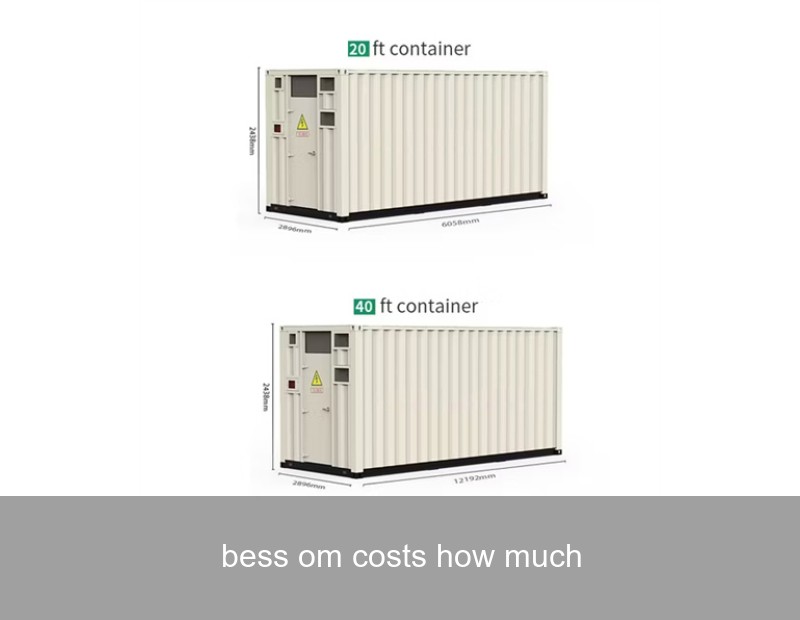
So, you've invested in a Battery Energy Storage System (BESS). It's humming along, providing backup power, shaving peak demand charges, or integrating your solar PV. But then, a question pops up: "What are the ongoing costs to keep this running?" Understanding BESS Operation and Maintenance (O&M) costs is crucial—not just for your budget, but for the long-term health and profitability of your energy asset. Whether you're a facility manager in Germany, a solar farm owner in California, or a municipality planning a microgrid, getting a clear picture of "BESS O&M costs: how much?" is the key to unlocking true value.
Table of Contents
- The Hidden Layer of BESS Ownership
- Breaking Down BESS O&M Cost Components
- The Data Story: From Averages to Real-World Ranges
- Case Study: A California Solar-Plus-Storage Farm
- Proactive Strategies to Reduce O&M Costs
- The Highjoule Approach: Intelligent O&M from the Start
- What's Your Biggest O&M Concern?
The Hidden Layer of BESS Ownership
Think of BESS O&M not as an expense, but as the insurance premium for your system's performance and longevity. Unlike a static piece of equipment, a battery system is a dynamic electrochemical asset. Its costs go beyond occasional cleaning or a yearly check-up. We're talking about a comprehensive regime that ensures safety, maximizes cycle life, and guarantees the system delivers the financial returns you modeled. Neglecting it can lead to rapid degradation, safety hazards, and ultimately, a failed investment. The core question isn't just "BESS O&M costs: how much?" but "What value does that cost deliver?"
Breaking Down BESS O&M Cost Components
To understand the total, let's dissect it. BESS O&M costs typically fall into two main buckets: Fixed Annual Costs and Variable/Performance-Based Costs.
Fixed & Scheduled Costs
These are the predictable, recurring expenses to keep the system operational and safe.
- Preventive Maintenance: Regular inspections, thermal imaging, connector tightening, firmware updates, and HVAC filter changes for the container.
- Remote Monitoring & Control: Subscription to a 24/7 Network Operations Center (NOC) platform. This is your first line of defense.
- Insurance & Warranties: Specific insurance for battery assets and potential extended warranty coverage.
- Spare Parts Inventory: Holding critical spares (like fans, sensors) to minimize downtime.
Variable & Unscheduled Costs
These costs depend on usage, performance, and unforeseen events.
- Corrective Maintenance: Reacting to failures. This is where quality upfront pays off—poor-quality systems have higher corrective costs.
- Performance Guarantee Top-Ups: If the system underperforms (e.g., capacity drops below a guaranteed threshold), the operator may incur penalties or costs to rectify.
- Battery Degradation & Replacement: The long-term cost. While cells are designed to last 10-15 years, their gradual capacity fade must be managed. Proactive O&M slows this fade.
- Ancillary Service Costs: For grid-service systems, costs related to market participation and compliance.
The Data Story: From Averages to Real-World Ranges
Now, to the numbers. Industry reports and our experience at Highjoule across thousands of deployments show that BESS O&M costs are often expressed as a percentage of the initial capital expenditure (CapEx) or in $/kW-year. However, these figures can be misleading without context.
A commonly cited range is $10 to $20 per kW per year for comprehensive O&M. For a 1 MW (1000 kW) system, that's $10,000 to $20,000 annually. But this is a starting point. Let's look at a more detailed breakdown from a 2023 NREL report on BESS costs, which provides crucial benchmark data.
| O&M Cost Component | Typical Annual Cost Range | Notes |
|---|---|---|
| Fixed O&M (Incl. Monitoring) | $5 - $10 / kW-year | Highly dependent on service level agreement (SLA). |
| Variable O&M | $2 - $7 / kW-year | Driven by usage cycles and corrective events. |
| Battery Replacement Reserve | $3 - $8 / kW-year | Set aside for eventual cell replacement; not an annual cash outlay. |
| Total Estimated O&M | $10 - $25 / kW-year | Wide range reflects system quality, duty cycle, and service depth. |
Image: Regular professional maintenance is a key fixed O&M cost that ensures long-term system health. Source: Unsplash

The lower end often applies to newer, high-quality systems with advanced diagnostics operating in benign environments with light cycling. The higher end can apply to older systems, those in harsh climates, or those subjected to aggressive daily cycling for revenue generation.
Case Study: A California Solar-Plus-Storage Farm
Let's make this real. A 5 MW / 20 MWh BESS collocated with a solar farm in California, participating in the CAISO market (providing frequency regulation and energy arbitrage).
- Challenge: Aggressive daily cycling was accelerating projected degradation, threatening performance guarantees and long-term revenue.
- Initial "Low-Cost" O&M Approach: Basic remote monitoring with quarterly on-site checks. Annual O&M cost: ~$65,000 ($13/kW-year).
- Problem: The team noticed uneven temperature distribution across battery racks and a slight but consistent voltage drift in some modules. The basic service couldn't diagnose the root cause.
- Shift to Predictive O&M: The owner partnered with a provider offering AI-driven analytics (like Highjoule's OptiCareTM Managed Service). This involved:
- Installing additional granular sensors.
- Implementing digital twin technology to model cell aging.
- Dynamic thermal management adjustments.
- Result: O&M cost increased to ~$85,000 ($17/kW-year). However, projected battery degradation was reduced by 15%, extending asset life. More importantly, it prevented an estimated $200,000+ in potential capacity guarantee penalties and lost revenue over 3 years. The value of O&M far exceeded its cost.
Proactive Strategies to Reduce Effective O&M Costs
You can influence these costs. The most effective lever is proactivity.
- Invest in Quality upfront: A higher-quality system from a provider like Highjoule, with robust battery management systems (BMS) and thermal design, inherently has lower failure rates and slower degradation.
- Demand Advanced Monitoring: Don't settle for simple data logging. Look for platforms with predictive analytics that flag anomalies before they cause downtime. As the U.S. Department of Energy's O&M Best Practices Guide notes, predictive maintenance is key to cost control.
- Optimize the Operating Regime: Work with your provider to tailor charge/discharge cycles to your specific goals, balancing revenue with longevity.
- Consider a Full-Service Agreement: A fixed-price, comprehensive O&M contract transforms variable costs into predictable ones and aligns the provider's incentives with your system's health.
The Highjoule Approach: Intelligent O&M from the Start
At Highjoule, we design our H-Series commercial & industrial storage systems and GridMax utility-scale solutions with total lifecycle cost in mind. We believe the answer to "BESS O&M costs: how much?" should be "less than you think, and delivering more than you expect."
Our secret is integration. Our proprietary HeliosTM Energy Management Platform isn't an add-on; it's the brain of the system. It enables our flagship OptiCareTM Managed Service, which includes:
- Predictive Health Analytics: Machine learning models analyze performance data to predict cell-level issues weeks in advance.
- Performance Guarantee Backing: We stand behind our systems with robust warranties, backed by our data-driven confidence in their longevity.
- Global NOC Support: 24/7 monitoring from our centers in the EU and US, capable of remote diagnostics and resolution for many issues.
- Lifecycle Optimization: We don't just fix problems; we provide reports and recommendations to optimize your system's financial output over its entire 15+ year life.
Image: Advanced monitoring dashboards, like Highjoule's Helios platform, are central to predictive O&M. Source: Unsplash

By baking intelligence into the hardware and software, we help our clients in Europe and North America keep their effective O&M costs toward the lower end of the spectrum, while maximizing uptime and return on investment. A Lazard's Levelized Cost of Storage analysis consistently shows that O&M is a critical variable in the lifetime cost equation—a variable we directly help you control.
What's Your Biggest O&M Concern?
We've moved from a simple price tag to a value conversation. The real cost of BESS O&M is not just a line item; it's a strategic decision that impacts your asset's lifespan and profitability. Are you currently budgeting based on industry averages, or on the specific profile of your system and its duty cycle? Have you evaluated the potential cost of not investing in predictive maintenance?
We invite you to share your perspective. What is the most pressing challenge you face when planning for the long-term care of your energy storage system?
 Inquiry
 Online Chat