


Choosing the Best Inverter for a 200Ah Battery: Your Guide to Reliable Power
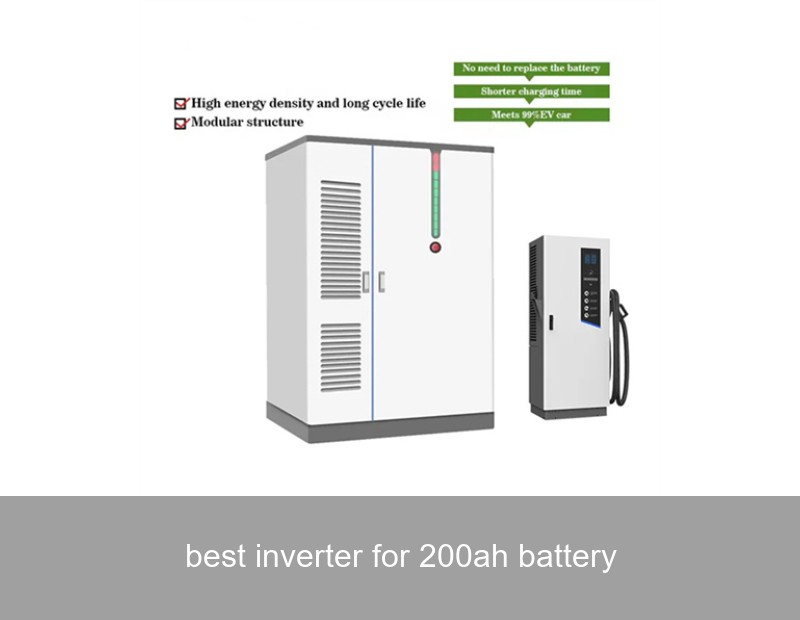
So, you've got a robust 200Ah battery bank. That's a fantastic foundation for your solar, off-grid, or backup power system. But here's the thing we see all too often: that powerful battery is only as good as the inverter you connect it to. The inverter is the brain and voice of your system, converting stored DC battery power into usable AC power for your appliances. Choosing the wrong one can lead to inefficiency, damage, or even failure. This guide will walk you through finding the best inverter for a 200Ah battery, balancing technical needs with practical performance.
Why Your 200Ah Battery Deserves a Perfect Match
Think of your 200Ah battery as a large water tank. The inverter is the pump and faucet that controls how much water (power) you can use, how quickly, and how clean it is. A mismatched inverter can "starve" your devices or, conversely, overload and drain your battery prematurely. For a 200Ah battery, which is a substantial energy reservoir commonly used in cabins, residential backup, and small commercial setups, the inverter choice dictates your system's reliability and lifespan. It's not just about powering appliances; it's about creating a harmonious, efficient, and safe energy ecosystem.
Key Technical Specs: Beyond the Wattage Label
Everyone looks at continuous wattage first, and rightly so. For a 200Ah system, you need to calculate your total load. But two other specs are equally crucial:
- Surge Power: Many appliances, like refrigerators or power tools, need a brief burst of power (2-3 times their running wattage) to start their motors. An inverter must handle this surge without tripping.
- Inverter Efficiency: Look for peak efficiency ratings above 93%. A 90% efficient inverter wastes 10% of your precious battery energy as heat. For a 200Ah battery, that's a significant loss over time.
Highjoule's HPS Series Hybrid Inverters, for instance, are engineered with peak efficiencies of over 97%. This means more of the energy from your 200Ah battery is converted into usable power for your home or business, directly extending your available runtime.
Inverter Types: Pure Sine Wave vs. Modified Sine Wave
This is a critical decision point. The waveform is the "quality" of the AC power produced.
| Feature | Pure Sine Wave Inverter | Modified Sine Wave Inverter |
|---|---|---|
| Output Waveform | Smooth, perfect sine wave (like grid power) | Stepped, blocky approximation |
| Device Compatibility | All devices: sensitive electronics (medical equipment, laptops), motors, inductive loads. | Basic resistive loads (heaters, incandescent lights). Can damage or cause buzzing in sensitive electronics. |
| Efficiency & Heat | Higher efficiency, runs cooler. | Lower efficiency, can cause motors to run hot. | Cost | Higher initial investment. | Lower initial cost. |
For any modern system with a 200Ah battery intended for regular or critical use, a pure sine wave inverter is the only recommended choice. It protects your investment in both your battery and your appliances. All Highjoule inverters, from our residential to commercial lines, deliver premium pure sine wave output, ensuring safe operation for every device you plug in.
The Critical Role of Battery Voltage (12V, 24V, 48V)
Your 200Ah battery can be configured at different voltages, and this drastically impacts inverter selection.
- 12V System: Common for smaller setups. To get high power (e.g., 3000W), you'd need extremely high current (250A+), requiring very thick, expensive cables and posing higher resistive losses.
- 24V System: A smart choice for a 200Ah bank. It halves the current for the same power, allowing for more manageable wiring and often greater inverter availability.
- 48V System: The industry standard for larger residential and commercial systems. It minimizes current and losses, is highly efficient, and unlocks access to more powerful, feature-rich inverters.

For a 200Ah capacity, a 24V or 48V configuration paired with a compatible Highjoule inverter creates a far more robust and scalable foundation than a 12V system.
Real-World Case: A German Bed & Breakfast's Solution
Let's look at a real example from Bavaria, Germany. A family-run Bed & Breakfast with unreliable grid power wanted a seamless backup for guest rooms (lighting, WiFi, mini-fridges) and the kitchen during outages. Their battery bank: a 200Ah, 48V lithium-ion system.
The Challenge: They needed an inverter that could handle the simultaneous start-up surge of multiple refrigeration compressors and a well pump without crashing, while also being efficient enough to maximize backup duration from their 200Ah bank.
The Solution: They installed a Highjoule HPS-5.0 Hybrid Inverter (5kW continuous, 10kW surge). Its high surge capability handled all motor starts smoothly. Its >96% efficiency meant they could power critical loads for over 8 hours. The integrated energy management also allowed them to prioritize solar charging during the day, making the system both a backup and a cost-saver.
The Data: In the first year, the system logged 42 grid outages totaling 55 hours. The inverter maintained 100% uptime for designated circuits. The owner reported an estimated 15% reduction in grid electricity costs due to smart solar self-consumption enabled by the inverter's logic. You can read more about grid stability trends in Europe from the European Network of Transmission System Operators (ENTSO-E).
Highjoule's Integrated Approach: More Than Just an Inverter
At Highjoule, we believe the best inverter for a 200Ah battery is part of a smarter whole. Our products are designed as integrated systems. Our inverters communicate seamlessly with Highjoule battery management systems (BMS) for optimal charging profiles, cycle life, and safety. For commercial applications, our Energy Management System (EMS) platform provides granular control and monitoring, turning your 200Ah battery and inverter into an intelligent asset for peak shaving and demand charge reduction.

This holistic approach ensures every component, from the battery cells to the inverter's output, works in concert. It’s why utilities and businesses trust Highjoule for microgrid and grid-support applications, where reliability is non-negotiable.
Installation & Safety: Don't Overlook the Essentials
Even the best inverter can underperform or fail if installed incorrectly. Proper cable sizing, based on current and distance, is paramount. Fusing and DC disconnects are mandatory for safety. The inverter should be installed in a cool, dry, well-ventilated location. We strongly recommend professional installation, especially for 24V and 48V systems, which carry significant energy. Highjoule provides certified installer training and detailed system schematics to ensure your setup is safe, compliant, and performs to its full potential for years to come.
Your 200Ah battery represents a significant step towards energy independence. Are you ready to unlock its full potential with an inverter that's not just a component, but the intelligent heart of your power system? What's the most critical load you need to keep running when the grid goes down?
 Inquiry
 Online Chat