


Finding the Best Solar Battery in the Philippines: A Guide to Energy Independence
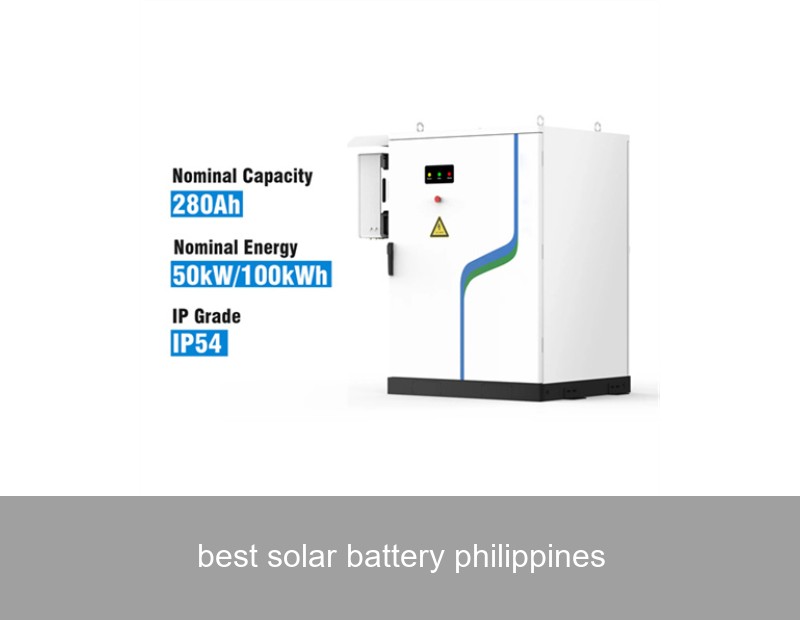
For homeowners and businesses across the Philippines, the dream of energy independence is becoming increasingly tangible. With abundant sunshine, the potential for solar power is enormous. Yet, the sun doesn't shine at night, and grid power can be unreliable or expensive. This is where the critical question arises: how do you choose the best solar battery in the Philippines for your specific needs? It's not just about storing energy; it's about ensuring resilience during outages, maximizing your solar investment, and taking control of your electricity costs. This guide will walk you through the key considerations, backed by data and real-world examples, to help you make an informed decision.
Table of Contents
- The Philippine Energy Challenge: More Than Just Sunshine
- Key Features of the Best Solar Battery for Philippine Homes
- Why Lithium Iron Phosphate (LFP) is a Game-Changer
- Case Study: A Family's Resilience in Cebu
- Highjoule's Tailored Solutions for the Philippine Market
- Making the Right Choice for Your Home
The Philippine Energy Challenge: More Than Just Sunshine
The Philippines has one of the highest electricity rates in Southeast Asia. According to data from the Department of Energy, residential rates can exceed ₱12 per kWh in some areas, heavily impacting household budgets. Combine this with frequent typhoons and an aging grid infrastructure leading to power interruptions, and the need for a reliable backup power solution becomes clear. A solar panel system alone addresses only half the equation. The true value is unlocked when you pair it with a high-quality battery storage system, allowing you to use your solar energy on demand, day or night.

This phenomenon of pairing solar with storage is a global trend, but its application in the Philippines is uniquely driven by resilience and cost-saving. The data shows a clear logical progression: high electricity costs and unreliable supply (the problem) lead to the adoption of solar PV (the first solution). To fully optimize this solution and achieve true energy security, integrating the best solar battery is the essential next step.
Key Features of the Best Solar Battery for Philippine Homes
Not all batteries are created equal, especially in a challenging tropical climate. Here’s what to look for:
- Cycle Life & Warranty: This indicates how many charge/discharge cycles a battery can handle before its capacity significantly degrades. Given daily use, you need a battery rated for thousands of cycles. A strong warranty (e.g., 10 years) is a good proxy for manufacturer confidence.
- Depth of Discharge (DoD): Refers to how much of the battery's capacity you can actually use. A 10kWh battery with a 90% DoD gives you 9kWh of usable energy. Higher is better.
- Power Rating & Capacity: Capacity (kWh) is your "energy tank" size—how much energy it stores. Power (kW) is how much energy it can deliver at once. You need enough power to start appliances like air conditioners and refrigerators.
- Climate Resilience: Batteries must operate efficiently in high heat and humidity. Look for robust thermal management systems and appropriate IP (Ingress Protection) ratings.
- Smart Management & Scalability: A good system includes an energy management system (EMS) to optimize usage based on your habits and weather. It should also allow you to add more batteries later if your needs grow.
Why Lithium Iron Phosphate (LFP) is a Game-Changer
While several battery chemistries exist, Lithium Iron Phosphate (LFP) has emerged as the leading technology for residential storage, particularly in markets like the Philippines. Here’s a quick comparison:
| Feature | LFP Battery | Traditional Lead-Acid |
|---|---|---|
| Cycle Life | Very High (6,000+ cycles) | Low (500-1,500 cycles) |
| Safety | Excellent thermal & chemical stability | Risk of acid leakage, gas emission |
| Depth of Discharge | Routinely 90-100% | Typically 50% to prolong life |
| Performance in Heat | More tolerant to high temperatures | Performance degrades faster | Maintenance | Virtually maintenance-free | Requires regular water topping |
As you can see, LFP batteries offer a longer lifespan, safer operation, and more usable energy—key factors that make them a cornerstone of modern, reliable solar storage systems. Organizations like the U.S. Department of Energy's Solar Office recognize the role of advanced battery tech in accelerating solar adoption.
Case Study: A Family's Resilience in Cebu
Let's look at a real-world example. The Santos family in Metro Cebu installed a 8kW solar PV system in 2022. While it reduced their daytime bill, evening usage and frequent brownouts remained a frustration. In early 2023, they integrated a 15kWh LFP battery storage system.
- Before (Solar Only): Average monthly bill: ₱3,500. Still experienced 4-8 hours of generator use per month during outages.
- After (Solar + Battery): Average monthly bill: ₱800 (primarily minimal grid charges). Generator use: 0 hours.
- Payback Period: The combined system's calculated payback time improved from 7 years (solar only) to under 5 years due to drastically higher self-consumption of solar energy and zero generator fuel costs.
- Key Event: During a 10-hour grid outage after a storm, the battery system seamlessly powered essential loads (lights, refrigeration, fans, internet) for the entire duration without interruption, providing not just savings but peace of mind.

This case illustrates the PAS framework perfectly: The Problem was high costs and unreliability. The Agitation was continued generator dependence. The Solution was a correctly sized, high-quality solar battery that provided financial and resilience benefits far beyond the initial solar installation.
Highjoule's Tailored Solutions for the Philippine Market
At Highjoule, with nearly two decades of experience as a global leader in advanced energy storage, we understand that the best solar battery in the Philippines must be more than just a commodity—it must be an integrated, intelligent solution built for local conditions. Our systems are engineered with the Philippine context front and center.
Our H-Joule HomePower series utilizes premium LFP battery cells, renowned for their safety and long cycle life. The integrated Smart EMS can be configured for multiple modes: maximizing self-consumption, providing backup power during grid failures, or even participating in future utility programs. Crucially, our systems feature advanced liquid cooling and climate-adaptive algorithms to ensure peak performance and longevity even in the hottest Philippine provinces.
For larger commercial or industrial applications, such as resorts, factories, or agricultural facilities facing high demand charges and unreliable supply, our H-Joule C&I Megapack solutions offer scalable, containerized storage that can manage energy costs at a whole different level. We work with a network of certified local installers to ensure proper design, installation, and after-sales support, making the journey to energy independence seamless.
Making the Right Choice for Your Home
Choosing the right battery is a significant decision. Start by asking yourself and your installer these questions:
- What are my critical loads during an outage? (This determines required power and capacity).
- What is my average daily energy consumption, especially at night?
- Is my primary goal bill savings, backup power, or both?
- Does the system offer remote monitoring and control via a smartphone app?
- Is the manufacturer a proven player with a strong local support network?
The energy landscape is evolving rapidly. With the Philippines' push for greater renewable integration, as noted by global energy authorities like the International Energy Agency (IEA), distributed storage will play a pivotal role.

So, as you consider taking the next step towards true energy independence, what specific energy challenge in your home or business would a reliable, high-performance solar battery solve first?
 Inquiry
 Online Chat