


Finding the Best Solar Panel for Residential Use: A Homeowner's Guide to Smart Energy
So, you've decided to harness the sun's power for your home. Congratulations! It's a fantastic step towards energy independence, lower bills, and a smaller carbon footprint. But as you start your research, you're quickly met with a dizzying array of options, technical specs, and bold claims. The central question emerges: What truly is the best solar panel for residential use? The answer, much like a well-designed solar system itself, is more nuanced than a simple brand name. The "best" panel is the one that optimally balances efficiency, durability, cost, and—critically—integrates seamlessly into a complete home energy ecosystem designed for your specific needs.
What Makes the "Best" Solar Panel for Your Home?
Let's clear something up first. Chasing the single highest efficiency panel on the market might not be your most cost-effective strategy. Think of it like buying a car: raw horsepower isn't everything; you need reliability, fuel economy, and features that suit your daily commute. Similarly, the best residential solar panel is the one that delivers the greatest long-term value and performance for your roof, your energy consumption, and your local climate. It's about the total lifetime performance, not just a peak laboratory rating.
Key Factors in Choosing Your Residential Solar Panels
To navigate your choice, focus on these core pillars. They are the universal metrics that separate quality investments from underwhelming installations.
Panel Efficiency & Power Output
Efficiency measures a panel's ability to convert sunlight into electricity. While premium monocrystalline panels often lead here (ranging from 20-23%), consider your roof's usable space. A slightly less efficient but more affordable panel might be perfect for a large, unshaded roof. The key metric for your installer's proposal is the total estimated annual kWh production. This number, modeled for your location, tells you what really matters: how much power you'll generate.

Image: Modern, high-efficiency monocrystalline panels blend form and function. Credit: Unsplash.
Durability, Warranty & Degradation Rate
Your panels are a 25+ year investment. Durability is non-negotiable. Look for panels with robust frames, high snow/wind load ratings, and proven performance in harsh environments. More important than the product warranty is the performance warranty. A top-tier panel will guarantee 90-92% of its original power output after 25 years, thanks to a low annual degradation rate (around 0.3-0.5%). This ensures your "best" panel stays the best for decades.
Aesthetics & System Compatibility
For many homeowners, how panels look on their roof is important. All-black panels with black backsheets offer a sleek, uniform appearance. Beyond looks, consider compatibility. The best panel becomes average if paired with a low-quality inverter or connected with subpar wiring. Your system is a chain, and every link must be strong.
Beyond the Panel: Why the Full System Matters Most
Here's the insight many miss: The true potential of your premium solar panels is unlocked not just by the inverter, but by intelligent energy storage. Without storage, excess energy you produce on a sunny afternoon is sold back to the grid at a low rate, only for you to buy it back at night at a higher price. This cycle limits your savings and self-sufficiency.
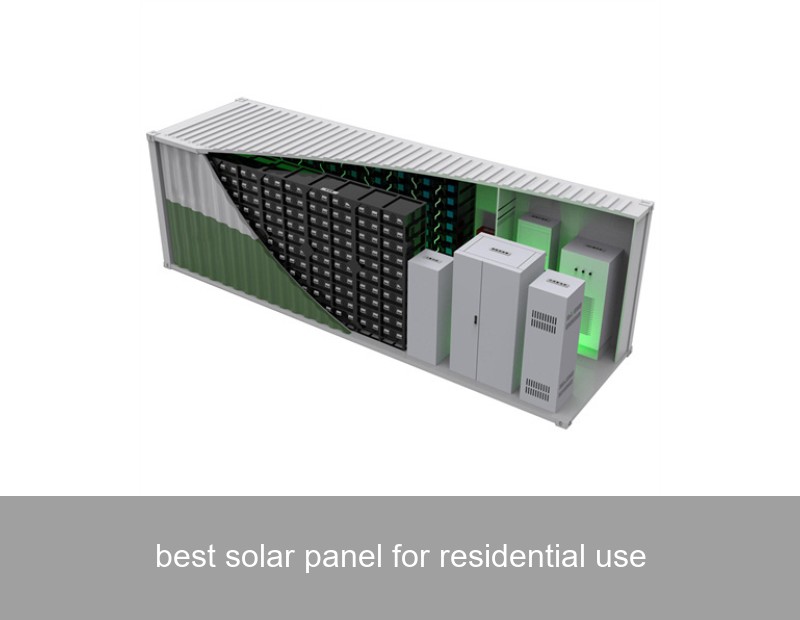
This is where the concept of a complete home energy system becomes critical. The panel generates the power, but a smart battery storage system captures, manages, and deploys it on your terms. It turns your solar array from a grid-supplement into a personal power plant.
A Real-World Case: The Johnson Family Home in Arizona
Let's look at data from a real, anonymized project in Phoenix, Arizona (a similar climate to Southern Europe). A family installed a 9.6 kW solar array using high-efficiency panels (22% rating).
- Initial Setup (Solar Only): Their daytime self-consumption was only ~30%. They exported 70% of their production to the grid under a net metering policy.
- The Challenge: The utility changed its rate structure, introducing high demand charges and reducing buy-back rates. Their bill savings plummeted.
- The Solution: They retrofitted a 13.5 kWh integrated battery storage system.
- The Result (12-month data):
- Self-consumption of solar power jumped from 30% to over 85%.
- Grid dependence during peak (expensive) hours dropped to nearly zero.
- Despite the rate change, their overall annual electricity costs were reduced by an additional 40% compared to the solar-only scenario.
The case shows that adding storage transformed their system's economics. The panels were the source, but the battery was the brain, maximizing every kilowatt-hour produced.
The Highjoule Solution: Intelligent Energy Storage as the Force Multiplier
At Highjoule, with nearly two decades of experience since 2005, we view the solar panel as the first, crucial component in a smarter energy equation. Our expertise lies in providing the advanced Battery Energy Storage Systems (BESS) that complete and elevate your solar investment.
For residential users, our HomePower Stack series is designed to seamlessly integrate with any high-quality solar installation. Here’s how it ensures you get the most out of your "best" panels:
- Maximized Self-Consumption: Our AI-driven energy management software automatically stores excess solar energy instead of exporting it at low value, directing it for use in the evening or during outages.
- Peak Shaving: The system learns your usage patterns and discharges battery power during grid peak rate periods, shielding you from the highest electricity costs.
- Grid Resilience: In areas with unreliable grids or increasing extreme weather events, the HomePower Stack provides essential backup power, keeping your lights on and fridge running. Your solar panels, when paired with our storage, become a true backup power source.
- Future-Proof Design: Our systems are software-upgradable and can be scaled over time, adapting to new utility rates, adding an electric vehicle charger, or expanding battery capacity.
We don't manufacture solar panels. We empower them. By partnering with leading solar installers across Europe and the US, Highjoule ensures that the premium panels on your roof deliver their absolute maximum potential, transforming your home into a resilient, efficient, and sustainable energy hub.

Image: A clean, wall-mounted home battery system like Highjoule's HomePower Stack integrates seamlessly. Credit: Unsplash.
Making Your Final Choice: A Practical Framework
So, how do you proceed? Use this framework for your consultations:
- Audit & Goal-Setting: Analyze your past year's utility bills. Define your goals: Is it pure bill savings, backup power, or maximizing green energy?
- Panel Shortlist: Ask installers for proposals featuring panels from reputable manufacturers (e.g., REC, Panasonic, Qcells, SunPower) with strong performance warranties (>90% at year 25).
- The Critical Question: Ask every installer: "How do you plan to maximize my self-consumption and provide resilience? Can you model this system with integrated battery storage?" If they only discuss panels and inverters, they're selling an incomplete solution.
- System Modeling: Request detailed production and savings forecasts for TWO scenarios: solar-only and solar + storage (like a Highjoule HomePower Stack). Compare the long-term financial and functional benefits.
For authoritative information on solar technology basics, you can refer to resources from the U.S. Department of Energy or the International Energy Agency (IEA).
Ready to see how the synergy of top-tier solar panels and intelligent storage can redefine your home's energy independence? What's the first question you'll ask your solar installer about your future system's capabilities?
 Inquiry
 Online Chat