


Finding the Best Solar Plates in Sweden: A Guide to Smart Energy Investment
Sweden's journey towards a fossil-free future is accelerating, and at the heart of this transition lies a critical question for homeowners and businesses alike: how do you choose the best solar plates in Sweden? While the Swedish sun may be modest in its hours, its potential is enormous when paired with the right technology. The choice isn't just about panels; it's about building a resilient, efficient, and intelligent energy system for your specific needs. This guide will navigate you through the key considerations, from panel efficiency in low-light conditions to the crucial role of energy storage, helping you make an informed decision for a sustainable and cost-effective power solution.
Table of Contents
- The Swedish Solar Phenomenon: More Than Meets the Eye
- Beyond the Panel: The Data on System Performance
- Case Study: A Karlstad Household's Year-Round Energy Independence
- The Storage Imperative: Your Key to Unlocking True Value
- The Highjoule Integrated Approach: Intelligence Meets Storage
- Choosing Your System: A Practical Checklist
The Swedish Solar Phenomenon: More Than Meets the Eye
You might be thinking, "Sweden? Solar power?" It's a common initial reaction. The phenomenon here isn't about blistering desert sun, but rather a strategic, technology-driven harnessing of available light. Sweden's solar capacity has seen exponential growth, driven by falling costs, government incentives like the tax deduction for solar cell installations (solcellsbidrag), and a strong national commitment to renewables. The key isn't just peak output on a rare sunny summer day; it's consistent performance during the long daylight hours of summer and the ability to capture diffuse light on cloudy days and during the low-angled sun of spring and autumn. This is where the quality of your components becomes non-negotiable.
What "Best" Really Means in a Swedish Context
In the search for the best solar plates in Sweden, shift your focus from a single spec sheet to a holistic system view. The "best" panel is the one that forms the most reliable and productive part of a larger ecosystem. Key factors include:
- Low-Light Performance: How efficiently does the panel convert diffuse sunlight? Premium brands often use advanced cell technology that excels in these conditions.
- Temperature Coefficient: Solar panels actually lose efficiency as they get hot. Panels with a better (lower) temperature coefficient will perform more consistently during Sweden's surprisingly warm summer days.
- Durability & Warranty: With harsh winters and potential snow loads, robust construction and strong product/performance warranties (often 25+ years) are essential.
- System Synergy: The panel must be perfectly compatible with a high-quality inverter and, most importantly, with an intelligent battery storage system.

Image: Solar panels must perform year-round in the Swedish climate. (Photo by Unsplash, illustrative)
Beyond the Panel: The Data on System Performance
Let's talk numbers. A high-efficiency panel might boast 22% conversion, but what matters is your annual kilowatt-hour (kWh) yield. In southern Sweden, a well-oriented 10 kWp system can produce approximately 9,000 kWh annually. In central regions, that figure might be closer to 8,000 kWh. But here's the critical insight: without storage, a typical household might only directly consume 30-40% of that solar energy. The rest is exported to the grid, often at a price lower than the cost to import electricity later. This self-consumption rate is the single most important metric for your return on investment. The goal, therefore, is not just to generate, but to capture and use your own clean power.
| Region | Estimated Annual Production | Self-Consumption Without Storage | Potential Self-Consumption With Storage* |
|---|---|---|---|
| Southern Sweden (Malmö) | ~9,000 kWh | ~3,200 kWh (35%) | ~7,200 kWh (80%) |
| Central Sweden (Stockholm) | ~8,200 kWh | ~2,900 kWh (35%) | ~6,500 kWh (80%) |
*Example based on integrating a sufficiently sized battery storage system like Highjoule's H2 Series.
Case Study: A Karlstad Household's Year-Round Energy Independence
Let's make this real. The Andersson family in Karlstad installed a 12 kWp solar array with premium bifacial panels in 2022. Initially, they paired it with a standard inverter. Their first-year data showed strong production (10,100 kWh) but a self-consumption rate of just 38%. They were exporting vast amounts of power in the summer and buying expensive electricity from the grid in the dark winter evenings.
In 2023, they decided to complete their system by integrating a Highjoule H2 Residential Battery System with a capacity of 15 kWh. The results were transformative:
- Self-Consumption Rate: Jumped from 38% to 86% annually.
- Grid Electricity Purchases: Reduced by over 70%.
- Bill Savings: Increased by an additional 65% compared to solar-only savings, despite a relatively modest increase in overall system cost.
- Winter Resilience: The intelligent energy management of the Highjoule system allows them to strategically use stored power during peak price periods, providing both financial and energy security.
"The panels are the harvest, but the battery is our pantry," Mr. Andersson noted. "Now, we truly feel in control of our energy, regardless of the season or the hour."
The Storage Imperative: Your Key to Unlocking True Value
This case study highlights the indispensable role of storage. The best solar plates in Sweden are only as good as your ability to use their output. A modern battery energy storage system (BESS) like those developed by Highjoule does more than just store excess energy. It acts as the intelligent core of your home's energy network:
- Maximizes Self-Consumption: Stores daytime surplus for use in the evening and night.
- Provides Backup Power: Keeps essential circuits running during grid outages—a valuable feature as extreme weather events become more common.
- Enables Smart Energy Management: Advanced systems can be programmed to charge from the grid during low-cost periods (if desired) and discharge during high-price peaks, a practice known as arbitrage.
The Highjoule Integrated Approach: Intelligence Meets Storage
At Highjoule, with nearly two decades of experience as a global leader in advanced energy storage, we believe the panel selection is a vital first step, but the system's brain is what makes it brilliant. Our role is to provide that intelligence. We partner with leading panel manufacturers and installers to ensure our storage solutions seamlessly integrate with the best solar plates on the Swedish market.
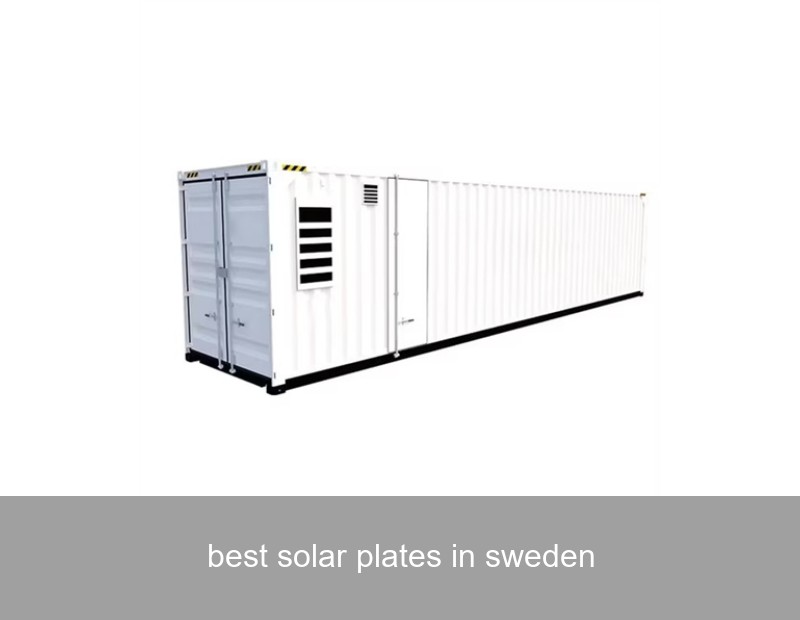
Our H-Series Residential Battery Systems are engineered for Nordic conditions. They feature high-cycle life chemistry designed for daily charging and discharging, sophisticated thermal management for stable operation year-round, and an intuitive energy management platform that gives you complete visibility and control. For larger commercial or microgrid applications, our MegaJoule C&I Solutions offer scalable, containerized storage that can manage demand charges, integrate renewables, and provide grid services.

Image: Intelligent energy storage systems, like Highjoule's H-Series, are the command center for modern solar homes. (Photo by Unsplash, illustrative)
Choosing Your System: A Practical Checklist
So, how do you proceed? Use this checklist as your guide:
- Audit & Goals: Analyze your annual electricity consumption (available on your bills). Define your goals: maximum bill savings, energy independence, backup power, or all three?
- Select a Certified Installer: Choose a certified installer from Svensk Solenergi. Discuss panel options suited for Swedish light conditions and your roof.
- Demand a Storage-First Design: Insist that your quote includes a properly sized battery storage system from the outset. Ask about integration capabilities and the energy management software.
- Evaluate the Ecosystem: The best solution is a cohesive unit. Ensure the installer has experience integrating panels, inverters, and batteries from Highjoule or similar tier-1 storage providers into a single, smart system.
- Calculate Total Value: Look beyond the upfront price. Model your projected annual energy bill savings over 10-15 years with a system that includes storage versus one without.
Your Energy Future
The journey to finding the best solar solution is ultimately about taking control. It's about moving from being a passive consumer to an active prosumer—producing, managing, and optimizing your own energy. The technology is here, it's proven in the Swedish context, and the long-term benefits are clear.
What specific question about integrating intelligent storage with your future solar array would most help you make a confident decision about your home's energy transition?
 Inquiry
 Online Chat