


Calculos para Instalacion de Paneles Solares: The Essential Guide to Sizing Your Solar Power System
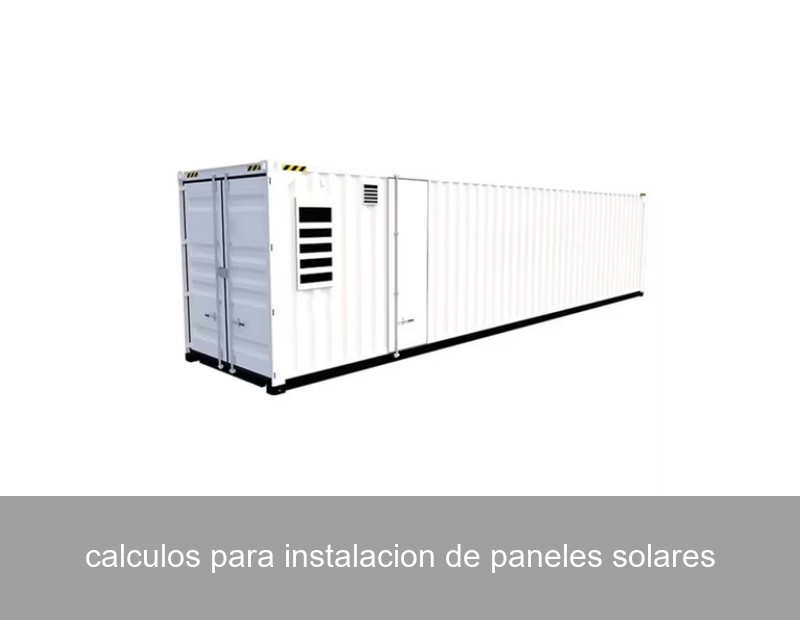
So, you've decided to harness the sun's power. Congratulations! But before the first panel is mounted, a critical phase determines whether your system will be a roaring success or a disappointing underperformer: the calculos para instalacion de paneles solares (calculations for solar panel installation). Getting these calculations right isn't just about number-crunching; it's about designing a system that meets your energy independence goals, maximizes your return on investment, and operates reliably for decades. As a global leader in advanced energy storage, Highjoule has been partnering with installers and homeowners since 2005 to ensure these foundational calculations translate into real-world performance, especially when integrated with smart battery storage.
Table of Contents
The Phenomenon: Why "Ballpark" Solar Estimates Fall Short
Many prospective solar owners start with a simple question: "How many panels do I need to cover my bill?" The instinct is to look at past consumption and divide by a panel's wattage. This approach, however, overlooks a symphony of variables. We've seen systems sized on annual averages struggle during short winter days, and others oversized without battery storage, exporting excess power at low rates. The true calculos para instalacion de paneles solares must account for when you use energy, not just how much. With the rise of time-of-use tariffs and increasing grid instability, precision in these calculations has moved from "recommended" to "essential."
The Core Calculations: A Step-by-Step Framework
Let's break down the essential calculations. Think of this as your project blueprint.
Step 1: The Energy Audit – Understanding Your Load
This is your foundation. Gather 12 months of utility bills to understand your baseline consumption (kWh). But don't stop there. Load profiling is key. Do you charge an EV overnight? Run a pool pump during the day? This temporal data is crucial. Create a table of your major appliances:
| Appliance | Power (Watts) | Daily Hours of Use | Daily Energy (kWh) |
|---|---|---|---|
| Air Conditioner | 3500 | 4 | 14.0 |
| EV Charger | 7200 | 2 | 14.4 |
| Refrigerator | 150 | 24 | 3.6 |
| Lighting (LED) | 200 | 5 | 1.0 |
Summing these gives you a detailed view of your daily kWh need. Don't forget to factor in future changes—planning for a heat pump or an electric vehicle now can save costly system upgrades later.
Step 2: Solar Resource Assessment – It's Not Just About Sunshine
Your location dictates your solar "fuel." Key metrics are Peak Sun Hours (PSH) and system derating factors. PSH represent the equivalent number of hours per day when solar irradiance averages 1000W/m². In Southern California, it might be 5.5 PSH; in Munich, Germany, it could be closer to 3.0. Use tools like the NREL PVWatts Calculator for authoritative, location-specific data.
Derating factors account for real-world losses: soiling (dirt on panels), shading, inverter efficiency, wiring losses, and temperature. A panel rated at 400W in ideal lab conditions (STC) might consistently deliver only 320W (an 80% derate) in your installed environment. Ignoring derating is a primary cause of underperformance.

Image: Accurate site assessment, including shading analysis, is a non-negotiable part of solar resource calculation. Credit: Unsplash.
Step 3: System Sizing – Bridging Demand and Supply
Now, we connect your load to your resource. A simplified formula for the required solar array size (in kW DC) is:
Daily Energy Need (kWh) ÷ Peak Sun Hours ÷ System Derate Factor = Array Size (kW)
Example: A home needs 30 kWh/day, in a location with 4.2 PSH, and a conservative derate of 0.75.
30 kWh ÷ 4.2 hours ÷ 0.75 = ~9.5 kW solar array.
This array would require roughly 24 panels of 400W each. But this calculation primarily supports daytime, grid-tied use. What happens when the sun sets or the grid fails? That's where storage transforms the equation.
Step 4: Battery Sizing (The Game Changer)
Battery sizing is about energy (kWh) and power (kW). You must determine two things: 1) How much energy do you want to back up (essential loads vs. whole home)? 2) What is the simultaneous power draw of those backed-up appliances?
- Energy Capacity (kWh): Sum the kWh of the loads you want to power during an outage over your desired backup duration (e.g., 10 kWh for overnight).
- Power Rating (kW): Ensure the battery's inverter can handle the surge of starting motors (like your fridge or well pump). A home might need a 5-10 kW continuous power output from the battery.
This is where partnering with an expert like Highjoule becomes invaluable. Our H-Joule Sentinel series of residential battery systems are designed with modular scalability. You can start with a 10 kWh stack for essential backup and easily add more capacity later as your needs evolve. Our integrated energy management system (EMS) automatically handles the complex calculos para instalacion in real-time, optimizing when to store solar energy, when to power your home, and when to export to the grid based on your preferences and utility rates.
From Theory to Practice: A California Case Study
Let's look at a real-world application. A medium-sized winery in Sonoma County, California, faced rising demand charges and needed backup for critical refrigeration. Their load analysis showed a base load of 50 kW with peaks to 150 kW. Using calculos para instalacion de paneles solares that factored in their specific PSH of 5.2 and a detailed derating analysis, Highjoule's engineering team designed a hybrid system:
- A 120 kWp rooftop solar array.
- A Highjoule H-Joule Matrix 500 commercial battery energy storage system (BESS) with 250 kWh of storage and 150 kW of inverter power.
The system was programmed for peak shaving—discharging the battery during high-rate periods to slash demand charges. The results after one year? A 42% reduction in overall electricity costs and seamless backup during two public safety power shutoff (PSPS) events, preserving thousands of dollars worth of inventory. The precise initial calculations ensured the system was neither overbuilt (saving capital) nor underbuilt (meeting all goals). Data sourced from California Distributed Generation Statistics shows such solar-plus-storage systems are increasingly the norm for commercial resilience.
Beyond the Basics: The Highjoule Advantage in System Design
While the formulas above provide a solid start, modern intelligent systems go further. At Highjoule, we believe the calculos para instalacion de paneles solares are just the beginning of a dynamic energy relationship. Our products, like the H-Joule Nexus residential unit or the Matrix series for C&I applications, come with our proprietary Adaptive Load Management software. This system continuously learns your consumption patterns, weather forecasts, and utility rate schedules. It doesn't just store energy; it makes strategic decisions about its use, ensuring every kilowatt-hour you produce delivers maximum value.
For complex microgrid or industrial applications, our team provides full feasibility studies and digital twin modeling, simulating thousands of scenarios to find the optimal configuration before installation begins. We move you from static calculations to a dynamic, future-proof energy asset.

Image: Intelligent energy management systems bring static calculations to life, optimizing flow every second. Credit: Unsplash.
Your Next Step Towards Energy Independence
The journey to a perfect solar and storage installation begins with meticulous calculations, but it culminates in choosing a partner who understands how to bring those numbers to life. Highjoule has been that partner for thousands of homeowners, businesses, and communities across Europe and North America since 2005. We provide not just hardware, but the intelligence and support to ensure your system performs optimally for its entire lifespan.
So, as you ponder your own calculos para instalacion de paneles solares, we leave you with this question: Is your goal simply to offset a past electricity bill, or to build a resilient, adaptive, and intelligent energy foundation for the future?
 Inquiry
 Online Chat