


Understanding the Canadian Solar Panel 700 Watt Price in Sweden: A Complete System Perspective
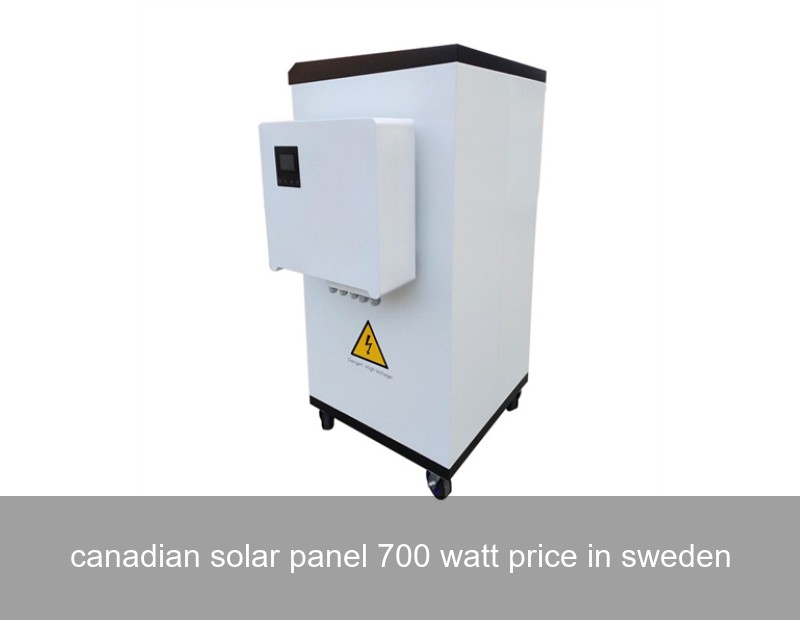
If you're researching the Canadian Solar panel 700 watt price in Sweden, you're likely planning a serious solar energy investment. It's a smart move, but here's a crucial insight: the panel's price tag is just one piece of the puzzle. The true value and return on your investment are determined by the entire system's performance, durability, and intelligence. In this article, we'll unpack what influences the cost in the Swedish market and why pairing high-efficiency panels with an advanced energy storage system is the key to maximizing your energy independence and savings.
Table of Contents
The Panel Price Puzzle: More Than a Sticker
When you see a price for a 700-watt module, you're looking at a component cost. In the Swedish market, as of late 2024, the price for a single high-wattage panel like the Canadian Solar HiHero 700W can range significantly based on order volume, distributor margins, and currency fluctuations. You might find figures roughly between SEK 2,800 and SEK 3,500 per panel ex-VAT. However, this number alone is almost meaningless for planning. Why? Because solar panels are not plug-and-play devices. Their efficiency—often a key selling point for 700W models—can only be fully harnessed when integrated with compatible inverters, robust mounting systems, and crucially, a way to store the excess energy you produce during Sweden's long summer days.
The Full System Cost Reality in Sweden
The total installed cost of a solar PV system in Sweden is what truly matters. According to data from the Swedish Energy Agency, the focus has shifted from pure cost-per-watt to lifetime value. A typical residential system with high-efficiency panels might have a total installed cost of SEK 20,000 to SEK 30,000 per kWp. For a commercial installation using 700W panels, the scale brings the cost down. Let's break down a simplified cost structure for a medium-sized commercial array:
| Component | Cost Share (Approx.) | Notes |
|---|---|---|
| Solar Panels (e.g., Canadian Solar 700W) | 25-35% | Bulk pricing applies; efficiency reduces needed roof space. |
| Inverter & Electrical Components | 20-25% | Must handle high input from 700W panels; quality is key for longevity. |
| Mounting System & Installation Labor | 25-30% | Swedish climate demands durable, corrosion-resistant hardware. |
| Planning, Permits, & Grid Connection | 10-15% | Local municipality costs and grid operator fees. |
| Energy Storage System (ESS) | +20-40% (add-on) | The game-changer for self-consumption and ROI. |
As the table shows, the panels are a major part, but the balance of system (BOS) costs dominate. This is where your choice of technology partners becomes critical.
Case Study: A Stockholm Commercial Retrofit
Let's look at a real-world example to see how this plays out. A medium-sized logistics warehouse in Stockholm upgraded its roof in 2023 and decided to install a 250 kWp solar array. They selected high-efficiency 700-watt panels to maximize production on their limited roof area.
- System Size: 250 kWp (approx. 358 panels).
- Challenge: Most energy was produced midday, but operational peaks were in the morning and evening. Without storage, over 40% of the solar energy was being exported to the grid at lower rates.
- Solution: The installer integrated a Highjoule H-Stack 250 commercial battery energy storage system (BESS) with a capacity of 500 kWh.
- Result: The system now stores excess midday solar energy. The facility uses this stored energy during its evening operational peaks, reducing grid draw during high tariff periods. Self-consumption of solar power jumped from ~60% to over 90%. The addition of the Highjoule BESS improved the projected payback period by an estimated 2.5 years by drastically reducing peak demand charges and optimizing time-of-use arbitrage.
This case highlights a pivotal trend: in Sweden, the discussion is moving from "solar system price" to "integrated energy management solution value."

Image: Modern commercial solar installation in a Nordic setting. The true value is unlocked when paired with intelligent storage. Credit: Unsplash.
Beyond the Panel: The Critical Role of Energy Storage
Think of your high-output Canadian Solar panels as a powerful, but intermittent, energy fountain. Without a "reservoir," much of that valuable water flows away unused. This is especially true in Sweden, where summer and winter production vary immensely. A Battery Energy Storage System (BESS) is that reservoir.
An advanced BESS like those from Highjoule does more than just store energy. It intelligently manages when to charge from your panels or the grid (when prices are low/renewable) and when to discharge to power your home or business (when prices are high or the grid is strained). This capability, known as peak shaving and load shifting, is where significant financial savings are realized, protecting you from volatile energy markets.
Highjoule: Integrating Your Solar Investment for Maximum Return
At Highjoule, we don't manufacture solar panels. We specialize in what makes your premium panel investment truly intelligent and resilient: advanced, software-driven energy storage systems. When you're considering a system built around high-power modules like the 700-watt Canadian Solar panels, you need a storage solution that can handle high charging currents efficiently and integrate seamlessly.
Our H-Stack series for commercial and industrial applications is designed precisely for this. With scalable capacity from 100 kWh to multiple MWh, superior cycle life, and our proprietary EnergyOS™ management platform, the H-Stack ensures every kilowatt-hour your panels produce is used optimally. For residential clients pairing high-efficiency panels with storage, our HomePower series offers the same intelligent control in a compact format.
Our services include full system design support, ensuring your Canadian Solar array is perfectly sized and configured to work in harmony with a Highjoule BESS. We provide the brains to the brawn of your solar panels, maximizing your self-sufficiency and return on investment.

Image: The interior of a modern battery energy storage system. Intelligence and safety are as important as raw capacity. Credit: Unsplash.
Making Your Informed Choice
So, when you ask about the Canadian Solar panel 700 watt price in Sweden, you're starting a more important conversation about total energy ecosystem value. The right question to pose to your installer is: "What is the total cost and projected 20-year ROI for a system that includes these high-efficiency panels and an intelligent battery storage solution like Highjoule's, tailored to my specific consumption pattern?"
Request quotes that include storage options. Analyze payback models that factor in rising grid electricity costs, potential demand charges (for businesses), and the increased self-consumption that storage enables. Consult resources like the International Energy Agency for global trends on solar and storage synergy.
Your Next Step
Given the complexity and long-term nature of this investment, what specific energy consumption pattern in your home or business are you most eager to solve with solar and storage – is it reducing nighttime grid imports, ensuring backup power during outages, or cutting peak demand charges?
 Inquiry
 Online Chat