


Características Principales de la Energía Solar: Una Guía para el Consumidor Moderno
Imagine powering your home or business with a fuel source that's silent, emits nothing, and whose bill arrives reliably every 93 million miles. That's the daily reality for millions embracing solar energy. The características principales de la energía solar—its defining features—are reshaping how we think about power, from individual rooftops to entire national grids. This isn't just about being "green"; it's about harnessing a fundamentally different, more resilient, and increasingly economical form of energy. In this guide, we'll break down these core characteristics, explore their real-world impact, and see how pairing them with advanced storage, like solutions from Highjoule, unlocks their full potential.
Table of Contents
- What is Solar Energy? Beyond the Panels
- The 5 Key Characteristics of Solar Energy
- From Intermittency to Independence: The Storage Imperative
- How Highjoule Complements Solar's Core Characteristics
- Case Study: Solar + Storage in Action
- What Could Your Energy Independence Look Like?
What is Solar Energy? Beyond the Panels
At its heart, solar energy is the conversion of sunlight into electricity, primarily using photovoltaic (PV) cells. But to truly understand its revolutionary nature, we must look past the hardware. It represents a shift from extractive energy models—digging, drilling, and burning finite resources—to a participatory one. Your roof, a commercial building's facade, or a community field becomes an active power generator. This democratization of energy is perhaps its most profound, yet often overlooked, characteristic. It empowers homeowners, businesses, and communities to take control of their power supply, insulating them from volatile fossil fuel markets.
The 5 Key Characteristics of Solar Energy
Let's dive into the specific traits that define solar power and make it such a compelling choice.
1. Abundant and Renewable
The sun delivers more energy to Earth in one hour than humanity uses in an entire year. This isn't just a fun fact; it's the foundation of solar's promise. Unlike coal or gas, sunlight is not a "resource" we deplete. It's a continuous flow, making solar the very definition of a renewable energy source. This abundance ensures long-term sustainability and energy security.
2. Intermittent and Variable
Here's the most talked-about challenge: the sun doesn't shine 24/7. Solar generation follows a daily and seasonal cycle and is affected by weather. This intermittency is a core característica principal de la energía solar that grid operators and system owners must address. It's not a deal-breaker, but it necessitates smart planning and, crucially, energy storage to shift excess daytime production for use at night or during cloudy periods.
3. Clean and Environmentally Friendly
Solar PV systems generate electricity with zero operational emissions—no greenhouse gases, no air pollutants. Their lifecycle carbon footprint is drastically lower than fossil fuels. According to the National Renewable Energy Laboratory (NREL), the energy payback time (the time to "repay" the energy used in manufacturing) for solar panels is now often between 1 to 4 years, with decades of clean operation to follow.
4. Distributed and Scalable
Solar energy systems can be deployed at virtually any scale. From a single 5-kW residential array to a 500-MW utility-scale solar farm, the technology is modular and flexible. This allows for distributed generation, reducing transmission losses and strengthening grid resilience by creating power closer to where it's consumed.
5. Declining Cost (High Initial, Low Operational)
The cost trajectory of solar is its most market-disrupting feature. The levelized cost of solar electricity has plummeted by over 90% in the last decade. While the initial investment in panels and equipment can be significant, the "fuel" is free for the system's 25-30+ year lifespan, leading to predictable, low long-term costs and protection against utility rate hikes.
| Characteristic | Solar PV | Natural Gas | Coal |
|---|---|---|---|
| Fuel Cost | Zero | High & Volatile | Moderate & Volatile |
| Operational Emissions | Zero | Medium (CO2, NOx) | High (CO2, SO2, Particulates) |
| Generation Profile | Intermittent (Daytime) | Dispatchable (On-Demand) | Baseload (Constant) |
| Typical Deployment Scale | Distributed & Utility | Centralized Plants | Centralized Plants |
From Intermittency to Independence: The Storage Imperative
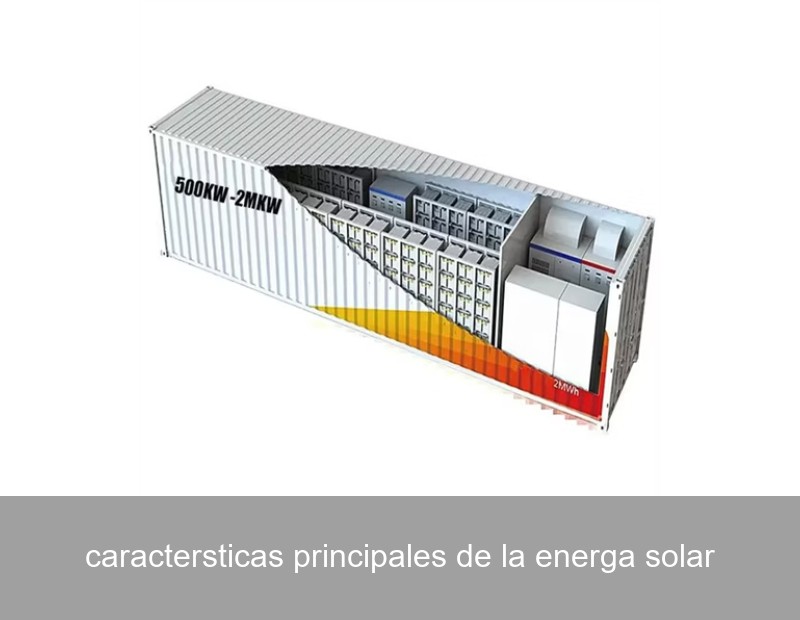
The intermittent nature of solar is the key puzzle piece. To move from a solar-assisted grid to a solar-powered one, we need a buffer. This is where Battery Energy Storage Systems (BESS) become non-negotiable. Think of storage as the "time machine" for solar energy, allowing you to capture the sun's noon surplus and use it at 8 PM. It transforms solar from a good source of daytime power into a reliable, 24/7 energy asset. This combination is what creates true energy independence, maximizes self-consumption, and can even provide backup power during grid outages.

Image Source: Unsplash (Representative image of a modern solar and storage installation)
How Highjoule Complements Solar's Core Characteristics
Understanding the características principales de la energía solar is what drives our product design at Highjoule. Since 2005, we've focused on creating intelligent storage solutions that don't just add a battery, but seamlessly integrate with and enhance every solar characteristic.
- For Intermittency: Our H-Joule Cube Commercial & Industrial (C&I) systems are engineered for high-cycle, high-power throughput. They automatically store excess solar and dispatch it during peak demand or low production, smoothing out solar's variability and turning it into a firm, dispatchable resource.
- For Scalability & Distribution: Our product line is modular by design. From the H-Joule Home for residential applications to multi-MW containerized solutions for microgrids, we provide scalable storage that grows with your solar investment and energy needs.
- For Maximizing Economics: Highjoule's integrated energy management software is the brain of the operation. It doesn't just store and release energy; it intelligently decides when to do so based on weather forecasts, electricity tariffs, and consumption patterns, ensuring you get the maximum financial return from your solar + storage system.
In essence, Highjoule's technology transforms the inherent features of solar from theoretical advantages into practical, daily benefits—resilience, savings, and control.
Case Study: Solar + Storage in Action – A German Manufacturing Facility
Let's look at a real example from Bavaria, Germany. A mid-sized automotive parts manufacturer installed a 1.2 MW rooftop solar array to reduce costs and carbon footprint. However, they found themselves exporting over 40% of their solar generation to the grid at low feed-in tariffs, while still drawing expensive power in the early morning and evening.
The Solution: They partnered with Highjoule to deploy a 500 kWh / 750 kW H-Joule Cube C&I storage system.
The Data-Driven Outcome (after 12 months):
- Self-Consumption of Solar: Increased from 58% to over 92%.
- Peak Grid Demand Charges: Reduced by 75% by discharging the battery during operational peaks.
- Overall Energy Costs: Lowered by an additional 31% beyond solar savings alone.
- Backup Power: The system now provides critical process backup for up to 2 hours, preventing costly production halts.
This case, documented in a Fraunhofer ISE report on commercial PV trends, illustrates perfectly how storage addresses solar's intermittency, unlocking its full economic and operational potential. The facility didn't just use solar power; it mastered it.

Image Source: Unsplash (Representative image of a large commercial solar installation)
What Could Your Energy Independence Look Like?
We've explored the defining features of solar power—from its clean, abundant nature to its practical need for storage. The technology is proven, the economics are compelling, and the need for resilient, local energy has never been clearer. The question is no longer if solar is viable, but how to design a system that truly harnesses its core characteristics for your specific needs. Are you ready to explore how a tailored Highjoule storage solution can transform your solar investment from a partial solution into a complete energy independence strategy?
 Inquiry
 Online Chat