


Sustainable Living Redefined: Powering Your Casas Contenedores España Dream
Imagine waking up in a sleek, modern home with floor-to-ceiling windows overlooking the Spanish countryside. The sun is rising, your coffee is brewing, and your home is quietly, efficiently powering itself. This isn't science fiction; it's the reality for a growing number of people choosing casas contenedores España (container homes in Spain) as a foundation for sustainable, autonomous living. These innovative dwellings, crafted from repurposed shipping containers, are more than an architectural trend. They represent a conscious shift towards minimalism, efficiency, and environmental responsibility. But to truly unlock their potential—especially in sunny, rural regions of Spain—one critical question must be addressed: how do you ensure a reliable, clean, and independent power supply?
The Hidden Energy Challenge of Modern Container Living
Let's be honest. The appeal of container homes is clear: they're cost-effective, modular, fast to construct, and have a fantastic industrial-chic aesthetic. For Spain, with its abundant sunshine and a culture embracing innovative design, they are a perfect match. However, the very features that make them attractive can also create a unique energy dilemma.
Container homes, by their nature, have a high surface-area-to-volume ratio. Their steel frames are excellent conductors of heat, which means in the scorching Spanish summer, they can turn into ovens without proper insulation and cooling. Conversely, a chilly night in the Spanish interior can make them feel cooler than a traditional brick home. The result? A significant portion of your energy consumption goes directly into heating and air conditioning. Relying solely on the traditional grid not only increases your carbon footprint and bills but also contradicts the very ethos of sustainable, off-grid-capable living that often draws people to casas contenedores in the first place.
Consider this data: The International Energy Agency (IEA) highlights that buildings account for nearly 30% of global final energy consumption. A self-sufficient home aims to slash that number dramatically. The challenge, then, is transforming a simple steel box into a truly intelligent, energy-positive habitat.

Image: A modern container home, a prime candidate for integrated solar and storage. Credit: Unsplash.
The Sustainable Power Solution: Going Off-Grid & Smart
The solution lies in a self-sustaining energy ecosystem. For casas contenedores España, this typically involves three core components:
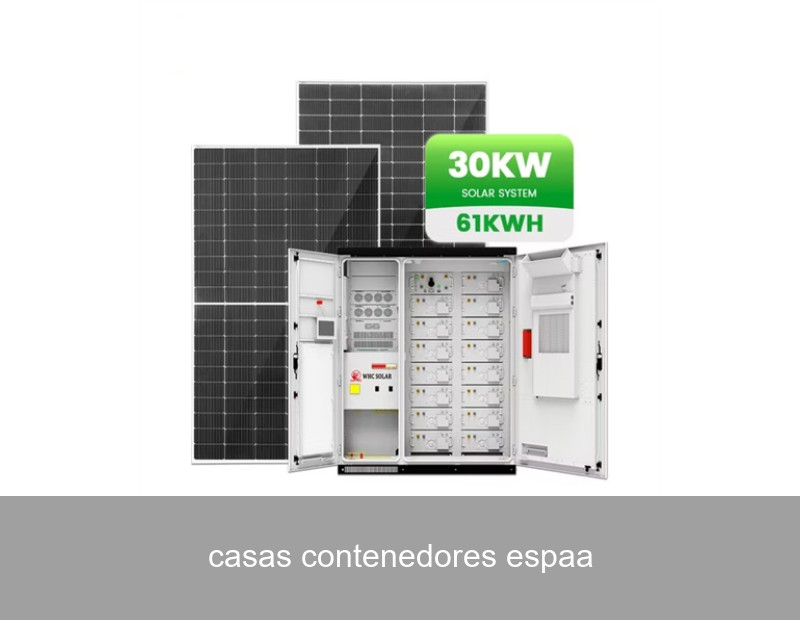
- Solar Photovoltaic (PV) Generation: Spain enjoys over 2,500 hours of sunshine annually. Capturing this free energy is a no-brainer. Rooftop solar panels are a natural fit for the flat, spacious roofs of container homes.
- Intelligent Energy Storage: Here's the key. The sun doesn't shine at night. An advanced battery storage system stores excess solar energy generated during the day for use in the evening, at night, or during cloudy periods. This is what grants true energy independence.
- Smart Energy Management: This is the "brain." A smart system monitors energy production, consumption, and storage levels. It can automatically prioritize solar usage, manage high-draw appliances, and even sell excess energy back to the grid if desired, optimizing every watt-hour.
This integrated approach turns a challenge into a superpower. You're not just building a home; you're creating a personal microgrid.
Why Battery Choice Matters for Your Container Home
Not all batteries are created equal. For a residential application, especially in a home where space might be at a premium, you need a solution that is safe, compact, long-lasting, and seamlessly integrable. Lithium iron phosphate (LiFePO4) battery technology, for instance, has become the gold standard for home storage due to its superior safety profile, long cycle life, and stability. When selecting a system, look for one designed for ease of installation and smart monitoring—features that align perfectly with the plug-and-play philosophy of container homes.
Real Case Study: An Off-Grid Container Home in Andalusia
Let's look at a real-world example. A couple built their dream casa contenedor in a remote, picturesque valley in Andalusia, Spain. Connection to the main electrical grid was prohibitively expensive and logistically complex. Their goal was 100% energy autonomy.
| Project Component | Specification |
|---|---|
| Home Size | 2 x 40ft shipping containers |
| Solar PV Array | 8.5 kWp rooftop installation |
| Battery Storage System | 15 kWh integrated lithium-ion battery |
| Key Loads | Air conditioning/heat pump, water pump, kitchen appliances, lighting, office electronics |
The results were transformative. The system generates an average of 12,500 kWh annually, fully covering their needs. During a particularly sunny summer month, they generated a 40% surplus, which was stored for later use or directed to non-essential loads. The homeowners reported zero power interruptions and, crucially, zero electricity bills from day one. Their only energy "source" is the Spanish sun. This case underscores a report by Solar Energy Technologies Office which confirms that pairing PV with storage is the most effective path to resilience for off-grid and remote homes.
Integrating Reliable Power: How Highjoule Elevates Container Living
This is where expertise makes all the difference. As a global leader in advanced energy storage systems since 2005, Highjoule specializes in transforming energy visions into reliable, hands-off reality. For pioneers building their casas contenedores España, our solutions provide the missing piece for complete energy autonomy.
Our Residential Energy Storage Systems are designed with the modern, sustainable homeowner in mind. Take our H-Joule HomePower series: a compact, wall-mounted lithium-ion battery system that is the perfect companion for a container home's solar installation. Its modular design allows for capacity expansion as your needs grow. More importantly, it's managed by our intelligent Energy Management System (EMS), which acts as the central nervous system for your home's power. It ensures solar energy is used first, automatically switches to battery power when needed, and provides you with real-time insights and control via a simple smartphone app.
For larger projects, such as multi-container family homes or small community microgrids, Highjoule's Commercial & Industrial (C&I) and Microgrid solutions offer scalable, robust power management. We understand that the success of an off-grid or hybrid-power home isn't just about the hardware; it's about seamless integration, intelligent control, and long-term peace of mind.

Image: The interior of a modern container home, reliant on stable, clean power for comfort. Credit: Unsplash.
Future Trends: Smarter, More Autonomous Homes
The evolution of casas contenedores is intrinsically linked to advancements in energy technology. We are moving towards homes that don't just consume energy but actively manage and trade it. Imagine your home's EMS communicating with your electric vehicle (V2H or vehicle-to-home), using the car's battery as a backup power source during peak demand. Or a system that automatically adjusts your thermostat or pool pump schedule based on forecasted solar production and stored energy levels.
These aren't distant dreams. They are the next logical steps in creating truly intelligent living spaces. The container provides the versatile, sustainable shell; the integrated renewable energy and storage system provide its independent, sustainable heart and brain.
Your Energy, Your Control
The journey to building a casa contenedor in Spain is one of freedom and innovation. By prioritizing a robust, smart energy system from the design phase, you safeguard that freedom. You protect yourself from rising energy costs, grid instability, and you make a profound positive impact on the environment.
What's the first step you would take to ensure your sustainable home project is truly energy independent?
 Inquiry
 Online Chat