


China Space Solar Panels: A Glimpse into the Future of Unlimited Clean Energy
Imagine a power source that operates 24/7, unaffected by clouds, night, or weather. This isn't science fiction—it's the ambitious goal of space-based solar power (SBSP), and a nation is charging ahead to make it a reality. While the concept has been discussed for decades, recent, concrete progress from one country is turning heads globally: China's space solar panels program. This initiative represents a staggering leap in renewable energy ambition, aiming to capture sunlight in orbit and beam it wirelessly to Earth. But what does this mean for our energy future, and how do these celestial ambitions connect to the power solutions we use today? Let's explore.
What Are Space Solar Panels?
At their core, space solar panels are similar to the photovoltaic (PV) modules on your roof. They convert sunlight into electricity. The revolutionary difference is their location. Placed in geostationary orbit, 36,000 kilometers above Earth, they bask in uninterrupted sunlight for over 99% of the year. The generated electricity is then converted into microwave or laser energy and beamed wirelessly to a receiving station (a "rectenna") on the ground, which converts it back into electricity for the grid.

Image: An artist's concept of a space-based solar power station. Credit: NASA
China's Leadership in Space-Based Solar
While the U.S. and Japan have long researched SBSP, China has now established a formal, state-backed roadmap with clear milestones. Dubbed the "Omega" project, China's Academy of Space Technology (CAST) plans to launch small-scale tests in the 2020s, a megawatt-level system by 2030, and a commercial-scale gigawatt station by 2050. This systematic approach signals a serious commitment.
Why is China so focused on this? The drivers are multi-faceted:
- Energy Security: Reducing reliance on imported fossil fuels.
- Technological Prestige: Leading the next frontier in energy and space technology.
- Carbon Neutrality: Meeting its ambitious 2060 carbon-neutral goal requires breakthrough technologies.
Their progress is tangible. In 2022, researchers at Xidian University successfully tested a full-chain, ground-based system for a proposed space solar power station, a critical proof-of-concept. As reported by the scientific journal Nature, such advances in wireless power transmission are foundational to the entire endeavor.
The Data Advantage: Why Space Beats Atmosphere
The theoretical efficiency gains are staggering. Let's look at the data:
| Factor | Ground-Based Solar Panel | Space-Based Solar Panel (Theoretical) |
|---|---|---|
| Sunlight Availability | ~6 hours peak sun average (varies widely) | 24 hours a day, ~99% of the year |
| Energy Density | Affected by atmosphere, ~1000 W/m² max | No atmospheric loss, ~1360 W/m² (solar constant) |
| Land Use Impact | Significant for utility-scale farms | Primary ground use is the receiving station |
This data shows the core appeal: consistency and density. A single space-based array could generate up to 40 times the annual energy of an identically sized terrestrial farm in many locations, according to some estimates from the U.S. Department of Energy.
Case Study: From Space Tech to Earth Solutions
The technological spillover from programs like China's space solar panels is already benefiting Earth-bound renewables. Consider the case of perovskite solar cells. Originally researched for space applications due to their light weight and high efficiency potential, they are now one of the most promising frontiers for commercial solar panels. A 2023 pilot project in Oxford, UK, integrated perovskite-on-silicon tandem cells into a commercial array, achieving a record-breaking 28.6% module efficiency—a significant jump from the standard 22% commercial average.
This case illustrates a vital pattern: the extreme demands of space (efficiency, weight, durability) drive material science innovations that eventually trickle down, making ground-based solar more efficient and affordable for everyone.
The Challenges Ahead for Space Solar
For all its promise, the path to operational China space solar panels is fraught with monumental hurdles:
- Launch Costs: Transporting thousands of tons of material into orbit is currently cost-prohibitive.
- Engineering & Assembly: Building football-field-sized structures in space autonomously is an untested feat.
- Wireless Transmission Efficiency & Safety: Beaming gigawatts of power through the atmosphere with minimal loss and ensuring the beam's safety is a profound challenge.
These are not trivial issues. They require breakthroughs in robotics, materials science, and energy transmission. The international community, through bodies like the European Space Agency's SOLARIS initiative, is also studying the feasibility and geopolitical implications of this technology.
The Earth Connection: Highjoule's Ground-Based Innovation
While the vision of space-based power unfolds over decades, the need for reliable, sustainable energy is here and now. This is where the mission of companies like Highjoule becomes critical. For nearly two decades, since 2005, Highjoule has been a global leader in advanced energy storage systems (ESS), providing the essential "missing link" for today's renewable grid.
Think of it this way: whether energy comes from a solar panel on a factory roof or, one day, from a satellite in orbit, its intermittency remains a challenge for a stable grid. Highjoule's intelligent battery storage solutions solve this by storing excess energy and dispatching it precisely when needed. Our systems ensure that every kilowatt-hour generated—from any source—is used efficiently and reliably.
For commercial and industrial clients across Europe and North America, Highjoule's modular ESS platforms offer:
- Grid Independence & Resilience: Providing backup power and reducing demand charges.
- Renewable Optimization: Maximizing self-consumption of solar and wind generation.
- Sustainability Leadership: Enabling a higher penetration of clean energy onto the grid.
We may not be launching satellites, but we are mastering the technology that makes a renewable-powered world possible today. Our work is the practical, scalable foundation upon which future breakthroughs, like space solar, can eventually integrate.

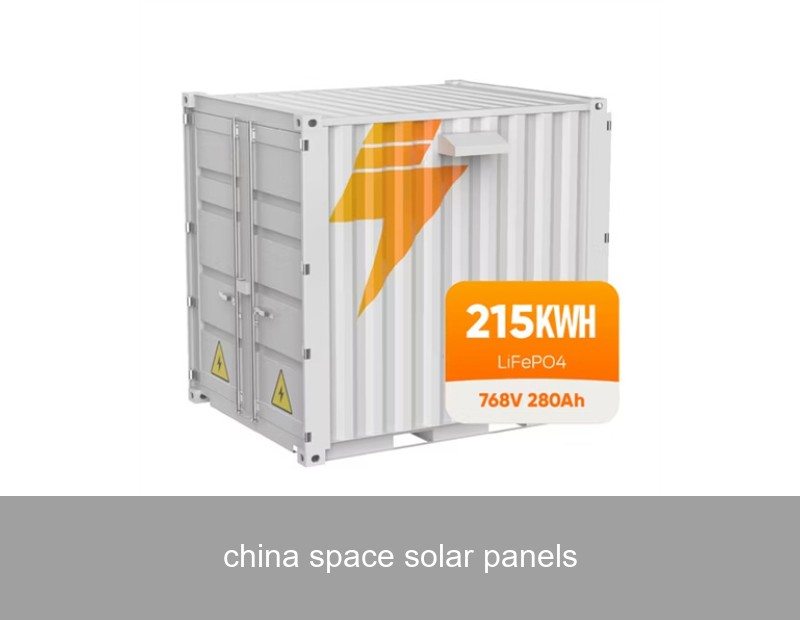
Image: A modern battery energy storage system, key to integrating renewables. Credit: Unsplash
Bridging the Gap Between Vision and Reality
The story of China's space solar panels is ultimately a story about human ambition. It pushes the boundaries of what's possible and accelerates innovation across multiple fields. However, the sustainable energy transition cannot wait for a single, distant solution. It requires deploying and perfecting the technologies we have now while supporting the R&D for tomorrow.
So, as we watch the skies for the next breakthrough, let's also focus on the ground. How can we better integrate the powerful, clean energy solutions already at our fingertips to build a more resilient and sustainable grid for the next generation?
 Inquiry
 Online Chat