


Understanding the Essential Component of a Solar System: A Guide to Powering Your Future
Have you ever looked at the sleek solar panels on a rooftop and wondered, "What exactly makes it all work?" The journey from sunlight to powering your home or business involves a sophisticated symphony of components, each playing a critical role. Understanding the component of a solar system is the first step to appreciating this modern marvel and making an informed decision about your own energy independence. In this guide, we'll demystify the key parts, explore how they interact, and see how choosing the right technology, like Highjoule's integrated solutions, can maximize your return on investment and energy resilience.
Table of Contents
- The Core Parts: More Than Just Panels
- The Power Conductor: Inverters and Their Crucial Role
- The Missing Link: Why Energy Storage is a Game-Changer
- A Real-World Case: From Theory to Practice in Germany
- Choosing the Right Components for Your Needs
The Core Parts: More Than Just Panels
Let's start with the most visible component of a solar system: the photovoltaic (PV) panels. These are the workhorses that capture sunlight and generate direct current (DC) electricity. But they don't operate alone. A typical grid-tied solar array consists of several fundamental components:
- Solar Panels (Modules & Array): Multiple panels wired together form a "string" or an array. Their efficiency and durability are paramount.
- Mounting System: This is the skeleton, securely attaching panels to your roof or ground. Its design affects airflow, angle, and long-term structural integrity.
- DC/AC Wiring & Conduit: The nervous system that safely transports electricity from the roof to other components.
- AC/DC Disconnect Switches: Critical safety devices that allow for the system to be manually shut off for maintenance or emergencies.
- Utility Meter & Grid Connection: For grid-tied systems, this bidirectional meter tracks the energy you import from and export to the utility grid.
While this setup can reduce electricity bills, it has a significant limitation: when the sun sets or the grid fails, the power stops. This brings us to the most transformative modern addition to the solar component family.
The Power Conductor: Inverters and Their Crucial Role
If panels are the muscles, the inverter is the brain and the voice. Its job is to convert the DC electricity from the panels into the alternating current (AC) that powers our homes and businesses. There are several types, but the trend is moving towards smart, integrated inverters that do much more than simple conversion. Modern hybrid inverters can manage multiple energy sources—solar, battery storage, and the grid—seamlessly. They optimize self-consumption, ensure grid compliance, and provide detailed energy monitoring. Choosing a high-quality, intelligent inverter is perhaps the single most important decision for system performance and future expandability. This is a core area of expertise for Highjoule, whose H-IQ Series Hybrid Inverters are designed for maximum efficiency and smart energy management, acting as the central command unit for the entire power ecosystem.
The Missing Link: Why Energy Storage is a Game-Changer
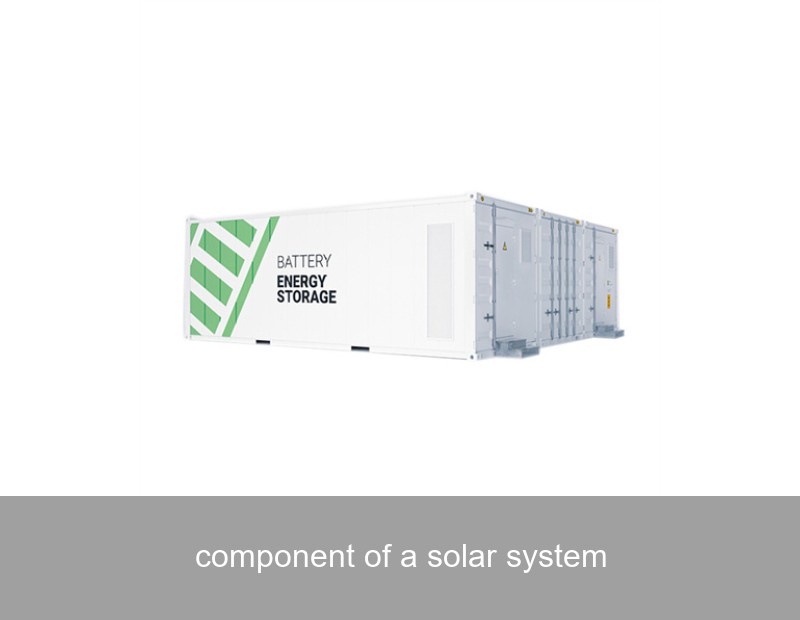
Here's the pivotal shift in thinking about a solar system's components. For decades, solar was a daylight-only affair. The addition of a battery energy storage system (BESS) fundamentally changes the equation, transforming a solar array into a true 24/7 power plant. The battery acts as a reservoir, storing excess solar energy produced during the day for use at night, during peak rate periods, or during grid outages.
Consider this data: The U.S. Energy Information Administration (EIA) notes that residential electricity demand often peaks in the evening, precisely when solar production drops. A system without storage misses the chance to offset this high-cost, high-demand period.
A complete, resilient solar-plus-storage system includes:
| Component | Function | Highjoule's Solution |
|---|---|---|
| Solar Panels | Generate DC electricity | Compatible with all high-efficiency panels |
| Hybrid Inverter | Converts DC to AC, manages power flow | H-IQ Series with AI-driven optimization |
| Battery Pack | Stores electrical energy | H-Cell Lithium Iron Phosphate (LFP) batteries, known for safety & long cycle life |
| Battery Management System (BMS) | Protects and monitors battery health | Advanced, self-learning BMS integrated into every H-Cell pack |
| Energy Management System (EMS) | The overarching brain for energy decisions | Highjoule's Horizon OS software platform for monitoring and control |
 Image: A modern home solar system with battery storage, a key component for energy independence. Source: Unsplash
Highjoule doesn't just sell individual boxes; we provide fully integrated, UL-certified systems where every component is engineered to communicate perfectly with the others. This integration eliminates compatibility issues, simplifies installation, and ensures optimal performance and safety for commercial, industrial, and residential applications.
A Real-World Case: From Theory to Practice in Germany
Let's see how these components come together with a tangible example. A medium-sized dairy farm in Bavaria, Germany, faced rising energy costs and sought to stabilize its operations, which required consistent power for refrigeration. They installed a 120 kWp solar canopy over a parking area, paired with a 240 kWh Highjoule H-Cell battery storage system and two H-IQ 60kW hybrid inverters.
The Phenomenon: Solar overproduction at midday was being sold to the grid at low feed-in tariffs, while the farm bought expensive power in the early morning and evening.
The Data & Outcome: By intelligently storing excess solar energy, the system now provides over 85% of the farm's total electricity consumption. During a regional grid disturbance lasting 4 hours, the storage system seamlessly kept critical cooling systems online, preventing spoilage of product worth an estimated €15,000. This case, documented in a Fraunhofer ISE report on PV system trends, highlights how the battery storage component turned a cost-saving solar project into a critical business continuity asset.
Choosing the Right Components for Your Needs
So, how do you ensure every component of your solar system is right for you? Ask these questions:
- What is my primary goal? (Bill reduction, backup power, sustainability, grid services?)
- Is my system future-proof? Can I easily add more storage or panels later?
- How important is safety and warranty? Lithium Iron Phosphate (LFP) chemistry, like in Highjoule batteries, offers superior thermal and chemical stability.
- Do the components "speak" to each other? An integrated solution from a single provider like Highjoule often outperforms a mix-and-match approach.
Ultimately, the most sophisticated component of a solar system might be the software that intelligently manages it all. Highjoule's Horizon OS platform allows users to monitor energy flows in real-time, set preferences (like maximizing self-consumption or preparing for a storm), and even participate in virtual power plant programs where available.
 Image: Monitoring software is a crucial component for understanding and optimizing your solar system's performance. Source: Unsplash
Ready to Build Your Intelligent Energy Ecosystem?
Understanding the component of a solar system empowers you to move beyond a simple installation and invest in a comprehensive energy solution. With nearly two decades of experience, Highjoule is at the forefront of designing these intelligent systems that are greater than the sum of their parts. What energy challenge could a perfectly harmonized solar and storage system solve for you?
 Inquiry
 Online Chat