


Container Notstromaggregat: The Silent, Sustainable Powerhouse Redefining Energy Backup
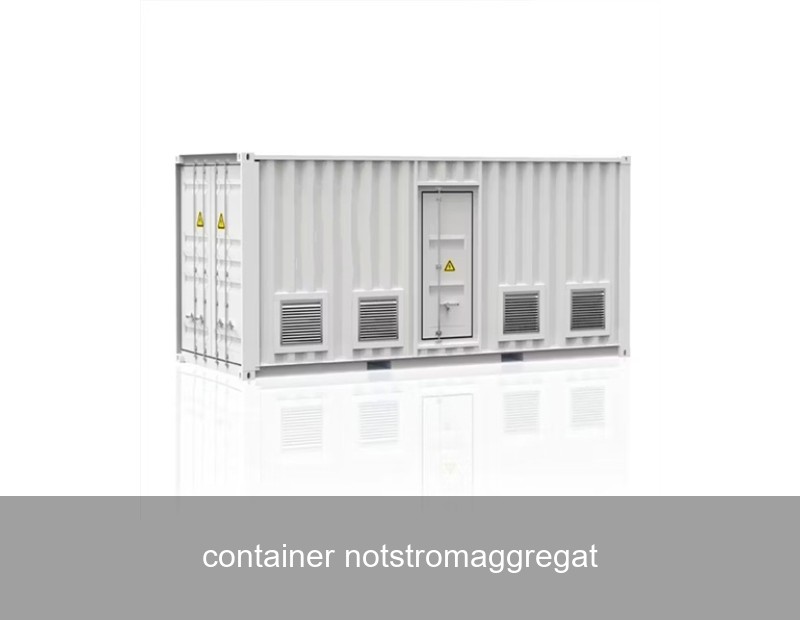
Imagine a critical data center during a grid outage. The immediate, thunderous roar of diesel generators kicking in has long been the standard soundtrack of emergency power. But what if the backup power was utterly silent, emitted zero fumes, and could be activated in milliseconds? This isn't a future concept; it's the reality delivered by the modern container Notstromaggregat—a containerized Battery Energy Storage System (BESS) that is fundamentally transforming how businesses and communities ensure energy resilience. For facility managers, project developers, and sustainability officers across Europe and the US, understanding this shift is no longer just technical—it's strategic.
What is a Container Notstromaggregat?
Traditionally, a "Notstromaggregat" (emergency power generator) conjures images of a diesel or gas-fired unit. A container Notstromaggregat redefines this term. It is a fully integrated, plug-and-play energy storage system housed within a standard shipping container. At its core are high-density lithium-ion or lithium-iron-phosphate (LFP) batteries, sophisticated power conversion systems (PCS), and an advanced energy management system (EMS). This all-in-one solution doesn't generate power by burning fuel; it stores electricity from the grid or renewable sources like solar, and delivers it on demand, providing seamless backup power, peak shaving, and grid services.
The Power Shift Phenomenon: Why Diesel Generators Are Falling Out of Favor
The reliance on diesel generators is being challenged from multiple angles. First, the operational reality: noise pollution often violates strict urban ordinances, exhaust emissions conflict with corporate Net-Zero goals, and maintenance is both costly and requires fossil fuel logistics. Second, the financial model is becoming less attractive. Diesel fuel price volatility, as seen during recent geopolitical tensions, makes long-term budgeting a nightmare. Finally, there's a sheer performance gap. A diesel genset can take valuable seconds to start and stabilize, while a battery system responds within milliseconds—a critical difference for sensitive industrial processes or IT infrastructure.

Credit: Photo by American Public Power Association on Unsplash. A modern containerized BESS provides silent, emission-free backup power.
Data-Driven Energy Resilience
Let's talk numbers. According to a U.S. Department of Energy report, power outages cost the U.S. economy an estimated $150 billion annually. In the EU, the European Environment Agency highlights increasing climate-related extremes as a major threat to grid stability. The financial risk of downtime for a medium-sized manufacturing plant or a cold storage facility can exceed $10,000 per hour. A containerized BESS directly mitigates this by providing instantaneous backup. Furthermore, when not needed for emergencies, the system generates revenue through peak shaving—storing cheap off-peak energy to use during expensive peak hours, often achieving a return on investment (ROI) in just 3-7 years, all while reducing carbon footprint.
Case Study: A Berlin Logistics Hub's Silent Revolution
Consider the real-world example of a major logistics hub on the outskirts of Berlin. Facing frequent short-duration grid sags and stringent local emissions regulations, their aging diesel generators were becoming a liability. In 2023, they deployed a 1 MWh container Notstromaggregat from Highjoule, integrated with their existing rooftop solar array.
| Metric | Before (Diesel) | After (Highjoule BESS) |
|---|---|---|
| Backup Response Time | 12-15 seconds | <20 milliseconds |
| Annual CO2 Emissions from Backup | ~28 tonnes | 0 tonnes (solar-charged) |
| Annual Operational Cost (Fuel & Maintenance) | €18,500 | €2,800 (system monitoring) |
| Peak Demand Charge Savings | N/A | €15,200 annually |
| Noise Level | 85 dB at 7 meters | 55 dB (ambient cooling fans) |
The results were transformative. The site now operates its critical cooling and sorting systems with flawless power quality, has slashed its energy bills through intelligent load management, and proudly contributes to its parent company's sustainability targets. The system paid for itself through savings and avoided costs in under five years.
The Highjoule Solution: Intelligent, Sustainable Power in a Box
At Highjoule, with nearly two decades of expertise in advanced energy storage, we've engineered our Containerized Power Solutions to be the benchmark for reliability and intelligence. Our systems are more than just batteries in a box; they are self-contained energy assets. Pre-configured, tested, and delivered to your site, they significantly reduce installation complexity and time. Our proprietary Adaptive Energy Management Platform continuously learns your energy consumption patterns, autonomously optimizing for cost savings, carbon reduction, and resilience. Whether for a remote microgrid in Scandinavia or a hospital in California requiring ultra-reliable backup, our solutions are built to the highest safety standards (UL 9540, IEC 62619).
Key Components of a Modern Containerized BESS
- Battery Modules: Utilizing safest LFP chemistry for long cycle life and thermal stability.
- Power Conversion System (PCS): The intelligent heart that manages bi-directional AC/DC flow.
- Thermal Management: Liquid-cooling or advanced air-cooling systems ensuring optimal performance from -30°C to 50°C.
- Energy Management System (EMS): The brain, offering remote monitoring, control, and grid service compatibility.
- Safety & Integration: Comprehensive fire suppression, gas detection, and grid interconnection hardware.

Credit: Photo by ThisisEngineering on Unsplash. Remote monitoring and control are key features of intelligent BESS solutions.
Who Needs a Container Notstromaggregat? Key Applications
- Commercial & Industrial (C&I): Manufacturing plants, data centers, and supermarkets use it for backup and demand charge management.
- Renewable Energy Integration: Solar and wind farm developers pair it to firm up intermittent generation and provide grid stability.
- Critical Infrastructure: Hospitals, water treatment facilities, and telecommunications towers ensure uninterrupted service.
- Event & Construction: Provides silent, temporary power for film sets, festivals, and remote construction sites, replacing noisy, polluting diesel generators.
- Microgrids: Forms the core storage component for off-grid or community resilience projects.
The Future Outlook for Containerized Power
The trajectory is clear. As battery costs continue to decline and grid dynamics become more complex, the container Notstromaggregat evolves from a backup option to a primary grid-interactive asset. Future systems will participate more actively in frequency regulation markets and virtual power plants (VPPs), turning a cost center into a significant revenue stream. The integration with AI for predictive energy trading is already on the horizon.
Is your organization still relying on 20th-century technology to solve 21st-century energy challenges? What would the impact be on your operational continuity and sustainability roadmap if your next power outage was met with silence and zero emissions?
 Inquiry
 Online Chat