


Decoding the Cost of a 2 Megawatt Solar Plant: A Smart Investor's Guide
So, you're considering investing in a 2 megawatt (MW) solar plant. That's a significant and forward-thinking move. A system of this scale can power hundreds of homes or a sizable commercial operation, but the first question that naturally arises is: what is the actual cost of a 2 megawatt solar plant? While you might hope for a single, simple number, the reality is more nuanced. The total investment is a tapestry woven from hardware, labor, permits, and increasingly, intelligent energy storage. In today's energy landscape, understanding this cost structure is key to unlocking not just clean power, but also long-term resilience and financial returns.
Understanding the Investment: What Makes Up the Cost?
The cost of a commercial-scale solar project like a 2 MW plant is typically measured in dollars per watt ($/W) or, for larger projects, as a total installed cost. As of 2024, the benchmark for a turnkey 2 MW solar plant in markets like the U.S. or Europe often falls within a range of $1.1 to $1.8 million USD. This translates to roughly $0.55 to $0.90 per watt. But why such a range? A 2 MW plant in sun-drenched Arizona will have different economics than one in Germany, not just due to sunlight, but because of regulatory frameworks, labor rates, and grid connection fees. The core components, however, remain consistent.

Image Source: Unsplash - A 2 MW solar plant represents a significant capital investment in infrastructure.
The Price Breakdown: From Panels to Permits
Let's dissect the investment. Think of it in three layers: the physical hardware, the intellectual and logistical work to get it running, and the cost of keeping it optimal for decades.
Hardware Costs (The Physical Plant)
This is the most visible part of your investment:
- Solar Panels (PV Modules): Accounting for ~25-30% of the cost. The choice between premium efficiency monocrystalline and standard polycrystalline panels impacts both upfront cost and long-term energy yield.
- Inverters: The brains of the operation, converting DC to AC power. Centralized or string inverters make up ~8-12% of the cost. Their reliability is paramount.
- Mounting & Racking: The skeleton holding the panels. Ground-mount systems for a 2 MW plant require significant steel and installation labor (~8-10%).
- Electrical Balance of System (BOS): Wiring, combiners, transformers, and switchgear. This is the nervous system, often ~12-18% of the cost.
Soft Costs (The Invisible Engine)
Often underestimated, these can make or break a project's viability:
- Engineering, Permitting, & Interconnection: Navigating local building codes, utility studies, and securing permits is complex and time-consuming (~5-10%).
- Installation Labor: Skilled labor for construction and electrical work (~10-15%).
- Sales Tax, Overhead, & Profit Margin: The legitimate costs of doing business for the EPC (Engineering, Procurement, and Construction) contractor.
Ongoing Costs (The Lifelong Partnership)
The initial build is just the beginning. Operational and Maintenance (O&M) costs typically run at $10-$20 per kilowatt annually. For a 2 MW plant, that's $20,000-$40,000 per year. This covers panel cleaning, inverter monitoring, vegetation management, and system repairs. This is where choosing a robust system with intelligent monitoring from the start pays dividends.
The Game-Changer: How Storage is Reshaping Solar Economics
Here's where the conversation gets exciting. The traditional model of a solar plant selling all its power to the grid as it's produced is evolving. With grid dynamics shifting, the true value of a 2 MW plant is maximized when paired with storage. Adding a battery energy storage system (BESS) allows you to:
- Shift Energy: Store midday solar surplus and discharge it during expensive evening peak rates.
- Enhance Grid Stability: Provide frequency regulation and backup power, potentially creating new revenue streams.
- Future-Proof Your Investment: Protect against changing net metering policies and increase energy independence.
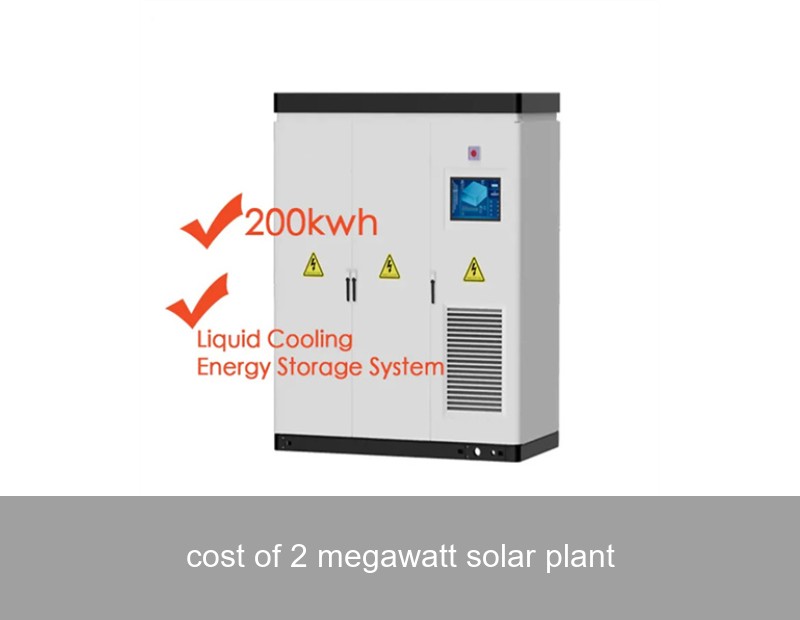
This is precisely where Highjoule's expertise becomes critical. As a global provider since 2005, we don't just see storage as an add-on; it's the intelligent core of a modern energy asset. Our H-Series Commercial Battery Systems are engineered to seamlessly integrate with solar plants of this scale. With industry-leading cycle life, advanced thermal management, and our proprietary EnergyOS™ platform, we ensure the storage asset maximizes the solar plant's financial return. You're not just building a solar plant; you're building a smart, dispatchable power station.

Image Source: Unsplash - Integrating battery storage, like Highjoule's H-Series, is key to maximizing solar ROI.
A Real-World Case: The 2 MW Plant in Nevada
Let's ground this in data. Consider a 2 MW ground-mount solar plant built in 2023 for a manufacturing facility in Nevada, USA. The turnkey installation cost came in at $1.42 million ($0.71/W). It's projected to produce approximately 3.8 million kWh annually.
The savvy developers didn't stop there. They allocated an additional portion of their capital budget to integrate a 1 MWh Highjoule H-300 battery system. This allowed the facility to:
- Reduce demand charges from the utility by over 30% by shaving peak loads.
- Secure backup power for critical processes, avoiding costly downtime.
- Participate in a utility demand response program, adding an annual revenue stream of roughly $15,000.
While the storage added to the upfront cost of the 2 megawatt solar plant, the internal rate of return (IRR) for the combined solar-plus-storage project was calculated to be 2.5 percentage points higher than solar alone, shortening the payback period. This case underscores a key insight: the levelized cost of energy (LCOE) is an important metric, but the value of energy—when and how you use or sell it—is now driven by flexibility. You can explore more on LCOE metrics from authorities like NREL.
| Component | Solar-Only Plant | Solar + Highjoule Storage | Impact |
|---|---|---|---|
| Typical Installed Cost (Range) | $1.1M - $1.8M | $1.4M - $2.2M (est.) | Higher upfront capital |
| Key Revenue/Value Streams | • Grid energy sales • ITC/PTC benefit |
• Grid energy sales • ITC/PTC benefit (for storage*) • Peak shaving • Demand response • Backup power value |
Diversified & enhanced |
| Grid Independence | Low | High | Increased resilience |
| Future Policy Risk | Higher (reliant on net metering) | Lower (self-consumption optimized) | Reduced exposure |
*Subject to current local regulations and investment tax credit (ITC) qualifications. Always consult a tax professional.
Beyond the Price Tag: The Highjoule Advantage
When evaluating the cost of a 2 megawatt solar plant, the choice of technology partners is decisive. Highjoule moves beyond being a simple component supplier. We offer an integrated value proposition:
- End-to-End System Design: Our experts work with your EPC to right-size the storage solution, ensuring optimal DC/AC coupling and control strategy.
- EnergyOS™ Intelligence: This platform doesn't just monitor; it autonomously optimizes dispatch based on weather forecasts, electricity tariffs, and facility load patterns, squeezing every cent of value from your assets.
- Global Support & Warranty: With a presence in key European and North American markets, we provide localized service and robust performance guarantees, protecting your investment for the long haul.
Choosing Highjoule means investing in a system designed for the next 20 years of energy market evolution, not just today's specs.
The Future of Solar Plant Costs
While photovoltaic module prices have famously fallen, future cost reductions will increasingly come from balance-of-system innovation, streamlined permitting (as seen with SolarAPP+ initiatives), and, most significantly, the deepening value stack enabled by smart storage. The question is shifting from "What does it cost?" to "What is it worth?"
Given that the economics of a 2 MW project are so intimately tied to local incentives, grid policies, and your specific load profile, what is the first data point you need to gather from your site or facility to start modeling a truly accurate—and profitable—solar-plus-storage project?
 Inquiry
 Online Chat