


Understanding the True Cost of a 2 MW Solar Power Plant
So, you're considering a 2 MW solar power plant. It's a significant and commendable step towards energy independence and sustainability. But when you start researching the cost of a 2 MW solar power plant, you quickly find a wide range of figures. Is it $1.5 million, $2.5 million, or more? The truth is, the sticker price of the solar panels is just the beginning. To make a truly informed decision, you need to understand the total cost ecosystem, which includes technology choices, long-term performance, and a critical, often underestimated component: the energy storage system. Let's demystify the real investment behind a 2 MW solar array.
Table of Contents
Breaking Down the Costs: More Than Just Panels
The total installed cost of a commercial-scale 2 MW solar power plant is typically quoted in dollars per watt ($/W). According to the National Renewable Energy Laboratory (NREL), the average benchmark for such systems in the U.S. can range from $1.60 to $2.10 per watt for the solar installation itself. This translates to a rough capital expenditure (CAPEX) of $3.2 million to $4.2 million. But what does this encompass?
- Photovoltaic (PV) Modules: The solar panels, typically 30-40% of the cost.
- Inverters & Balance of System (BOS): Components like inverters, mounting structures, cabling, and combiner boxes.
- Installation & Labor: Engineering, procurement, and construction (EPC) costs.
- Soft Costs: Permits, interconnection fees, engineering studies, and financing.
However, this traditional view misses a pivotal factor. A solar plant without storage is like a supercar with no steering wheel—you generate immense power, but you have limited control over when and how to use it. You're at the mercy of the sun and grid constraints, often forced to sell excess power at low rates or face curtailment. This is where the Levelized Cost of Energy (LCOE), a more holistic metric, becomes crucial, and where adding storage intelligently can dramatically improve it.
The Storage Game-Changer: Why Your Solar Plant Needs a Brain
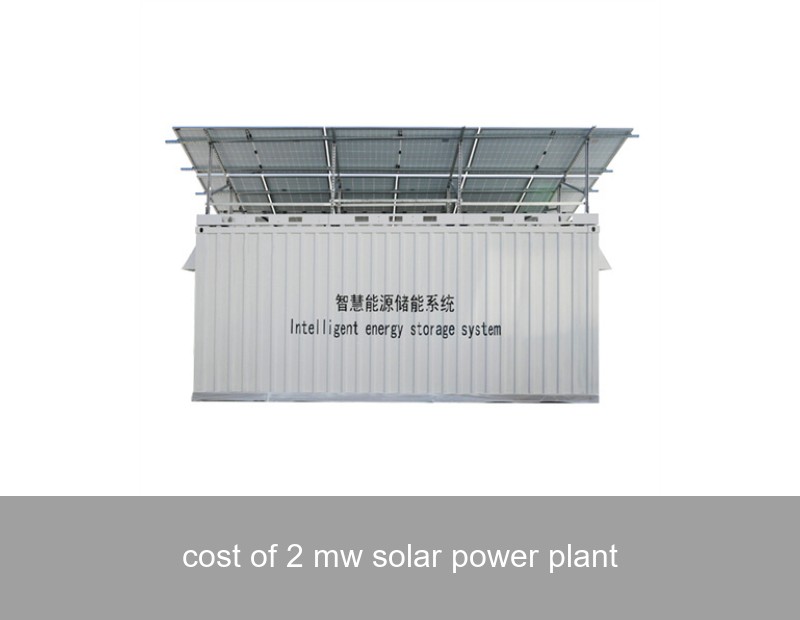
The modern cost of a 2 MW solar power plant analysis is incomplete without储能. Think of storage not just as a battery, but as the brain and buffer of your energy system. It transforms your solar asset from a passive generator into a flexible, revenue-optimizing power source.
| Challenge Without Storage | Solution With Intelligent Storage |
|---|---|
| Excess solar energy at noon is sold cheaply or wasted. | Store midday surplus and discharge during expensive evening peak rates (arbitrage). |
| No power generation at night or on cloudy days. | Provide reliable, clean power 24/7, increasing self-consumption. |
| Vulnerability to grid outages. | Ensure critical backup power and enhance grid resilience. |
| Limited participation in grid services markets. | Enable frequency regulation and capacity services for additional revenue streams. |
Adding storage increases the upfront CAPEX but can significantly boost the internal rate of return (IRR) over the plant's 25+ year lifespan. The key is choosing a storage system designed for durability, safety, and seamless integration.

Credit: Photo by American Public Power Association on Unsplash. Modern solar plants increasingly integrate storage for optimal performance.
The Highjoule Solution: Intelligent Storage for Maximized ROI
This is where Highjoule's expertise becomes critical. Since 2005, we've moved beyond simply supplying batteries. We provide advanced, AI-driven Battery Energy Storage Systems (BESS) that act as the intelligent core of your 2 MW solar plant. Our systems are engineered to maximize the financial return and operational stability of your renewable investment.
For a 2 MW solar installation, we would typically recommend a modular BESS solution, such as our H-Joule Cube series, scalable from 500 kW to multi-MW applications. Here’s how we add value:
- Advanced Energy Management System (EMS): The true brain of the operation. Our EMS uses predictive algorithms to forecast solar generation and load patterns, automatically deciding the most profitable times to charge or discharge.
- Lithium Iron Phosphate (LFP) Chemistry: We prioritize safety and longevity. Our LFP batteries offer a longer cycle life, superior thermal stability, and are inherently non-combustible compared to other chemistries, reducing long-term risk.
- Seamless DC-Coupling Option: For new solar+storage projects, our DC-coupled solutions can be more efficient and cost-effective by reducing inverter costs and conversion losses.
- Global Support & Monitoring: With operations in Europe and North America, we offer 24/7 remote monitoring and local service to ensure your plant performs optimally for decades.
Integrating a Highjoule BESS might add to your initial cost of a 2 MW solar power plant, but it fundamentally changes the economics, turning a cost center into a smarter, more profitable asset.
A Real-World Case Study: From Theory to Practice
Let's look at a concrete example. A medium-sized manufacturing facility in Bavaria, Germany, installed a 2.1 MWp rooftop solar system in 2021. Initially, they faced high grid demand charges and could not use about 30% of their solar generation during weekends.
- Project: 2.1 MWp Solar PV + 1.2 MWh Highjoule H-Joule Cube BESS.
- Goal: Increase self-consumption, shave peak demand charges, and provide backup power for critical processes.
- Outcome (Data from first year of operation):
- Self-consumption of solar energy increased from 68% to 92%.
- Peak demand charges were reduced by an average of 40%.
- The additional revenue from arbitrage and savings, combined with available EU renewable incentives, projected a payback period for the storage addition of under 7 years.
The plant manager noted, "The Highjoule system wasn't just an add-on; it became the tool that unlocked the full potential of our solar investment. We now treat energy as a strategic resource."
Future-Proofing Your Investment
The energy landscape is shifting rapidly. Grids are becoming more congested, and electricity tariffs are increasingly dynamic. When evaluating the cost of a 2 MW solar power plant, you must ask: Is this system designed for the grid of today or the grid of 2030?
A "solar-only" plant faces the risk of declining value as penetration increases. A "solar-plus-intelligent-storage" plant, however, is an adaptive asset. It can participate in future virtual power plants (VPPs), provide critical grid services, and protect your operations from volatile energy prices. According to a Lazard study, the LCOE for solar-plus-storage is already competitive with conventional peaking plants in many regions, and the trend is accelerating.

Credit: Photo by Science in HD on Unsplash. Intelligent control systems are key to managing complex solar-storage assets.
Highjoule's systems are built with this future in mind. Our software-upgradable platform ensures your plant can adapt to new market rules and revenue opportunities without needing a complete hardware overhaul.
Ready to Calculate Your Plant's True Potential?
The question is no longer simply "What is the cost of a 2 MW solar power plant?" The more pertinent question is: "What is the optimal configuration of solar and storage to meet my specific financial and operational goals for the next 25 years?" Every site is unique, with different load profiles, tariff structures, and incentives.
We invite you to move beyond generic cost estimates. What specific energy challenge are you aiming to solve with your solar project, and how can intelligent storage transform that challenge into an opportunity?
 Inquiry
 Online Chat