


Best Monocrystalline Solar Panel Brands: Your Guide to Premium Efficiency
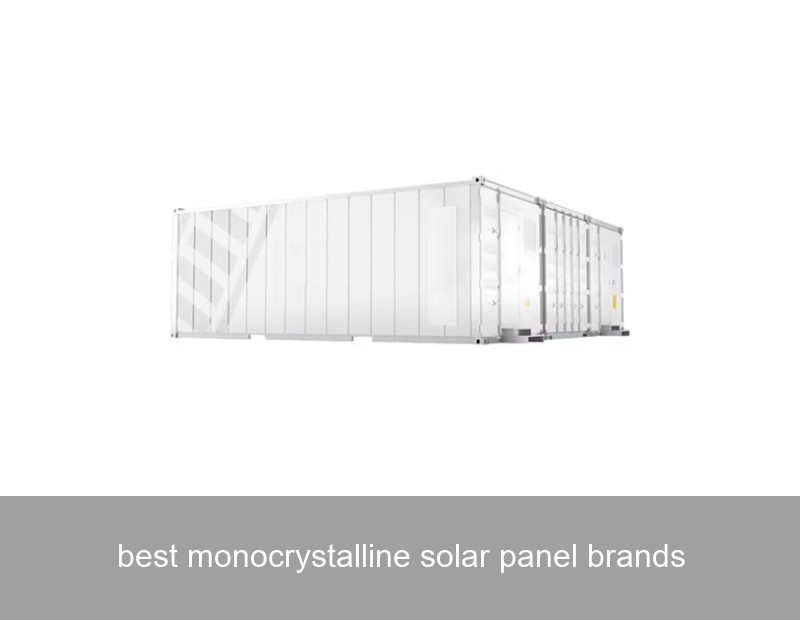
Choosing among the best monocrystalline solar panel brands is a critical decision for any homeowner or business investing in solar energy. It's the difference between simply having solar panels and owning a high-performance power system that delivers reliable, cost-saving energy for decades. In this guide, we'll cut through the marketing noise. We'll explore what truly defines a top brand, backed by data and real-world performance, and explain how the right panel is just the first step in a complete, intelligent energy solution.
Table of Contents
- The Efficiency Imperative: Why Monocrystalline Leads
- Beyond the Label: Key Criteria for Evaluating Top Brands
- From Spec Sheet to Rooftop: A Case Study in Real-World Performance
- The Bigger Picture: Why Your Entire Energy System Matters More
- The Highjoule Advantage: Intelligent Storage Meets Premium Generation
- What Does Your Ideal Energy Independence Look Like?
The Efficiency Imperative: Why Monocrystalline Leads
Let's start with a simple fact: not all solar panels are created equal. The market is dominated by two main silicon technologies: polycrystalline and monocrystalline. While polycrystalline panels have their place, monocrystalline panels are universally recognized as the premium, high-efficiency choice. Why? Their cells are made from a single, pure crystal of silicon. This uniform structure allows electrons to flow more freely, converting a greater percentage of sunlight into electricity.
Think of it like this: a polycrystalline cell is a bustling city with winding alleys (grain boundaries), while a monocrystalline cell is a sleek, straight highway. Sunlight, our "traffic," moves faster and with less resistance on the highway. This translates to tangible benefits for you:
- Higher Efficiency Rates: Monocrystalline panels typically offer efficiencies of 20% and above, with leading brands pushing past 22%. Polycrystalline panels usually range from 15-17%.
- More Power in Less Space: Higher efficiency means you need fewer panels to meet your energy needs. This is crucial for residential roofs with limited space.
- Better Performance in Low-Light: They generally perform better in cloudy weather or indirect sunlight, capturing more energy throughout the day.
- Longevity and Degradation: Top monocrystalline brands often come with 25+ year performance warranties, guaranteeing 90%+ output after 10 years and 80%+ after 25 years.
So, when we talk about the "best" brands, we're inherently discussing those that perfect and push the boundaries of monocrystalline technology.
Beyond the Label: Key Criteria for Evaluating Top Brands
With a crowded market, how do you distinguish a genuinely top-tier brand from a mediocre one? Look beyond the sticker price and focus on these pillars of quality:
| Criterion | What to Look For | Why It Matters |
|---|---|---|
| Product Warranty | 15-25 years on materials and workmanship. | Indicates the manufacturer's confidence in the physical durability of their product. |
| Performance Warranty | 25+ years, guaranteeing >90% output at Year 10 and >80% at Year 25. | The most critical spec. It ensures your long-term energy yield and return on investment. |
| Temperature Coefficient | A percentage per °C (e.g., -0.30%/°C to -0.35%/°C). | Measures power loss as panels heat up. A lower (closer to zero) negative number is better, especially in hot climates. |
| Manufacturer's Financial Health | Bankability ratings from BloombergNEF or PV ModuleTech. | Ensures the company will be around in 25 years to honor your warranty. It's a risk assessment. |
| Independent Testing & Certification | UL (USA), IEC (EU), and rigorous third-party testing results. | Validates the safety, performance, and durability claims made by the manufacturer. |
Brands like REC, SunPower (Maxeon), Panasonic, and LG (though exiting the market) have historically set these benchmarks. Today, several manufacturers produce excellent panels that meet these criteria. The real question becomes: what happens to all that premium electricity once it's generated?
From Spec Sheet to Rooftop: A Case Study in Real-World Performance
Specifications are one thing; real-world energy yield is another. Let's consider a project in Southern California, a market with high electricity rates and abundant sunshine, making premium panels a smart investment.
Project: A medium-sized commercial warehouse with a 100 kW rooftop system.
Goal: Maximize on-site consumption of solar energy to offset high demand charges and time-of-use rates.
Challenge: The facility's energy use peaked in the late afternoon and evening, after solar production naturally declined. This created a mismatch.
Solution & Data: The installer chose high-efficiency monocrystalline panels (22%+ efficiency) from a top-tier brand. However, the true genius was pairing them with an integrated battery storage system. The system was designed to:
- Use solar production to directly power daytime operations.
- Charge the battery system with excess solar generation.
- Dispatch stored energy during the peak rate period (4 PM - 9 PM), virtually eliminating grid draw during those expensive hours.
Result: The high-efficiency panels ensured maximum harvest from the limited roof space. But it was the storage that unlocked the financial value. The system achieved a 92% self-consumption rate of solar energy and reduced the facility's monthly energy bill by over 85%. The premium panels provided the high-quality "fuel," but the battery was the "engine" that delivered true energy independence and savings. (NREL Study on Solar+Storage Value).

Image: A commercial solar installation. Source: Unsplash (Credit: American Public Power Association)
The Bigger Picture: Why Your Entire Energy System Matters More
This case study reveals a fundamental truth: the panel brand, while important, is a component of a larger ecosystem. An efficient panel loses much of its value if the energy it produces is wasted or not optimally used. The modern energy system is built on three interconnected pillars:
- Generation: Your high-efficiency monocrystalline panels.
- Storage: A battery system to time-shift solar energy for use when you need it most.
- Management: Intelligent software that orchestrates generation, storage, and grid interaction to maximize economics and resilience.
Neglecting storage and management is like buying a Formula 1 car but only driving it in city traffic. You're not utilizing its full potential. This holistic view is where companies like Highjoule redefine the game. We don't just sell components; we provide integrated, intelligent energy solutions.
The Highjoule Advantage: Intelligent Storage Meets Premium Generation
At Highjoule, with our deep expertise since 2005, we understand that the best solar panel brands are the starting point, not the finish line. Our role is to ensure every kilowatt-hour they produce is leveraged for maximum benefit. We specialize in advanced Battery Energy Storage Systems (BESS) that seamlessly integrate with any top-tier solar array.
Our HPS Series for commercial and industrial applications and HRS Series for residential use are built with the same philosophy of quality and longevity you seek in premium panels. They feature:
- High-Cycle Life Lithium-Ion Chemistry: Engineered for daily charging and discharging over decades, matching your solar system's lifespan.
- Advanced Energy Management System (EMS): The true "brain" of the operation. Our software intelligently decides when to store solar energy, power your home/business, or sell back to the grid based on weather forecasts, usage patterns, and real-time electricity rates.
- Scalable Design: Systems can be expanded over time as your energy needs grow.
- Grid Services Ready: For larger installations, our systems can provide grid stability, opening potential revenue streams.
By pairing your investment in the best monocrystalline solar panel brands with a Highjoule storage system, you transform from a passive producer into an active manager of your energy ecosystem. You're not just saving money; you're building resilience against outages and contributing to a more stable, sustainable grid. (U.S. Department of Energy on Storage Benefits).

Image: A modern home battery storage unit. Source: Unsplash (Credit: Laurentiu Morariu)
What Does Your Ideal Energy Independence Look Like?
The journey to solar is an exciting one. You're right to research the best monocrystalline solar panel brands—it shows you value quality and long-term performance. But I invite you to think one step further. Imagine a day where a passing cloud or sunset doesn't dictate your energy costs. Imagine powering your home through a grid outage with silent, automatic backup. Imagine having a personal energy asset that works 24/7 to optimize your financial and environmental return.
That's the promise of a complete solar-plus-storage solution. As you consult with installers and get quotes featuring those top panel names, ask them this crucial question: "How will your system design ensure I use the *maximum amount* of the solar energy I produce, day and night, and not just when the sun is shining?"
The answer will guide you to a truly premium energy future.
 Inquiry
 Online Chat