


Understanding the True Cost of Solar Power Per KW: A Comprehensive Guide for 2024
If you're considering solar energy, the first question is likely, "What's the actual cost of solar power per kW?" It seems straightforward, but the answer is more nuanced than a simple price tag. The journey of solar from a costly alternative to a mainstream power source is one of the most exciting stories in modern energy. In this guide, we'll demystify the costs, explore the factors at play, and show you how to maximize your investment for a sustainable future.
Table of Contents
Breaking Down the "Per kW" Cost: More Than Just Panels
When we talk about the cost of solar power per kW (kilowatt), we're typically referring to the installed cost per kilowatt of peak capacity (kWp). This is your upfront capital expenditure. In the U.S. and Europe, as of 2024, this figure can range from $2,500 to $3,500 per kWp for residential systems, and often $1,000 to $1,800 per kWp for larger commercial or utility-scale projects due to economies of scale. But what does this price include?
- Solar Panels (Modules): Typically 20-30% of the total cost. Efficiency and brand are key drivers here.
- Inverters: The "brains" that convert DC to AC power, accounting for 10-15% of costs.
- Balance of System (BOS): This includes mounting, wiring, conduits, and other hardware.
- Soft Costs: Often the most variable part! This encompasses permitting, inspection, customer acquisition, and installer labor. In some regions, soft costs can be as high as 50% of the total price.
So, a quoted "cost per kW" is a package deal. Choosing a provider that optimizes every component, especially the soft costs through streamlined processes, is crucial for value.
The Global Trend: Why Costs Have Plummeted
Let's look at the phenomenon. A decade ago, solar was a premium investment. Today, it's often the cheapest source of new electricity generation in many parts of the world. What happened?
The Data Tells the Story: According to the International Renewable Energy Agency (IRENA), the global weighted average levelized cost of electricity (LCOE) from utility-scale solar photovoltaics fell by a staggering 89% between 2010 and 2022. That's not just incremental improvement; it's a revolution driven by:
- Manufacturing Scale: Massive growth in production, particularly in Asia, drove panel prices down.
- Technological Innovation: Higher panel efficiency means you generate more power from the same roof space.
- Market Competition and Experience: As installers gained experience, installation processes became faster and more efficient.

Image Source: Unsplash - Photo of a utility-scale solar farm, a key driver behind falling per-kW costs.
A Real-World Case: Commercial Solar in Germany
Let's ground this data with a concrete example. Consider a mid-sized manufacturing company in Bavaria, Germany. They investigated a 500 kWp rooftop solar installation in 2023 to offset high grid electricity prices and meet corporate sustainability goals.
| Cost Component | Euro Range (per kWp) | Notes |
|---|---|---|
| Turnkey Installation Cost | €850 - €1,100 | Included high-efficiency panels & inverters |
| Estimated Annual Generation | 500,000 - 550,000 kWh | Depends on Bavarian insolation |
| Simple Payback Period | 6-8 years | Factoring in German electricity prices & self-consumption |
| Internal Rate of Return (IRR) | >12% | A highly attractive financial return |
The key insight? The levelized cost of energy (LCOE) for their self-generated solar power came in at under €0.08/kWh. Compared to the volatile grid price, which has frequently been above €0.25/kWh in recent years, the savings are dramatic. This case shows that the true metric isn't just the upfront cost per kW, but the cost per kWh generated over the system's 25+ year lifespan.
The True Cost: Looking Beyond Installation
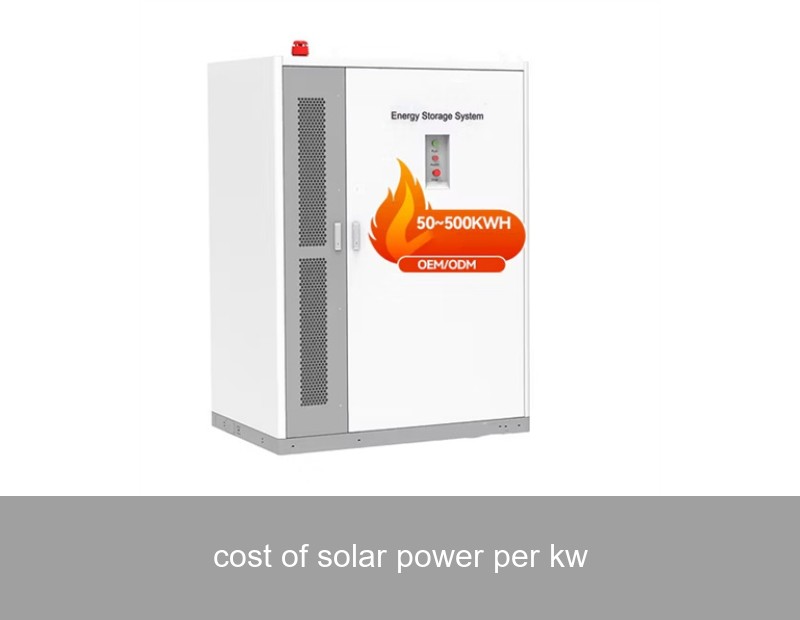
Here's where many calculations fall short. The real economics of solar are about the total system lifecycle. What happens when the sun isn't shining? Without a way to store excess daytime energy, you're still reliant on the grid at night, missing out on the full potential of your investment.
This is the critical juncture where adding energy storage transforms the equation. A solar-plus-storage system allows you to:
- Maximize self-consumption (using your own solar power day and night).
- Provide backup power during grid outages.
- Participate in grid services (in some markets) for additional revenue.
While this increases the initial cost per kW of the overall system, it drastically reduces your long-term cost per usable kWh and enhances energy independence.
Highjoule's Integrated Approach: Maximizing Solar Value
At Highjoule, we've been at the forefront of this evolution since 2005. We understand that the lowest upfront cost per kW doesn't always lead to the lowest cost of ownership. Our philosophy is to provide intelligent, integrated systems that deliver the highest long-term value.
For our commercial and industrial clients across Europe and North America, we don't just sell solar panels. We design Highjoule Solar+ solutions that seamlessly combine high-efficiency photovoltaic arrays with our advanced HES (Highjoule Energy Storage) systems. Our smart energy management software, JouleMind AI, acts as the conductor, deciding the optimal time to store solar energy, power your operations, or even sell back to the grid based on real-time pricing.
Image Source: Unsplash - A modern home with integrated solar and battery storage, representing the future of residential energy.
For a warehouse in Ohio or a dairy farm in the Netherlands, this integrated approach can push the effective self-consumption rate of solar power from 30-40% to over 80%. Suddenly, that cost per kW of installed solar is working much harder for you, delivering a faster payback and a greater reduction in both costs and carbon footprint.
The Future Outlook for Solar Economics
The trend is clear: solar hardware costs may stabilize, but continued innovation in software, storage, and system integration will keep driving the value of solar power higher. The rise of virtual power plants (VPPs) and AI-driven energy optimization, areas where Highjoule is deeply invested, will further redefine the return on investment for solar assets.
So, when you evaluate the "cost of solar power per kW," are you looking at it as a simple commodity purchase, or as the foundation of a intelligent, resilient, and cost-effective energy ecosystem for the next 25 years?
What specific energy challenge—be it peak shaving, backup power needs, or a net-zero target—could a truly integrated solar and storage solution solve for your business or home?
 Inquiry
 Online Chat