


How Much Electricity Does a Solar Panel Generate? Your Complete Guide
If you're considering solar panels for your home or business, the first question that likely comes to mind is: "How much electricity does a solar panel actually generate?" It's a fundamental question, and the answer isn't a single number. It depends on a fascinating interplay of technology, environment, and system design. As energy costs remain volatile and the push for sustainability grows, understanding solar output is key to making an informed investment. Let's demystify the factors at play and explore how modern solutions, like intelligent energy storage, maximize every kilowatt-hour your panels produce.
Table of Contents
Key Factors That Determine Solar Panel Output
Think of a solar panel not as a constant power source, but as a sophisticated energy harvester. Its yield is influenced by several critical elements:
1. Panel Specifications: The Nameplate Capacity
Each panel has a "nameplate" rating under Standard Test Conditions (STC), measured in watts (W). Today, most residential panels range from 350W to 450W. A 400W panel, in ideal lab conditions (full sun at a specific angle and temperature), would produce 400 watts of power. But the real world is rarely ideal.
2. Sunlight Exposure: It's About More Than Just Sunshine
This is measured in "peak sun hours." One peak sun hour equals one hour of sunlight at an intensity of 1,000 watts per square meter. Your location is paramount. The European Commission's PVGIS tool shows that southern Spain may average 5 peak sun hours daily, while northern Germany might see 2.5-3. This geographic variance directly halves or doubles potential output.

Image: Peak sun hours are critical for solar yield. Source: Unsplash
3. Orientation and Tilt: The Angle of Attack
In the Northern Hemisphere, south-facing roofs capture the most energy. The optimal tilt angle roughly equals your latitude. A system with poor orientation or a flat roof setup can see significant production losses—often 15-25% compared to an optimally angled system.
4. Temperature and Shading: The Silent Thieves
Contrary to intuition, solar panels become less efficient as they get hotter. A panel rated at 20°C might lose 0.3-0.4% of its output per degree Celsius rise. Partial shading from a chimney or tree can disproportionately reduce output due to panel wiring, making module-level power electronics a valuable upgrade.
From Theory to Reality: Calculating Real-World Generation
Let's put this into practice with a simple formula for a residential setup:
Daily Energy (Wh) = Panel Wattage (W) × Peak Sun Hours × System Efficiency (usually 0.75-0.85)
Consider a home in California (5 peak sun hours) with ten 400W panels and an 80% system efficiency factor (accounting for inverter losses, wiring, dust, etc.).
| Component | Calculation | Result |
|---|---|---|
| Per Panel, Per Day | 400W × 5 hours × 0.80 | 1,600 Wh or 1.6 kWh |
| Total System, Per Day | 1.6 kWh × 10 panels | 16 kWh |
| Total System, Per Year | 16 kWh × 365 days | ~5,840 kWh |
For context, the average U.S. household consumes about 10,600 kWh annually (U.S. Energy Information Administration). This example system could cover a substantial portion of that demand.
Beyond the Panel: Why System Design is Everything
Maximizing the answer to "cuanta electricidad genera un panel solar" isn't just about picking the highest-rated panel. The balance of system (BOS) is crucial. The inverter, which converts DC from panels to usable AC, is the heart of the system. Microinverters or power optimizers can mitigate shading issues and provide panel-level monitoring. But the true game-changer in modern solar design is energy storage.
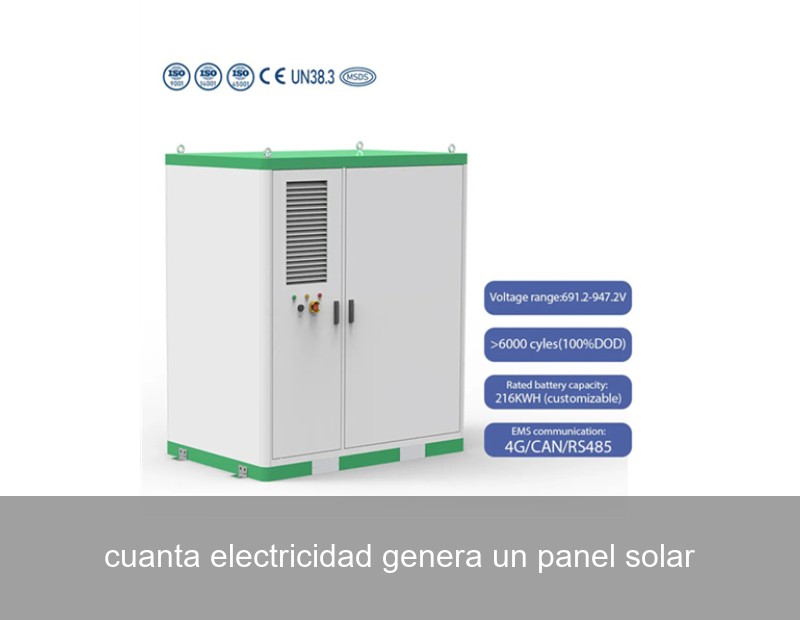
Without storage, excess solar energy generated midday is often exported to the grid at low rates, only to be repurchased in the evening at higher prices. This is where companies like Highjoule redefine solar value. Our integrated Highjoule HiveStack™ battery energy storage systems (BESS) are engineered to capture that surplus solar generation. By pairing intelligent storage with your solar array, you can increase your self-consumption of solar power from 30-40% to 70% or more, fundamentally changing the economics of your installation. For commercial and industrial applications, our GridSynergy™ platform allows for advanced energy management, peak shaving, and backup power, ensuring not a single self-generated kilowatt-hour goes to waste.
Case Study: Maximizing Solar ROI for a European Agri-Business
Let's look at a real-world application. A medium-sized winery in Tuscany, Italy, installed a 100 kW solar PV system on its warehouse roofs. The initial data showed strong generation—averaging 145,000 kWh annually. However, due to the winery's operational schedule (heavy energy use for cooling and bottling in the morning and late afternoon), they were only directly consuming 35% of their solar production, exporting the rest.
The Challenge: High grid feed-in tariffs had ended, making exported solar energy far less valuable than self-consumed energy.
The Highjoule Solution: The winery integrated a Highjoule HiveStack 50 kWh battery system with advanced forecasting software. The system was programmed to store excess midday solar energy and discharge it during evening operational peaks and early mornings.
- Self-Consumption Rate: Increased from 35% to 82%.
- Grid Energy Cost Reduction: Achieved a 68% reduction in monthly demand charges and peak-time energy purchases.
- Payback Period: The added storage component improved the overall system ROI, shortening the payback period by an estimated 2 years.
This case exemplifies that the true question isn't just about panel generation, but about usable, cost-effective generation. The intelligent storage transformed their solar array from a partial solution into a comprehensive, resilient, and highly economical power asset.

Image: Agri-businesses like wineries benefit hugely from solar plus storage. Source: Unsplash
The Future of Solar: Integration and Intelligence
The next frontier for solar isn't merely incremental efficiency gains in panels. It's in holistic system intelligence. Imagine a system that doesn't just generate power but predicts your home's energy usage, weather patterns, and grid price fluctuations to optimize every electron. This is the principle behind Highjoule's Energy Operating System (EOS), which manages generation, storage, and consumption across residential, commercial, and microgrid applications.
For homeowners, this means seamless backup power and maximized savings. For businesses, it translates to energy cost predictability and participation in grid services. For communities, it enables resilient microgrids that can operate independently. The panel's raw generation is the starting point; the intelligence behind it unlocks the full potential.
So, as you evaluate solar for your property, what will be your strategy to ensure you capture and utilize every possible kilowatt-hour your roof can generate?
 Inquiry
 Online Chat