


Navigating the Different Types of Solar Panels for Home: A Homeowner's Guide
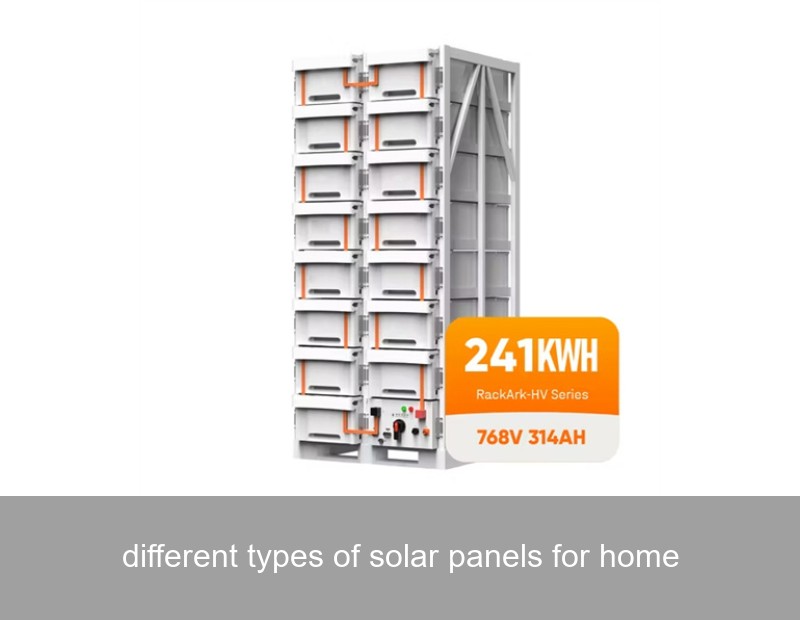
So, you've decided to harness the sun's power for your home. Congratulations! It's a smart move towards energy independence and sustainability. But as you start researching, you quickly encounter a fundamental question: what are the different types of solar panels for home use, and which one is right for me? The choice isn't just about blue or black rectangles on your roof; it's about efficiency, aesthetics, budget, and long-term energy strategy. Let's demystify the main technologies—monocrystalline, polycrystalline, and thin-film—and see how pairing them with the right storage system, like those from Highjoule, unlocks their full potential.
Monocrystalline Solar Panels: The Efficiency Leader
Often called "mono" panels, these are the premium choice in the residential solar market. You can recognize them by their uniform dark black color and rounded cell edges.
- How They're Made: Grown from a single, pure silicon crystal, a complex process that results in a highly ordered molecular structure.
- Key Advantage – High Efficiency: This pure structure allows electrons to flow more freely. Monocrystalline panels typically convert 20-23% of sunlight into electricity, with premium models reaching even higher. This means you need less roof space to meet your energy needs.
- Performance & Aesthetics: They perform slightly better in low-light conditions and high temperatures compared to polycrystalline. Their sleek, uniform black appearance is often preferred for modern home designs.
- The Trade-off: The manufacturing process is energy-intensive, making mono panels usually the most expensive of the silicon-based options. However, their higher power output can justify the initial cost over the system's lifetime.

Image Source: Wikimedia Commons (CC BY-SA)
Polycrystalline Solar Panels: The Established Value Proposition
Polycrystalline, or "poly" panels, have been a reliable workhorse for homes for years. They have a distinctive blue, speckled appearance due to their manufacturing.
- How They're Made: Molten silicon is poured into a square mold and cooled, forming multiple crystals. This process is simpler and less wasteful than growing a single crystal.
- Key Advantage – Cost-Effectiveness: The simpler production translates to a lower price point per panel, making solar energy more accessible. They are a robust and proven technology.
- Efficiency & Space: Their efficiency range is generally 15-18%. This means you'll need more panels (and thus more roof space) to generate the same amount of power as an equivalent monocrystalline system.
- Best For: Homeowners with ample roof space who are prioritizing a lower upfront investment while still getting a dependable, long-lasting solar array.
Thin-Film Solar Panels: The Flexible and Emerging Alternative
This category is different. Instead of rigid silicon wafers, thin-film panels are made by depositing photovoltaic material onto a substrate like glass, metal, or plastic.
- Types & Appearance: Common types include Cadmium Telluride (CdTe), Amorphous Silicon (a-Si), and Copper Indium Gallium Selenide (CIGS). They are very thin, can be flexible, and often have a uniform black or dark gray look.
- Key Advantages – Flexibility & Low-Light Performance: Their lightweight and flexible nature allows for unique applications where traditional panels can't go. They also tend to perform better than silicon in high temperatures and diffuse light (e.g., cloudy days).
- The Trade-offs: Efficiency is significantly lower (typically 10-13% for residential applications), requiring substantial space. They also degrade faster than silicon panels. While panel costs can be low, balance-of-system costs can make overall installation comparable. For most standard home rooftops, they are less common.
For a deeper dive into the science behind these technologies, the U.S. Department of Energy provides an excellent authoritative resource.
Side-by-Side: Choosing Between Different Types of Solar Panels for Home
| Feature | Monocrystalline | Polycrystalline | Thin-Film |
|---|---|---|---|
| Typical Efficiency | 20-23%+ | 15-18% | 10-13% |
| Appearance | Uniform black | Speckled blue | Thin, uniform black/gray |
| Roof Space Needed | Lowest | Moderate | Highest |
| Temperature Performance | Good | Good | Best |
| Estimated Cost (per watt) | Highest | Moderate | Varies (can be low) |
| Best For | Limited space, high output, aesthetic focus | Cost-conscious with ample space | Non-standard roofs, large commercial spaces |
Beyond the Panel: The Critical Role of Energy Storage
Here's a crucial insight many homeowners miss: the type of solar panel is only half the equation. The true power of your home solar system is unleashed when paired with intelligent energy storage. Why? Solar panels produce power only when the sun shines. Without storage, excess energy flows back to the grid (often for a low feed-in tariff), and you draw power from the grid at night at full price.
This is where a company like Highjoule transforms your solar investment. Since 2005, Highjoule has been pioneering advanced battery energy storage systems (BESS) that seamlessly integrate with any type of solar panel you choose. Our ResiCore series for homes is designed to:
- Maximize Self-Consumption: Store your excess solar energy during the day for use in the evening and overnight, drastically reducing your grid dependence.
- Provide Resilience: Keep your lights on during grid outages. While your solar panels alone shut off for safety, a Highjoule system with backup functionality can power essential circuits.
- Enable Smart Energy Management: Our intelligent energy management system learns your usage patterns and can be configured to charge from the grid during off-peak low rates, further optimizing your electricity bill.
Choosing between monocrystalline and polycrystalline matters for generation, but pairing them with a Highjoule storage system defines your actual energy independence and savings.
Case Study: A Real-World Look at Performance and Payback in Hamburg
Let's move from theory to real data. Consider the Müller family in Hamburg, Germany—a region not known for endless sunshine. In 2021, they installed a 8 kW rooftop system.
- Panel Choice: They opted for high-efficiency monocrystalline panels (22% efficiency) due to their partially shaded roof and desire to maximize limited space.
- Storage Integration: Crucially, they paired it with a Highjoule ResiCore 10 battery system (10 kWh usable capacity).
- The Data: In its first full year, the system generated 7,400 kWh. The Highjoule battery enabled a self-consumption rate of 78% (meaning they used 78% of the solar power they generated directly). Without storage, this rate would typically be around 30-40%.
- The Financial Impact: By storing cheap solar power and minimizing grid imports during high evening rates, the Müllers reduced their annual electricity bill by over 85%. The intelligent storage system also allows them to participate in a flexible tariff, buying grid power only during the cheapest 6-hour window at night if needed to top up the battery.
This case, based on aggregated and anonymized data from European installations, shows that the panel technology enables generation, but the storage system defines utilization and savings. For current benchmarks on solar costs and savings, homeowners can refer to resources like the National Renewable Energy Laboratory (NREL) reports.

Image Source: Unsplash
Making the Right Choice for Your Home
So, how do you decide? Ask yourself and your installer these key questions:
- What is my available roof space, and what is its orientation? Limited or shaded space leans towards high-efficiency monocrystalline.
- What is my primary goal? Maximum long-term savings (mono + storage), lowest upfront cost (poly), or a specific architectural need (thin-film)?
- Have I planned for storage from the start? This is non-negotiable for modern energy resilience. The inverter and battery system must be compatible and sized correctly for your chosen panels and consumption.
At Highjoule, we believe your solar journey shouldn't end at the panels. Our experts work with installers across Europe and the U.S. to design holistic systems. Whether your installer recommends premium monocrystalline or value-driven polycrystalline panels, our ResiCore storage solutions ensure no watt goes to waste. We provide the intelligence and reliability that turns a solar generator into a true 24/7 home power plant.
Ready to see how the different types of solar panels for home can be optimized for your specific situation? What's the biggest hurdle you face in making your home energy-independent—is it understanding the technology, the finances, or finding the right partner?
 Inquiry
 Online Chat