


EcoFlow 800W PowerStream: Your Gateway to Intelligent, Portable Solar Power?
Imagine you're on a weekend camping trip, miles from the grid, or perhaps you're a digital nomad working from a remote cabin. Your devices need power, and the sun is shining. This is the exact scenario portable power stations like the EcoFlow 800W PowerStream are designed for. They promise a plug-and-play solar experience, turning sunlight into usable AC power for your gadgets and small appliances. But as the demand for personal energy independence grows, a crucial question arises: is a portable unit the complete solution, or is it the first step towards a more permanent, powerful, and intelligent energy ecosystem for your home or business?
Table of Contents
- The Rise of Personal Power: More Than Just a Camping Gadget
- Beyond Portability: Understanding Capacity, Lifespan, and Grid Integration
- Case Study: From Portable to Permanent in the Swiss Alps
- The Highjoule Difference: Intelligent Storage for Demanding Lifestyles
The Rise of Personal Power: More Than Just a Camping Gadget
The market for portable power stations has exploded. Devices like the EcoFlow PowerStream offer a compelling proposition: compact, user-friendly, and capable of harnessing solar energy. For the average consumer, it demystifies solar power. You simply connect a compatible solar panel, and you have electricity. This "gateway" experience is invaluable, raising awareness about renewable energy and personal storage.
However, this phenomenon also highlights a broader trend. According to the International Energy Agency (IEA), global renewable capacity is set to grow by 2,400 gigawatts between 2023-2028. A significant portion of this is decentralized—on rooftops and in homes. The success of portable units signals a deep-seated desire for energy resilience, a desire that often starts small but quickly scales up.

Image Source: Unsplash - A typical portable solar setup in nature.
Beyond Portability: Understanding Capacity, Lifespan, and Grid Integration
While a 800W portable power station is perfect for charging laptops, drones, or running a mini-fridge, it reaches its limits when asked to power a household. This is where understanding key specifications becomes critical:
- Energy Capacity (Wh): This is your "gas tank." An 800W output tells you how much power can be delivered at once, but the Wh rating (often 768Wh for such units) tells you for how long. Running a 800W kettle would drain it in under an hour.
- Battery Chemistry & Cycle Life: Most portable stations use Lithium-ion (NCM/LFP). Cycle life—the number of complete charge-discharge cycles before significant degradation—is key. A quality portable unit may offer 800+ cycles to 80% capacity. For daily home use, you need thousands of cycles.
- Grid Integration & Intelligence: Can the system tie into your home's main electrical panel? Can it automatically switch during an outage, prioritize solar self-consumption, or interact with time-of-use electricity rates? Portable units are typically off-grid islands; a full home system is an intelligent grid partner.
The transition from a portable device to a whole-home solution isn't just about buying a bigger battery. It's about integrating a robust, long-lasting, and smart system into the very infrastructure of your property.
Case Study: From Portable to Permanent in the Swiss Alps
Consider the real-world example of the Müller family chalet in the Swiss Alps. Initially, they used a high-end portable power station for their tool shed and weekend trips. However, after experiencing increased grid instability during winter storms and wanting to reduce their diesel generator use, they sought a permanent solution. Their needs were clear:
| Challenge | Portable Unit Limitation | Required Solution |
|---|---|---|
| Power entire chalet during 12+ hour outages | Insufficient capacity & output | 10+ kWh storage, 5kW+ continuous output |
| Seamless automatic backup | Manual connection required | Integrated automatic transfer switch (ATS) |
| Maximize ROI from existing rooftop PV | No grid or high-power PV input | AC/DC coupling with high-voltage PV strings |
| Withstand freezing alpine temperatures | Limited operating temperature range | Industrial-grade battery with thermal management |
Their journey mirrors that of many homeowners: a portable device revealed the potential and limitations, leading them to invest in a sophisticated, stationary storage system.
The Highjoule Difference: Intelligent Storage for Demanding Lifestyles
This is where Highjoule's expertise, honed since 2005, becomes essential. We don't just sell batteries; we provide intelligent energy ecosystems. For homeowners and businesses whose energy needs have outgrown the portable stage, Highjoule offers the next logical step.
Our Residential Energy Hub (REH) Series is designed for this transition. Unlike a standalone portable unit, the REH Series is a modular, wall-mounted system that integrates directly with your home's electrical system and solar array. Think of it as the central brain and powerhouse for your home's energy.
- Scalable Capacity: Start from a base of 10 kWh and expand modularly to over 30 kWh, far beyond any portable device.
- High-Power Output: Deliver 5kW to 10kW of continuous power, enough to run critical loads—refrigerators, heating systems, medical equipment—simultaneously during an outage.
- Advanced Lithium Iron Phosphate (LFP) Batteries: With a lifespan of over 6,000 cycles, our batteries are built for daily, deep cycling over decades, not just occasional use.
- Smart Energy Management: Our AI-driven software optimizes energy flow. It maximizes self-consumption of your solar energy, can be programmed for time-based control to save on utility bills, and provides remote monitoring and control via a smartphone app.

Image Source: Unsplash - A modern home with integrated solar and battery storage.
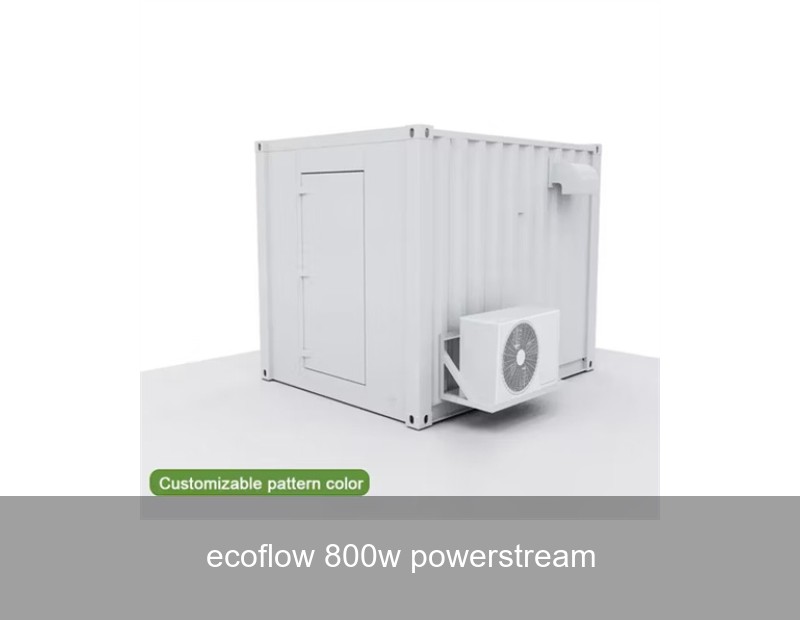
For commercial and microgrid applications, our Industrial Containerized Storage Solutions take this principle to a utility scale, providing stability and renewable integration for factories, farms, and remote communities.
Making the Right Choice for Your Energy Needs
So, where does the EcoFlow 800W PowerStream fit in? It's an excellent tool for mobility, emergencies, and low-power applications. It's the perfect companion for the adventurous spirit or as a supplemental backup for specific devices. It answers the question: "How can I get clean power where there is no grid?"
But if your question has evolved to: "How can I make my entire home or business resilient, slash my electricity bills, and contribute to a cleaner grid?" then your solution needs to evolve too. The journey from a portable power station to a whole-property energy management system is a journey from convenience to true energy independence.
Is your portable power station a sign that you're ready for a more powerful, permanent, and intelligent energy solution for your home?
 Inquiry
 Online Chat