


Energy Gearbox: How Much Does This Critical Component Cost for Your Storage System?
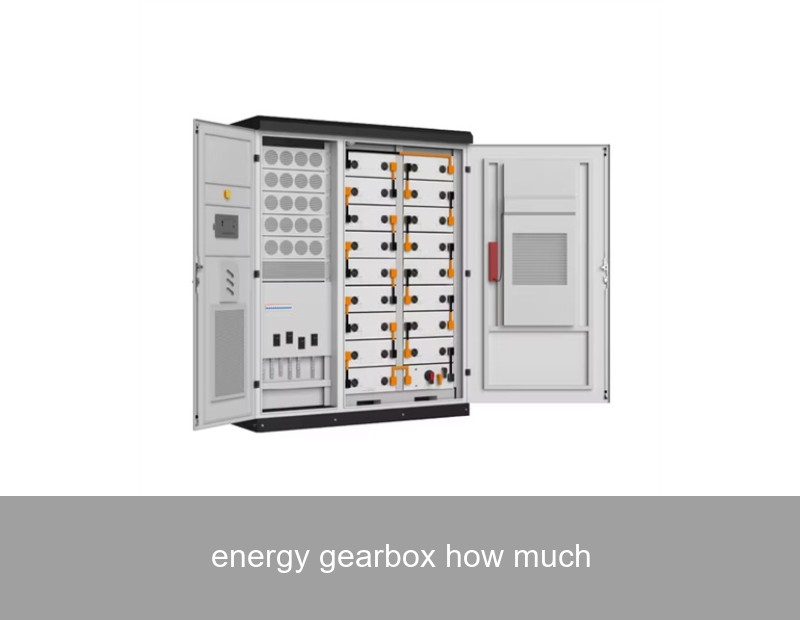
You're investing in a solar-plus-storage system to gain energy independence. You've researched batteries, inverters, and panels. But then you hear about another crucial component: the energy gearbox. Suddenly, a key question arises: "Energy gearbox, how much does it add to the project cost?" This isn't about a physical gear; it's the sophisticated power conversion and management system that acts as the brain and brawn of modern energy storage. Let's demystify its cost and value.
Table of Contents
What Exactly is an "Energy Gearbox"?
Think of your energy storage system like an electric vehicle. The battery cells are the fuel tank, but the vehicle's performance, range, and safety depend on the powertrain—the motor, gearbox, and control unit. In energy storage, the "energy gearbox" is this powertrain. It primarily refers to the Bi-Directional Inverter and the advanced Energy Management System (EMS) that governs it.
This subsystem doesn't just convert DC from batteries to AC for your home or grid. It intelligently decides when to charge, when to discharge, at what rate, and how to maintain battery health. It's the component that transforms a passive battery bank into a dynamic, revenue-generating, and resilient asset. So, when you ask "how much?", you're really pricing the intelligence of your entire storage solution.
Key Factors That Determine "How Much"
The cost of this critical subsystem isn't a single line item. It's woven into the overall storage system price, but its sophistication directly influences the total. Here are the core factors:
1. Power Rating and Scalability
How much power can flow through it at once? A residential system might need a 5-10 kW inverter, while a commercial site may require 100 kW or more stacked in parallel. Cost scales with power capability.
- Residential (5-20 kW): Often an integrated AC-coupled or DC-coupled unit.
- Commercial & Industrial (50-500+ kW): Modular, scalable systems are key for future growth.
2. Functional Intelligence (The "Gear" Logic)
This is where value diverges. A basic inverter does simple conversion. A true energy gearbox enables:
| Feature | Impact on Cost & Value |
|---|---|
| Peak Shaving | Algorithms predict usage and discharge strategically to avoid high utility demand charges. |
| Grid Services (Frequency Regulation) | In markets like the US PJM or European TSOs, this can generate significant revenue. Requires ultra-fast response. |
| Black Start & Islanding | Ability to form a microgrid during an outage adds complexity and cost but is invaluable for resilience. |
| Thermal Management & Degradation Mitigation | Advanced software that extends battery life by 20-30% pays for itself many times over. |
3. Market-Specific Grid Compliance
In the US, UL 9540 and IEEE 1547-2018 are critical. In Europe, CE marking and specific grid codes (like VDE-AR-N 4105 in Germany or G99 in the UK) are mandatory. The engineering required for certification is a significant part of the "gearbox" cost. Non-compliant systems simply cannot connect.

Image: Grid compliance is a core engineering challenge for the energy gearbox. Source: Unsplash
Real-World Case: A German Manufacturing Plant
Let's ground this with data. A mid-sized automotive parts manufacturer in Bavaria faced volatile energy prices and high demand charges, with a peak load of 850 kW.
Phenomenon: Rising operational costs threatened competitiveness.
Data: Analysis showed 40% of their electricity cost came from demand charges and grid fees during 300 hours of peak usage annually.
Solution: They installed a 500 kW / 1 MWh battery storage system. The heart of the project was not just the battery containers, but the high-performance energy gearbox—a centralized PCS (Power Conversion System) and EMS configured for the German market.
Outcome: The system's intelligence delivers:
- €68,000 annual savings from peak shaving (cutting demand charges).
- €15,000 annual revenue from primary control reserve (PCR) market participation, enabled by the gearbox's fast response capability.
- ROI period shortened from 8 to under 5 years due to the dual income stream.
The "gearbox" component, representing about 20-25% of the total system cost, was the critical enabler for 100% of the revenue generation and a significant portion of the savings. Fraunhofer ISE cost studies consistently show that intelligent system integration is the multiplier for storage economics.
The Highjoule Approach: Integrated Intelligence
At Highjoule, we've engineered our HPS (Highjoule Power System) series with the "energy gearbox" philosophy at its core. We don't just supply components; we deliver an optimized, intelligent powertrain for energy.
Our HPS-Commercial system, for instance, features a proprietary Adaptive Grid Interface (AGI) module. This is the essence of our gearbox:
- Multi-Market Ready: Pre-configured software profiles for EU and North American grid codes, drastically reducing commissioning time and risk.
- Predictive Peak Shaving: Leveraging cloud-based weather and load forecasting to optimize discharge cycles, not just reactively.
- Battery Health First Logic: Our EMS prioritizes long-term degradation over short-term gains, a strategy that protects your capital investment.
For residential users, our HPS-Home integrates this intelligence into a sleek, user-friendly interface. The cost? It's bundled into a complete, warranted solution where the value of avoided outages, time-of-use bill savings, and extended warranty clearly outweighs the price of a less intelligent alternative.

Image: Integrated residential storage systems like Highjoule's HPS-Home contain the 'energy gearbox' within. Source: Unsplash
Looking Beyond the Initial Price Tag
Asking "energy gearbox, how much?" is the right start, but the deeper question is "what is its return on intelligence?" A cheaper, less capable conversion system might save 10-15% upfront but can lead to:
- Inability to participate in lucrative grid service markets.
- Higher long-term battery replacement costs due to poor management.
- Longer payback periods due to suboptimal dispatch.
Industry data from sources like Wood Mackenzie shows that levelized cost of storage (LCOS) is falling, driven largely by smarter software and system integration—the very essence of the gearbox. The most cost-effective project over 15 years is rarely the one with the lowest initial hardware price.
Is Your System's "Gearbox" Optimized for Your Market's Opportunities?
You now understand that the cost is tied to capability. The real task is to define what capabilities your business or home needs. Are you in a region with high demand charges? Does your utility offer time-of-use rates or buy-back schemes? Is grid resilience your top priority?
We invite you to share your primary goal: Is it maximizing financial return, ensuring operational continuity, or contributing to a greener grid? Defining this will point you to the exact "gear ratio" your energy storage system needs.
 Inquiry
 Online Chat