


Energy Storage Cabinet for 1MW Solar System: The Key to Unlocking True Energy Independence
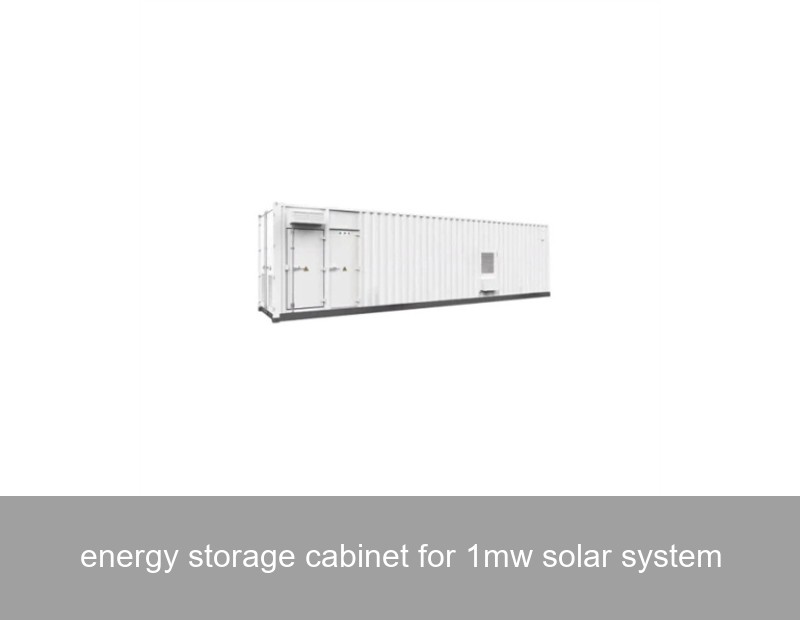
Table of Contents
- The Challenge: When Your 1MW Solar System Isn't Enough
- The Solution: The 1MW Energy Storage Cabinet
- Key Components of a Robust Energy Storage Cabinet
- A Real-World Case: Stabilizing a California Microgrid
- The Highjoule Approach: Intelligent Storage for Demanding Applications
- The Future Outlook for Commercial Solar-Plus-Storage
You've made the smart investment. Rooftops or fields are covered with panels, and your 1-megawatt (MW) solar system is a testament to your commitment to clean energy and cost savings. But if you're like many commercial and industrial operators, you've likely encountered a frustrating reality: the sun doesn't always shine when you need power the most. This mismatch between solar generation and your facility's energy consumption is more than an inconvenience; it's a barrier to true energy resilience and financial optimization. This is precisely where integrating a purpose-built energy storage cabinet for 1MW solar system becomes a game-changer.
The Challenge: When Your 1MW Solar System Isn't Enough
Let's paint a familiar picture. Your 1MW solar array produces a beautiful bell curve of power throughout the day, peaking around noon. Meanwhile, your manufacturing plant, data center, or commercial complex has a relatively flat—or even an evening-peaking—load profile. The result? A significant portion of your valuable solar energy is exported to the grid at low, wholesale rates, only for you to purchase expensive power from the utility later in the day. According to the National Renewable Energy Laboratory (NREL), without storage, a typical commercial solar system might only directly offset 20-40% of a site's total electricity consumption, depending on load patterns.
The phenomenon is clear: solar over-generation during peak production hours and an energy deficit during peak demand periods. This not only hurts your ROI but also does little to protect you from grid outages or volatile time-of-use (TOU) rates that are becoming standard across Europe and the United States.
The Solution: The 1MW Energy Storage Cabinet
This is where the energy storage cabinet for a 1MW solar system enters as the critical linchpin. Think of it not just as a big battery, but as an intelligent energy asset. Its primary function is to capture the excess solar energy produced during the day, store it efficiently, and dispatch it precisely when your site needs it most—during evening demand peaks, grid outages, or periods of high electricity costs.
The benefits are substantial and multi-faceted:
- Maximized Self-Consumption: Increase the portion of your solar energy used on-site from 30% to 80% or more.
- Demand Charge Reduction: Slash peak demand charges, which can constitute up to 50% of a commercial electricity bill, by discharging stored energy during short, high-power intervals.
- Enhanced Resilience: Provide seamless backup power for critical loads during grid failures.
- Grid Services: In some markets, aggregated storage can provide frequency regulation or capacity services, creating a new revenue stream.

Image Source: Unsplash - Representative image of a contemporary energy storage system installation.
Key Components of a Robust Energy Storage Cabinet
A reliable energy storage cabinet for a 1MW solar system is a sophisticated piece of engineering. It's far more than just battery cells in a box. Here’s what you should look for in a high-performance system:
| Component | Function | Why It Matters |
|---|---|---|
| Battery Cells (Li-ion NMC or LFP) | The core energy storage medium. | LFP (Lithium Iron Phosphate) chemistry, now widely preferred, offers superior safety, longer cycle life (6,000+ cycles), and better thermal stability, crucial for commercial applications. |
| Battery Management System (BMS) | Monitors and manages cell voltage, temperature, and state of charge. | Ensures safety, longevity, and performance by preventing overcharge, deep discharge, and cell imbalance. |
| Power Conversion System (PCS) | Bi-directional inverter that converts DC battery power to AC for the building/grid. | Its speed and accuracy determine how quickly the system can respond to load changes or grid signals. High efficiency (e.g., >98%) is critical for preserving energy. |
| Thermal Management System | Active cooling/heating to maintain optimal battery temperature. | Directly impacts system safety, performance in extreme climates, and battery degradation rate. Liquid cooling is often standard for MW-scale cabinets. |
| Energy Management System (EMS) | The "brain" that controls charge/discharge based on algorithms. | This intelligent software maximizes economic value by automating decisions based on solar forecast, load patterns, and utility rate schedules. |
A Real-World Case: Stabilizing a California Microgrid
Let's move from theory to practice. Consider a 1.2MW solar carport installation at a large food distribution warehouse in Southern California. The facility operated 24/7 with high refrigeration loads, leading to significant demand charges and vulnerability to the state's Public Safety Power Shutoffs (PSPS).
The Problem: Despite the large solar array, the facility was still exporting over 40% of its generation and facing $50,000+ monthly demand charges. Grid outages threatened spoilage of millions of dollars in inventory.
The Solution: The integrator deployed two 500kW/1MWh energy storage cabinets, specifically configured to pair with the 1.2MW solar system. The integrated system was designed for two primary functions: daily peak shaving and backup power for critical cold storage.
The Data-Driven Outcome (12-month period):
- Demand Charge Reduction: Peak demand was reduced by an average of 35%, translating to annual savings of over $180,000.
- Self-Consumption Increase: On-site use of solar power jumped from 58% to 92%.
- Resilience Proven: During a planned 8-hour grid outage, the storage system, coupled with solar, maintained full operation of all critical refrigeration units, preventing any loss of product.
- ROI: The projected payback period for the storage addition was calculated at under 5 years, enhanced by available state incentive programs like SGIP (Self-Generation Incentive Program).
This case, documented in a California SGIP impact report, highlights the tangible value proposition of a correctly sized and managed storage solution.
The Highjoule Approach: Intelligent Storage for Demanding Applications
At Highjoule, with nearly two decades of experience since 2005, we understand that a commercial or industrial energy storage cabinet for a 1MW solar system is not a commodity. It's a mission-critical asset. Our H-Series Commercial Energy Storage Systems are engineered from the ground up for this scale and rigor.
Our modular cabinet design allows for flexible configurations, typically scaling from 250kW to multi-MW installations, making them a perfect match for 1MW solar projects. What sets the Highjoule H-Series apart is its integrated intelligence. Our proprietary EMS doesn't just react; it forecasts. By integrating local weather data and historical load profiles, it optimizes the charge/discharge cycle to maximize economic return under the most complex utility tariffs.
Furthermore, safety is non-negotiable. Our cabinets feature industry-leading, UL-certified LFP battery modules, an advanced liquid cooling system for uniform temperature control, and a multi-layer safety architecture with both active and passive protection systems. We provide a complete solution—from initial feasibility and financial modeling to system design, grid interconnection support, and long-term performance monitoring through our Highjoule Pulse™ digital platform.

Image Source: Unsplash - Representative image of an engineer overseeing a battery storage control system.
The Future Outlook for Commercial Solar-Plus-Storage
The trajectory is clear. As grid modernization continues and the share of variable renewables grows, the value of dispatchable, behind-the-meter resources like your energy storage cabinet will only increase. We're moving towards a future where every major commercial solar installation will be viewed as incomplete without integrated storage. The question is no longer "Why storage?" but rather "What is the optimal storage strategy for my specific operational and financial goals?"
Is your 1MW solar system operating at its full potential, or is a significant portion of its value literally flowing back to the grid? What would a 40% reduction in your peak demand charges do for your bottom line this year?
 Inquiry
 Online Chat