


Unlocking Grid Resilience: The Strategic Power of a 1MW Energy Storage Cabinet
a commercial facility's electricity bill suddenly spikes due to a demand charge event. A manufacturing plant faces costly downtime from a fleeting grid disturbance. Or a solar farm must curtail its green energy because the local grid is saturated. These are not hypotheticals; they are daily challenges in our modern energy landscape. The solution emerging as a cornerstone for commercial, industrial, and utility strategies is the 1MW energy storage cabinet. This isn't just a bigger battery; it's a standardized, scalable power block that is redefining how businesses and grids manage energy. As a modular unit, a 1MW energy storage cabinet delivers a substantial one megawatt of power capacity, typically paired with 2-4+ hours of energy (MWh), making it the ideal building block for significant load management, revenue generation, and infrastructure support.
What is a 1MW Energy Storage Cabinet?
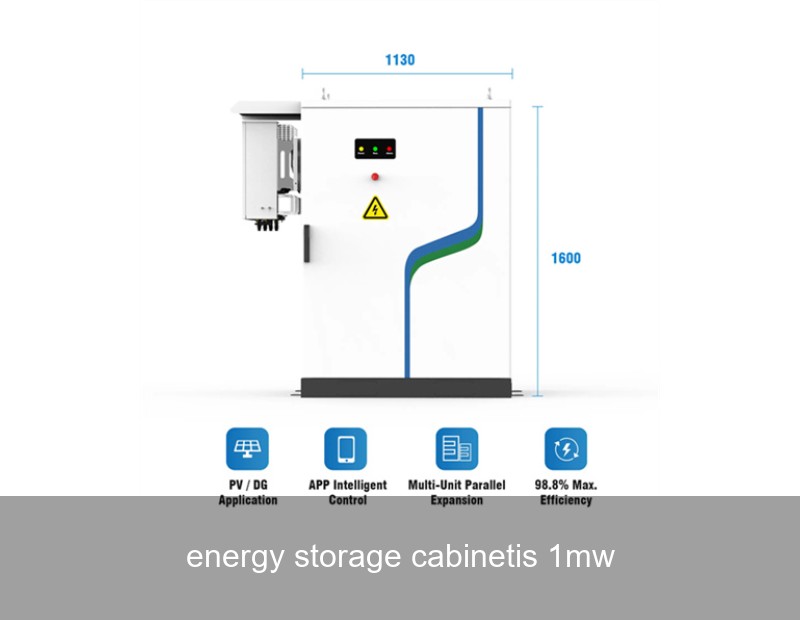
At its core, a 1MW energy storage cabinet is a containerized, all-in-one system that stores electrical energy, most commonly in lithium-ion batteries, for later use. The "1MW" refers to its power rating—its ability to instantly discharge one megawatt of electricity, equivalent to powering approximately 750-1,000 average European homes at peak output. Think of it as a massive, intelligent power reservoir. Unlike a series of scattered smaller units, these cabinets are engineered as unified systems, housing not just battery racks, but also integrated power conversion systems (PCS), thermal management, fire suppression, and sophisticated control software within a single, often modular, enclosure.

Image Source: Unsplash - Representative image of modular industrial energy units.
Why the 1MW Scale is a Game Changer
The shift towards the megawatt-scale cabinet is driven by compelling economics and operational needs. For businesses, energy is a major cost center. Utility tariffs often include "demand charges," fees based on the highest 15-30 minutes of power usage in a month. A 1MW energy storage cabinet can strategically discharge during short peak periods, shaving that maximum demand and slashing these charges, often paying for itself in a few years. For grid operators, clusters of these cabinets provide essential services like frequency regulation, helping to balance supply and demand in real-time and stabilize the grid as renewable penetration grows. The scale of 1MW is the sweet spot where significant financial and technical benefits become achievable for a wide range of players.
Inside the Cabinet: Key Components & Technology
So, what makes a high-quality 1MW energy storage cabinet tick? It's a symphony of advanced engineering:
- Battery Cells & Module Design: Utilizing high-cyclability Lithium Iron Phosphate (LFP) chemistry for safety and longevity, arranged in modular packs for easy serviceability.
- Power Conversion System (PCS): The brain of the power flow, this bidirectional inverter converts DC battery power to AC grid power and vice versa with high efficiency (>98%).
- Thermal Management System: A critical safety and longevity component. Liquid cooling or advanced air-cooling maintains optimal cell temperature, ensuring performance and preventing thermal runaway.
- Energy Management System (EMS): The true intelligence. This software platform controls when to charge and discharge based on electricity prices, grid signals, or on-site generation, maximizing ROI.
- Safety & Integration: Multi-layer protection includes fire suppression, gas detection, and rigorous compliance with international standards like UL 9540 and IEC 62619.
Real-World Applications: Where 1MW Cabinets Shine
The versatility of the 1MW energy storage cabinet is its greatest asset. Here’s how it’s being deployed:
| Application | Primary Value | Typical Configuration |
|---|---|---|
| Commercial & Industrial (C&I) | Demand charge reduction, backup power, time-of-use arbitrage. | 1-4 cabinets (1-4MW), 2-4 hour duration. |
| Solar/Wind Farm Co-location | Renewable energy time-shifting, curtailment reduction, grid compliance. | Multiple cabinets (10MW+), 4+ hour duration. |
| Microgrids & Critical Infrastructure | Grid independence, resilience during outages, seamless integration of diesel gensets. | 2-10+ cabinets as part of a hybrid system. |
| Utility Grid Services | Frequency regulation, voltage support, deferred grid upgrades. | Clusters of cabinets at substations or strategic grid nodes. |
The Highjoule Solution: Engineered for Performance
At Highjoule, with nearly two decades of experience since 2005, we've refined the 1MW energy storage cabinet into a product that balances raw power with intelligent design. Our H-CUBE Megapack series is the embodiment of this philosophy. Designed for the European and North American markets, each H-CUBE unit is a pre-assembled, containerized 1MW energy storage cabinet that features:
- Ultra-Safe LFP Chemistry & Liquid Cooling: Our proprietary thermal management system ensures cell-to-cell temperature variation of less than 3°C, extending cycle life beyond 6,000 cycles.
- Grid-Forming Inverter Technology: This advanced capability allows our cabinets to not just follow the grid but to support it by creating a stable voltage and frequency "island," crucial for microgrids and areas with weak grid infrastructure.
- AI-Driven Fleet Management: Our Horizon EMS platform doesn't just manage one cabinet; it optimizes entire fleets across continents, using predictive algorithms to maximize revenue stacking—from demand management to participating in wholesale energy markets.
We provide more than hardware; we offer a full turnkey service—from initial feasibility studies and financial modeling to grid connection support, installation, and 24/7 remote monitoring—ensuring our clients' 1MW energy storage cabinet projects deliver on their promised returns.

Image Source: Unsplash - Technician performing checks on a large-scale battery system.
Case Study: A 4.8MW Commercial Hub in Germany
Let's look at a real example. A large logistics and retail distribution center outside Frankfurt, Germany, faced annual electricity costs exceeding €1.5 million, with nearly 30% attributed to demand charges. Their on-site 3MW solar array often produced excess energy during midday lows.
The Solution: Highjoule deployed a system comprising four of our H-CUBE 1MW energy storage cabinets, configured for a total of 4.8MW power and 9.6MWh of energy storage (2-hour duration).
The Results (18-month operational data):
- Demand Charge Reduction: Peak grid draw was reduced by an average of 4.2MW, cutting demand charges by €185,000 annually.
- Solar Self-Consumption Optimization: Increased consumption of on-site solar from 68% to over 92%, saving an additional €65,000 per year.
- Grid Services Revenue: The system participates in the German primary control reserve market via Highjoule's Horizon EMS, generating approximately €40,000 in annual ancillary service revenue.
- Total Payback: The project achieved a simple payback period of just under 5 years, a compelling investment for the site owner.
This case demonstrates the multi-faceted value a well-integrated 1MW energy storage cabinet system can deliver, transforming a cost center into a revenue-generating, resilient asset. For further reading on grid service markets, the U.S. Department of Energy's grid modernization page provides useful context.
The Future Outlook for Megawatt-Scale Storage
The trajectory is clear. As noted by the International Energy Agency (IEA), grid-scale battery storage capacity is set to multiply exponentially this decade, driven by falling costs and policy support like the Inflation Reduction Act in the U.S. The 1MW energy storage cabinet is the fundamental modular unit enabling this growth. Future advancements will see even higher energy densities, broader use of second-life EV batteries in stationary storage, and deeper integration with AI for predictive grid balancing.
For a business leader, utility planner, or project developer, the question is no longer if battery storage is viable, but how to implement it strategically. The modular, scalable nature of the 1MW energy storage cabinet lowers risk and allows for phased investment. So, as you look at your energy challenges—be it price volatility, reliability concerns, or sustainability goals—what specific load or renewable asset on your balance sheet could be transformed by the strategic placement of a megawatt of intelligent power?
 Inquiry
 Online Chat