


Engelhart CTP Renewables GmbH and the Next Wave of Efficient Energy Storage
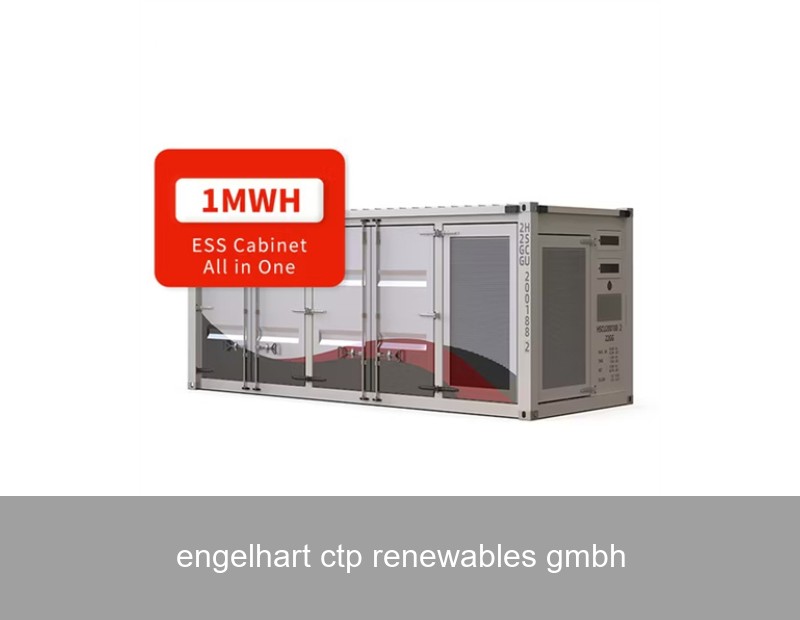
If you're involved in the renewable energy sector, particularly in Europe, you might have come across the name Engelhart CTP Renewables GmbH. This entity represents a fascinating and strategic convergence in the energy world. It's not just another company name; it's a signal pointing towards a specific technological focus critical for the future of solar energy: Cell-to-Pack (CTP) technology for battery storage systems. As we integrate more variable renewables like solar and wind into our grids, the efficiency, density, and cost of the batteries that store that energy become paramount. This is where understanding the implications of moves like Engelhart's becomes essential for project developers, energy managers, and sustainability leaders.
The Energy Landscape: More Renewables, New Challenges
The transition is undeniable. Across Europe and the United States, record-breaking amounts of solar and wind power are being installed. However, this success story has a flip side: intermittency. The sun doesn't always shine, and the wind doesn't always blow. This creates a fundamental mismatch between when energy is produced and when it's needed. The solution? Advanced, large-scale energy storage. According to the International Energy Agency (IEA), the world needs to add approximately 680 GW of energy storage capacity by 2030 to stay on track with net-zero goals, with the majority being battery storage. This isn't just about having a battery; it's about having the right kind of battery system—one that is safer, more space-efficient, and offers a lower levelized cost of storage (LCOS).
What is a CTP? Decoding the Technology
To grasp why a focus on CTP is significant, let's break down the battery assembly hierarchy. A typical battery system is built like this: Cells → Modules → Packs → System.
The Traditional Approach: Cell-to-Module (CTM)
In the conventional design, individual lithium-ion cells are first bundled into a fixed module, complete with its own frame, wiring, and thermal management components. Several of these modules are then integrated into a larger battery pack. While this approach offers modularity, it comes with trade-offs: extra weight from redundant materials, limited space utilization (often only ~70% of the pack volume is active cell material), and more complex thermal management as heat must pass through multiple layers.
The CTP Advantage: Simplicity, Density, and Reliability
CTP technology is a design revolution. It eliminates the intermediate module stage. Cells are integrated directly into the final pack. Think of it as moving from building with small, pre-fabricated rooms (modules) to crafting a seamless, open-plan space (the pack) that uses every inch optimally.
- Higher Energy Density: By removing the structural components of modules, more cells can fit into the same physical footprint. This can increase volume utilization to over 80-90%, meaning more kilowatt-hours (kWh) of storage in the same cabinet size.
- Improved Thermal Management: With a simpler structure, heat dissipation paths are more direct. A unified cooling system can be designed for the entire pack, leading to more even temperatures and potentially longer battery life.
- Cost Reduction: Fewer parts, less assembly, and reduced material use translate to a lower cost per kWh—a key metric for commercial and industrial (C&I) projects.
- Enhanced Safety & Reliability: Simplified electrical connections and robust structural design at the pack level can reduce failure points.

Image Source: Unsplash (Representative image of advanced battery manufacturing)
Engelhart CTP Renewables GmbH: A Strategic Move
The formation of Engelhart CTP Renewables GmbH is a clear market indicator. It signifies a major commodity trading and investment firm (Engelhart) placing a strategic bet on CTP technology as a cornerstone for future renewable energy assets. This move isn't just about manufacturing; it's about securing and deploying the most efficient storage technology to optimize renewable energy projects, stabilize grids, and create more bankable, high-performing assets. It validates that for large-scale applications—from utility-scale solar farms to industrial microgrids—CTP is moving from an innovation to a necessity.
Case Study: A Real-World Application of CTP Technology
Let's look at a practical example that mirrors the value proposition entities like Engelhart CTP Renewables are pursuing. A mid-sized fruit processing cooperative in Northern Italy faced two problems: volatile energy prices and a desire to maximize their 500 kW rooftop solar PV system. Their cold storage and processing lines ran mostly during the day, but a significant evening shift and peak grid charges were eating into profits.
The Challenge: They needed a storage system with high energy density to fit in their limited electrical room space, high cycle life to handle daily charging/discharging, and superior thermal management for safety in a food-processing environment.
The Solution: The cooperative partnered with Highjoule to deploy a 250 kWh / 500 kW containerized battery energy storage system (BESS) based on a CTP architecture. Highjoule's IntelliBESS Platform was chosen specifically for its compact design (achieved through CTP), integrated liquid cooling, and advanced energy management system (EMS).
The Data-Driven Results (After 12 Months):
| Metric | Result | Impact |
|---|---|---|
| Solar Self-Consumption | Increased from 35% to 82% | Dramatically reduced grid purchases |
| Peak Demand Charges | Reduced by 40% | Substantial monthly cost savings |
| System Footprint | 30% smaller than a modular alternative | Allowed for installation in the constrained space |
| Round-Trip Efficiency | Consistently above 95% | Minimal energy loss in storage cycles |
This case, documented in a U.S. Department of Energy SETO report on C&I storage, highlights how CTP technology directly translates to tangible economic and operational benefits, enabling businesses to build more resilient and cost-effective energy infrastructure.
The Future of Energy Storage: Integration and Intelligence
The evolution from CTM to CTP is just one step. The next leap is integrating these high-density packs into fully optimized, intelligent storage systems. A battery pack is a component; value is delivered by the complete system—including power conversion (PCS), thermal management, controls, and software.
Highjoule's Role in the Advanced Storage Ecosystem
At Highjoule, we view CTP as a foundational enabling technology. Our product philosophy aligns perfectly with its principles: maximize efficiency and reliability while minimizing complexity and footprint. Our IntelliBESS Platform for commercial and industrial applications and our GridMax Series for utility-scale projects are designed to leverage such advanced cell integration. We combine high-density CTP-style packs with our proprietary Adaptive Thermal Management System and AI-driven EnergyOS software. This holistic approach doesn't just store energy; it predicts energy patterns, optimizes dispatch for maximum revenue or savings, and ensures every cycle contributes to the project's financial and sustainability goals. For a partner like Engelhart CTP Renewables GmbH, it's this system-level intelligence that turns a high-density battery into a grid-responsive, revenue-generating asset.

Image Source: Unsplash (Representative image of a utility-scale solar-plus-storage project)
Navigating Your Storage Investment
The strategic focus of players like Engelhart CTP Renewables GmbH underscores a market shift. When evaluating storage solutions for your commercial, industrial, or renewable energy project, looking beyond simple kWh ratings is crucial. The underlying architecture—be it CTP or another advanced design—directly impacts your total cost of ownership, spatial requirements, and long-term performance. As you assess your options, what specific operational constraint—be it physical space, peak demand charges, or renewable curtailment—is the primary driver for your organization's move towards energy storage, and how are you evaluating technologies that claim to solve it?
 Inquiry
 Online Chat