


Enphase Off-Grid: How Much Does a Reliable System Really Cost?
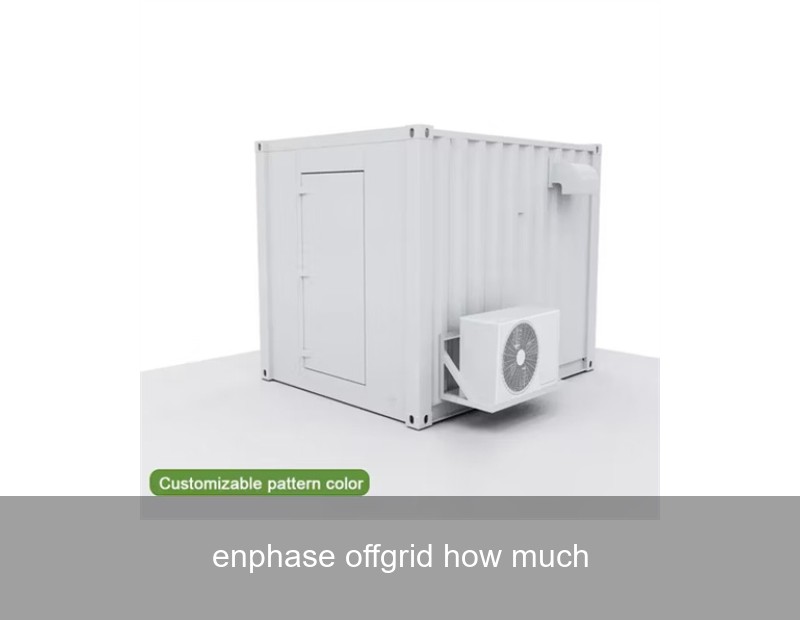
So, you're considering cutting the cord with your utility company and going fully off-grid. It's an exciting prospect – complete energy independence, immunity from rising electricity rates, and the satisfaction of powering your life with clean energy. As you research, a common question emerges: "Enphase off-grid how much?" While Enphase is a renowned name in solar microinverters, building a robust off-grid system involves more than just one brand. The true cost isn't just a sticker price; it's an investment in reliability, efficiency, and peace of mind. Let's break down what you're really paying for and how to build a system that won't let you down when the clouds roll in.
Table of Contents
- The Off-Grid Phenomenon: More Than a Trend
- Beyond the Sticker Price: The Real Cost Components
- A European Case Study: The Swiss Mountain Retreat
- Highjoule's Holistic Approach to Off-Grid Reliability
The Off-Grid Phenomenon: More Than a Trend
The drive for energy self-sufficiency is accelerating globally. In Europe and the US, factors like grid instability, remote living, and a growing desire for sustainability are pushing homeowners and businesses to explore off-grid solutions. It's a shift from simply wanting solar panels to desiring a fully autonomous energy ecosystem. However, the initial search for "Enphase off-grid cost" often reveals a complex equation. The price fluctuates wildly based on location, energy needs, and the all-important battery storage capacity, which is the true heart of any off-grid system.
Beyond the Sticker Price: The Real Cost Components
Asking "how much" is like asking the price of a house without specifying size, location, or materials. A functional off-grid system is built on four pillars, each with its own cost variable:
- Energy Generation (Solar Panels): This is your fuel source. Size depends on your location's sun hours and your daily consumption (measured in kWh).
- Energy Conversion (Inverters & Components): This includes microinverters (like Enphase) or string inverters that convert DC solar power to usable AC power. For off-grid, you need a specific type: a multi-mode or off-grid inverter that can manage battery charging and grid-forming.
- Energy Storage (Battery Bank – The Critical Component): This is your "energy insurance policy." Cost is directly tied to capacity (kWh) and depth of discharge. Skimping here is the most common cause of system failure.
- Balance of System & Installation: This includes mounting, wiring, switchgear, energy management systems, and professional design/installation labor. A poorly installed system, regardless of component brands, will underperform.
Let's put this in a typical sizing table for a moderate off-grid home in Southern Europe or California:
| Component | Typical Spec for a 3-4 Bedroom Home | Cost Influence |
|---|---|---|
| Solar Array | 8-12 kW | High (Number of panels, panel efficiency) |
| Battery Storage | 20-30 kWh usable capacity | Very High (Lithium chemistry, cycle life, brand) |
| Inverter System | 10-15 kW continuous power, off-grid capable | Medium-High (Technology, features, brand) |
| Installation & Balance | Full system design, permitting, labor | Medium-High (Site complexity, local regulations) |
As you can see, focusing solely on "Enphase off-grid how much" misses the larger picture. The inverter is just one part of the engine. The battery bank and its integration are often 40-50% of the total system cost, and rightly so.
A European Case Study: The Swiss Mountain Retreat
Let's look at a real-world example. A family in the Swiss Alps, far from the main grid, needed a year-round power solution. Their primary challenge was not just sunny days but consecutive days of heavy winter snow and low light.
- Phenomenon: Total energy independence required in a location with high seasonal variability.
- Data & Solution: A system was designed with a 14 kW solar array and a massive 48 kWh lithium iron phosphate (LiFePO4) battery bank. The key was oversizing the storage to act as a "seasonal buffer." The inverters chosen were capable of high-efficiency operation in sub-zero temperatures.
- Outcome: The system provides 100% of their energy, even during a recorded 10-day period of minimal solar gain. The total investment was significant, but the cost of connecting to the distant grid was estimated to be 60% higher, making the off-grid system economically sensible over its 25+ year lifespan.

Image Source: Unsplash (Representative image of an alpine solar installation)
This case highlights that the right question isn't just "Enphase off-grid how much," but "What is the cost of a system guaranteed to power my home through my worst-case weather scenario?"
Highjoule's Holistic Approach to Off-Grid Reliability
At Highjoule, with nearly two decades of experience since 2005, we've learned that successful off-grid living is built on resilience, not just components. While we integrate top-tier components like high-efficiency panels and robust inverters, our true expertise lies in designing the system intelligence and storage backbone.
Our HPS (Highjoule PowerStack) Series of modular lithium battery systems is engineered specifically for the demands of off-grid and microgrid applications. Unlike standard batteries, the HPS features:
- Advanced Thermal Management: Ensures optimal performance and longevity from -20°C to 50°C, crucial for both Swiss mountains and Arizona deserts.
- Scalable Architecture: Start with 10 kWh and expand seamlessly to over 100 kWh as your needs grow, protecting your initial investment.
- Integrated Energy Management System (EMS): This is the "brain." It doesn't just store energy; it intelligently prioritizes loads, forecasts weather-based solar production, and manages generator backup (if any) to minimize fuel use. This software optimization can effectively increase your usable storage capacity by 15-20% compared to a poorly managed system.

Image Source: Unsplash (Representative image of a modern battery storage installation)
We pair this with our GridTitan Inverter Series, which are specifically designed for off-grid and hybrid applications, offering seamless switching between solar, battery, and backup generator sources. When you work with Highjoule, you're not buying a list of parts; you're investing in a guaranteed performance outcome: reliable, 24/7 power.
Making the Right Investment for Your Independence
Navigating the complexities of off-grid solar requires moving beyond brand-specific searches. The U.S. Department of Energy and the European Commission's PVGIS tool are excellent authoritative resources for understanding solar potential in your specific area.
The most critical step is a professional, site-specific energy audit and design. An off-grid system is a long-term infrastructure investment. The cheapest upfront cost often leads to the highest long-term cost through premature failure, inadequate power, or the need for a costly generator.
So, what should your next question be?
Instead of "Enphase off-grid how much," consider asking potential providers: "Can you show me a detailed simulation of my system's performance across all four seasons, and what is the projected lifecycle cost of the battery system over 15 years?" This shifts the conversation from price to value and long-term reliability.
Is your goal simply to have solar panels, or is it to achieve true, worry-free energy independence, no matter what's happening outside your window or on the main grid?
 Inquiry
 Online Chat