


European Solar Batteries: Powering Energy Independence and a Greener Grid
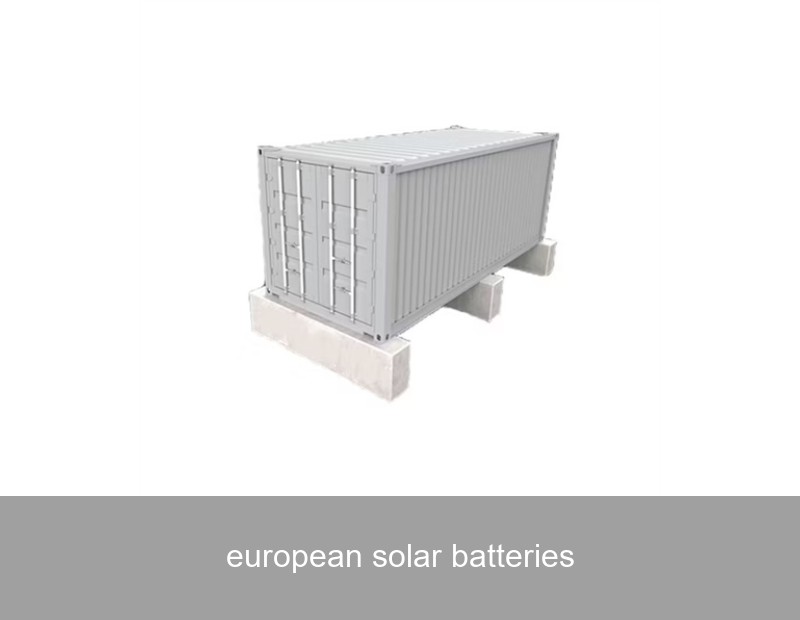
Across Europe, a quiet revolution is taking place on rooftops and in utility rooms. The familiar sight of solar panels is now increasingly paired with a sleek, boxy companion: the solar battery. For European homeowners and businesses, this combination is transforming from a niche eco-choice into a cornerstone of modern energy management. But what's driving this surge, and how do you choose the right technology for your specific needs? As a leader in advanced energy storage for nearly two decades, Highjoule is at the forefront of this shift, providing intelligent systems that make solar power work harder, day and night.
Table of Contents
- The Rise of the Prosumer: Why Europe is Embracing Solar Batteries
- Beyond Kilowatt-Hours: Key Metrics for Choosing European Solar Batteries
- Technology Showdown: What Powers Your Home?
- Real-World Impact: A Case Study from Germany
- Highjoule's Role: Smart Storage for a Complex Energy Landscape
- The Future Horizon: Solar Batteries and the European Grid
The Rise of the Prosumer: Why Europe is Embracing Solar Batteries
The European energy landscape is undergoing a profound transformation. Driven by ambitious climate targets, volatile energy prices, and a desire for greater self-sufficiency, citizens are moving from being passive consumers to active "prosumers"—both producing and consuming their own energy. Solar panels were the first step. However, a critical challenge remained: the sun doesn't shine on demand. Most solar energy is generated in the middle of the day, often when households are empty. Without a battery, this excess power is fed back to the grid, often for a modest feed-in tariff, only for homeowners to buy back expensive electricity in the evening.
This mismatch created a compelling financial and practical case for European solar batteries. By storing midday surplus for use during peak hours, households can dramatically increase their self-consumption rate—sometimes from 30% to 70% or more. This directly shields them from peak tariff rates and enhances their energy resilience. Furthermore, policies across Europe, from Italy's Superbonus 110% to various national grant schemes, have provided crucial incentives. The European Commission's REPowerEU plan, aiming to accelerate renewable rollout, further cements the strategic importance of storage (source: European Commission).

Image: A typical modern European home energy setup, combining solar generation with battery storage. (Source: Unsplash)
Beyond Kilowatt-Hours: Key Metrics for Choosing European Solar Batteries
Choosing a battery isn't just about picking the biggest one. It's about understanding your home's energy fingerprint. Let's break down the key terms you'll encounter:
- Usable Capacity (kWh): This is the actual amount of energy you can store and use. Think of it as the size of your fuel tank. A typical European household might look for systems between 5 kWh and 15 kWh.
- Power Rating (kW): This determines how much power the battery can deliver at once. Can it run your oven, washing machine, and heat pump simultaneously? A higher power rating is crucial for high-demand appliances.
- Depth of Discharge (DoD): A battery with a 90% DoD means you can safely use 90% of its capacity without damaging it. Higher is better.
- Round-Trip Efficiency: The percentage of energy put into the battery that you can get back out. Premium systems, like those from Highjoule, often exceed 95%, meaning very little energy is lost in the storage process.
- Cycles & Warranty: A cycle is one full charge and discharge. Manufacturers offer warranties guaranteeing a certain capacity (e.g., 70%) after a set number of cycles (e.g., 10,000) or years (often 10).
| Metric | What It Means | Why It Matters |
|---|---|---|
| 10 kWh Capacity | Can store 10 kilowatt-hours of electricity | Could power an average EU home's essential loads for 12-24 hours |
| 5 kW Power | Can deliver 5 kilowatts of power instantaneously | Can run multiple high-power appliances (oven, kettle) at once |
| 95% Efficiency | Loses only 5% of energy during charge/discharge | Maximizes the value of every solar panel kilowatt-hour you produce |
Technology Showdown: What Powers Your Home?
The heart of any storage system is its battery chemistry. In the European market, two dominant technologies have emerged.
Lithium Iron Phosphate (LFP)
LFP has become the dominant chemistry for residential European solar batteries. It offers an excellent balance of safety, longevity, and performance. LFP batteries are inherently stable, have a long cycle life (often over 6,000 cycles), and perform well across a wide temperature range. While slightly less energy-dense than some alternatives, their safety profile makes them ideal for home installations. This is the chemistry Highjoule primarily utilizes in its ResiCore series, prioritizing decades of safe, reliable service in your home.
Nickel Manganese Cobalt (NMC)
NMC batteries offer higher energy density, meaning more capacity in a slightly smaller space. They have historically been common in electric vehicles. However, they typically have a slightly shorter lifespan than LFP and require more sophisticated battery management systems for thermal safety. The technology is continually improving, but for stationary home storage, LFP's safety and longevity are often the preferred choice.

Image: A professional, wall-mounted battery storage system installation. (Source: Unsplash)
Real-World Impact: A Case Study from Germany
Let's move from theory to practice. Consider the Müller family in Bavaria, Germany. In 2021, they installed a 12 kWp solar array on their detached home. Without a battery, their self-consumption was around 35%. They exported most of their daytime production and drew heavily from the grid in the evening.
In early 2023, they added a Highjoule ResiCore 10 battery system (10 kWh usable capacity). The results after one year were telling:
- Self-Consumption Rate: Increased from 35% to 82%.
- Grid Import Reduction: Reduced annual grid electricity purchases by 68%.
- Financials: Combined with their solar PV, the system provided a simple payback period of under 8 years, a figure strengthened by high German electricity prices. More importantly, it locked in a low, predictable energy cost for the next two decades.
"For us, it was never just about the quickest return," said Mr. Müller. "It was about taking control. Now, during a grid outage, our lights stay on. We know our energy is clean and ours. The Highjoule system's app makes it simple to track our energy flows in real-time—it's empowering." This case reflects a broader trend documented by groups like SolarPower Europe, which highlights storage as the key to unlocking solar's full potential.
Highjoule's Role: Smart Storage for a Complex Energy Landscape
At Highjoule, we understand that a modern European solar battery is more than just a container for electrons. It's an intelligent energy manager. Our systems, like the ResiCore for homes and the GridMax for commercial applications, are built with this philosophy.
Our integrated energy management system (EMS) is the brain. It doesn't just store solar excess; it learns your consumption patterns, considers variable electricity tariffs (crucial in markets with dynamic pricing), and can even integrate with smart home devices. In the future, as vehicle-to-home (V2H) technology matures, our platforms are designed to seamlessly integrate electric vehicles as additional storage assets.
For businesses and municipalities, our GridMax systems provide stability. They can perform peak shaving—reducing demand charges by discharging the battery during periods of maximum grid draw—and provide backup power for critical operations. This is vital for Europe's industrial sector as it electrifies and seeks to manage costs in an uncertain energy market.
The Future Horizon: Solar Batteries and the European Grid
The collective impact of millions of distributed European solar batteries could be transformative for the continent's grid. Imagine a virtual power plant, aggregating the capacity of thousands of home systems to provide grid-balancing services, alleviating strain during winter peaks, and soaking up excess renewable energy in summer. This isn't science fiction; pilot projects are already underway.
This future requires batteries that are not only reliable but also communicative and grid-responsive. Highjoule designs its systems with this interoperability in mind, ensuring they can contribute to a more resilient and decentralized energy network. As grid operators increasingly value flexibility, the role of the prosumer will evolve from just saving money to actively participating in and stabilizing the energy market.
Is your home or business ready to become an active node in Europe's new energy landscape? What would energy independence look like for you?
 Inquiry
 Online Chat