


Fortune's Solar: How Much Can You Really Save and Earn?
You've seen the headlines: "Solar panels can cut your bills to zero!" or "Earn money by selling power back to the grid!" It sounds like a modern-day gold rush, a literal fortune in solar. But when you peel back the marketing, the core question remains: Fortune's solar, how much is actually achievable? The answer isn't a simple number. It's a dynamic equation involving your location, energy habits, the technology you choose, and—critically—the intelligence of your energy storage system. Let's move beyond the hype and calculate the real value of your solar investment.
Table of Contents
The Phenomenon: From Cost Center to Revenue Stream
Gone are the days when solar was just about environmental goodwill. Today, it's a hard-nosed financial decision. The phenomenon is the shift of solar power from a passive asset to an active, grid-interactive one. With net metering policies evolving and utility rates becoming more complex, simply having panels on your roof isn't enough. The real "fortune" is unlocked by maximizing self-consumption—using the power you generate—and strategically interacting with the energy market. This requires not just production, but smart management and storage.

Image: A modern solar and storage setup. The true fortune lies in how intelligently these systems work together. (Photo by Vivint Solar on Unsplash)
The Data: Decoding the Payback Period
So, let's talk numbers. The classic metric is the payback period. In the US, the average payback period for a residential solar system hovers around 8-12 years, depending on state incentives and electricity costs. In Europe, with higher energy prices, it can be as low as 6-9 years. But here's the catch: these figures often assume optimal, constant conditions. They don't fully account for:
- Time-of-Use (TOU) Rates: Where electricity costs 2-3x more during peak evening hours, exactly when solar production stops.
- Declining Feed-in Tariffs: The rate you're paid for exporting surplus solar is falling rapidly in many regions.
- System Degradation: Panels slowly lose efficiency over 25+ years.
This is where the basic calculation falls short. Your solar fortune isn't just about offsetting consumption at a flat rate; it's about playing the market every day, hour by hour.
| Scenario | Solar Only | Solar + Basic Battery | Solar + Highjoule AI-Driven Storage |
|---|---|---|---|
| Self-Consumption Rate | 30-50% | 60-80% | 85-95%+ |
| Savings from Peak Shaving | Low | Moderate | High (AI optimizes for highest rates) |
| Grid Services Revenue Potential | None | Limited | Activated (e.g., frequency response) |
| Estimated Payback Period Reduction | Base (e.g., 10 years) | Reduced by 1-2 years | Reduced by 3-5 years or more |
The Game Changer: Intelligence in Storage
Think of a basic battery as a simple bucket—it stores solar energy for later use. An intelligent Battery Energy Storage System (BESS), however, is like a savvy stock trader for your home or business. This is the pivotal piece in the "fortune's solar, how much" puzzle. A smart BESS does more than just store; it learns, forecasts, and decides.
- It learns your consumption patterns.
- It forecasts weather and solar yield.
- It knows your utility's rate schedule in real-time.
- It can even respond to grid signals for additional revenue.
By charging from excess solar or cheap off-peak grid power and discharging during expensive peak periods, it maximizes every kilowatt-hour. This intelligent arbitrage is where significant savings and earnings are generated, fundamentally changing the financial model of your solar installation.
The Case Study: A European Business Transforms Its Fortune
Let's make this concrete. Consider a mid-sized dairy processing plant in Germany. They installed a 500 kW solar array, but with production during the day and high energy needs for cooling running into the evening, their self-consumption was only 35%. They were selling low and buying high.
The Solution: They integrated a 250 kWh / 500 kW Highjoule H-Ion C&I battery storage system with our proprietary EnergyOS platform.
The Results (12-month period):
- Self-consumption of solar jumped from 35% to 92%.
- By avoiding peak-time grid purchases, they saved over €48,000 on their energy bill.
- By participating in a secondary reserve frequency market (automated by EnergyOS), they generated an additional €15,000 in revenue.
- The combined financial benefit shortened the payback period for the entire solar+storage system by an estimated 4 years.
This isn't just savings; it's creating a new, predictable stream of value from an existing asset. The plant manager now views their energy system as a profit center, not just a utility. Studies by Fraunhofer ISE consistently highlight such value stacking as critical for commercial solar ROI.
The Highjoule Advantage: Engineering Your Energy Fortune
At Highjoule, we engineer storage systems with this precise intelligence at their core. Our fortune isn't just in selling hardware; it's in delivering the maximum financial return on your energy assets.
- For Homes: Our H-Ion Home series, managed by the intuitive Highjoule app, seamlessly shifts your solar power to night-time use, protects you from blackouts, and automatically avoids peak tariffs. It's the silent financial manager for your household energy.
- For Business & Industry: The H-Ion C&I modular systems are scalable powerhouses. Coupled with EnergyOS, they perform complex, automated value stacking—peak shaving, demand charge management, and even grid services—delivering a compelling ROI.
- For Utilities & Microgrids: Our large-scale H-Ion Grid systems provide stability and enable higher renewable penetration, turning grid challenges into economic opportunities.
Founded in 2005, our deep experience across global markets means our systems are built for the specific regulatory and economic landscapes of Europe and North America. We don't just provide a battery; we provide a guarantee of performance and a pathway to your optimal energy economy.

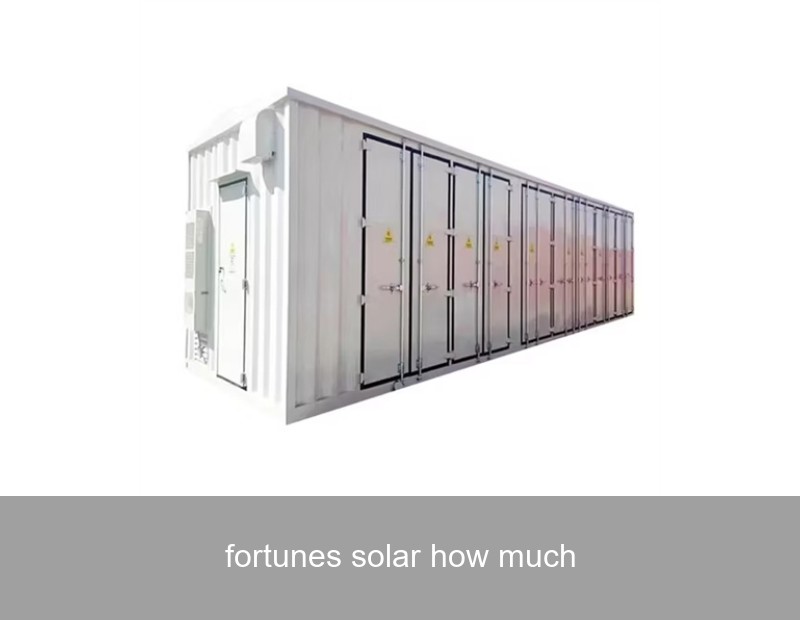
Image: A large-scale BESS installation. Intelligent systems like these are key to grid stability and renewable integration. (Photo by American Public Power Association on Unsplash)
The Future of Your Energy Fortune
The landscape is moving towards transactive energy models, where every prosumer can trade energy peer-to-peer. The question "fortune's solar, how much" will increasingly be answered by the sophistication of your software and your system's ability to communicate with the grid and markets. The fortune is there, but it's no longer lying passively on your rooftop. It's in the dynamic, intelligent system that manages, stores, and dispatches that precious energy.
So, what's the first step to quantifying your potential fortune? It begins with a detailed analysis of your energy data—your consumption patterns, your local rates, and your solar production profile. What would a 90% self-consumption rate do to your bottom line?
 Inquiry
 Online Chat