


How Much Does the Luna2000 215kWh Energy Storage System Really Deliver?
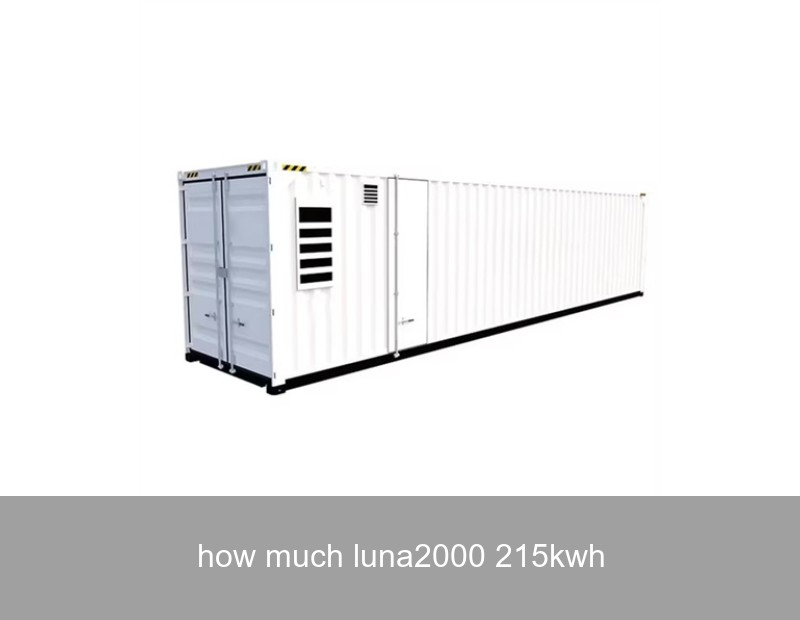
If you're managing a commercial facility, powering a remote industrial site, or designing a resilient microgrid, you've likely asked the question: "How much can a large-scale battery storage system actually do for my energy costs and security?" The query often crystallizes around specific models, like the Luna2000 215kWh. But here's the insight we at Highjoule have gained from over 18 years in advanced energy storage: the real question isn't just "how much does it cost," but "how much value does it unlock?" Let's unpack the capabilities, economics, and real-world impact of a 215kWh-class system and explore how solutions like ours are engineered to maximize every kilowatt-hour.
Table of Contents
- The Phenomenon: Beyond the Sticker Price of a Battery
- The Data: Understanding the 215kWh Capacity & Performance
- The Case Study: A German Logistics Center's Transformation
- The Highjoule Insight: Intelligence is the True Differentiator
- The Highjoule Solution: Engineered for Maximum Value
- What's Your Energy Storage Potential?
The Phenomenon: Beyond the Sticker Price of a Battery
Across Europe and the U.S., businesses face a dual energy challenge: volatile electricity prices and increasing pressure to ensure sustainability and resilience. A large battery bank sitting in a container or equipment room might seem like a simple capital purchase. However, the industry-leading perspective views it as a dynamic financial and operational asset. The initial inquiry about the Luna2000 215kWh system is a gateway to a deeper conversation about load shifting, demand charge reduction, backup power duration, and renewable integration. The system's nameplate energy capacity (215kWh) is just the starting point; its true worth is determined by how efficiently and intelligently that stored energy is managed and discharged.

Think of it this way: two identical cars with full tanks of gas won't travel the same distance if one has a superior engine management system. Similarly, two 215kWh systems can deliver vastly different financial returns based on their power output (kW), round-trip efficiency, depth of discharge, cycle life, and—most critically—the brain that controls them.
The Data: Understanding the 215kWh Capacity & Performance
Let's break down the key specifications that define a system's output. A 215kWh rating tells you the total amount of energy it can store. But to understand its power, you need the accompanying kW rating. A typical configuration might be 215kWh with a 100kW inverter. This means:
- Energy Storage: 215 kilowatt-hours. In practical terms, this could power an average U.S. home for 1.5-2 days, or a significant portion of a commercial facility's critical loads for several hours.
- Power Output: 100 kilowatts. This is the rate at which it can deliver electricity. A higher kW rating allows you to support heavier equipment or shave sharper peaks in your demand.
- Key Value Drivers:
- Demand Charge Reduction: For many commercial users, 30-50% of their electricity bill comes from demand charges (peak power usage). A 215kWh/100kW system can strategically discharge to "clip" these peaks, leading to substantial savings. (NREL Report on Commercial Storage).
- Solar Self-Consumption: It can store excess solar generation from a large rooftop array for use in the evening, increasing renewable usage from ~30% to 70% or more.
- Backup Duration: Duration = Energy (kWh) / Power (kW). For a 50kW critical load, 215kWh provides over 4 hours of backup. This is crucial for data centers, manufacturing processes, or cold storage.
| Application | Primary Benefit | Typical Metric | Potential Annual Savings* |
|---|---|---|---|
| Commercial Peak Shaving | Reduce Demand Charges | Clip 100kW peak for 2 hrs/day | $15,000 - $30,000 |
| Industrial with Solar | Increase Self-Consumption | Shift 150kWh of solar daily | $10,000 - $20,000 |
| Microgrid/Backup | Avoid Outage Losses | Provide 4+ hrs for critical loads | Value of avoided downtime |
| *Savings are highly dependent on local utility rates, usage patterns, and incentives. A detailed audit is essential. | |||
The Case Study: A German Logistics Center's Transformation
Let's move from theory to a tangible example. In 2023, Highjoule partnered with a major logistics hub in North Rhine-Westphalia, Germany. The facility operated 24/7, had a 500kW rooftop PV system, and faced steep demand charges and grid congestion fees.
The Challenge: Their solar array was often curtailed at noon, and afternoon grid peaks were costly. They needed a solution to capture their own solar energy and control their peak load.
The Highjoule Solution: We deployed a customized, scalable battery energy storage system (BESS) with a total capacity of 258kWh (a modular configuration similar to the 215kWh scale) and a 150kW inverter, integrated with our proprietary GridSync AI energy management platform.
The Data-Driven Results (First 12 Months):
- Solar Self-Consumption Rate: Increased from 35% to 82%.
- Peak Demand Reduction: Achieved a consistent 28% reduction in peak grid draw.
- Financial Return: Combined savings from increased solar usage and reduced demand charges resulted in a projected payback period of under 7 years, enhanced by available German incentive programs.
- Grid Services: The system is now enrolled in a local grid flexibility program, generating an additional revenue stream by providing stabilizing services.

This case highlights that the value of a 215kWh-class system isn't static. With intelligent control, it becomes a multi-revenue stream asset.
The Highjoule Insight: Intelligence is the True Differentiator
At Highjoule, we've learned that hardware is only half the story. The chemistry inside the battery cells (we prefer LFP for its safety and longevity) and the quality of the power conversion system are foundational. But the operational intelligence is what transforms a cost center into a profit center.
Our systems, whether for commercial, industrial, or microgrid applications, are built around this core principle. When you ask about a system like the Luna2000 215kWh, we guide the conversation toward your specific load profile, tariff structure, and sustainability goals. We then model how our Highjoule H-Series BESS, with capacities scalable from 100kWh to multi-megawatt-hours, can be optimized for you.
The Highjoule Solution: Engineered for Maximum Value
Our product philosophy centers on modularity, safety, and smart integration. Here’s how we approach a 215kWh-scale deployment:
- Modular & Scalable Design: Our H-Series units can be stacked to reach your exact capacity needs, starting from a base module. This future-proofs your investment.
- Uncompromising Safety: Utilizing Lithium Iron Phosphate (LFP) chemistry, our systems offer superior thermal and chemical stability. They are equipped with multi-level protection and are certified to the highest international standards (UL, IEC).
- GridSync AI Platform: This is the "brain." It doesn't just react; it forecasts. Using weather data, load predictions, and real-time electricity pricing (where available), it makes autonomous decisions to charge, discharge, or hold to minimize costs and maximize ROI. (U.S. Department of Energy on Integration).
- Comprehensive Services: From initial energy audit and financial modeling to installation, grid connection support, and remote performance monitoring, Highjoule provides a turnkey solution. We ensure your system delivers on its promised value for decades.
What's Your Energy Storage Potential?
So, back to the initial question. The "how much" of a Luna2000 215kWh or any comparable system is a multifaceted answer involving upfront investment, ongoing savings, resilience value, and sustainability benefits. The final figure on your return is uniquely yours, defined by your facility's heartbeat—its energy consumption pattern.
Here's our challenge to you: What if you could see that potential mapped out clearly? What specific peak on your utility bill would you most want to eliminate, and what critical process in your operation absolutely cannot afford a grid interruption?
We invite you to start a conversation. Share your latest utility bill or energy goals with our experts. Let's model a scenario specific to your site and build a business case that goes far beyond a simple price-per-kilowatt-hour quote. The future of your energy independence and cost control might be just one detailed audit away.
 Inquiry
 Online Chat