


Giga Storage BV for Sale: A Signal of the Maturing European Grid-Scale Energy Storage Market
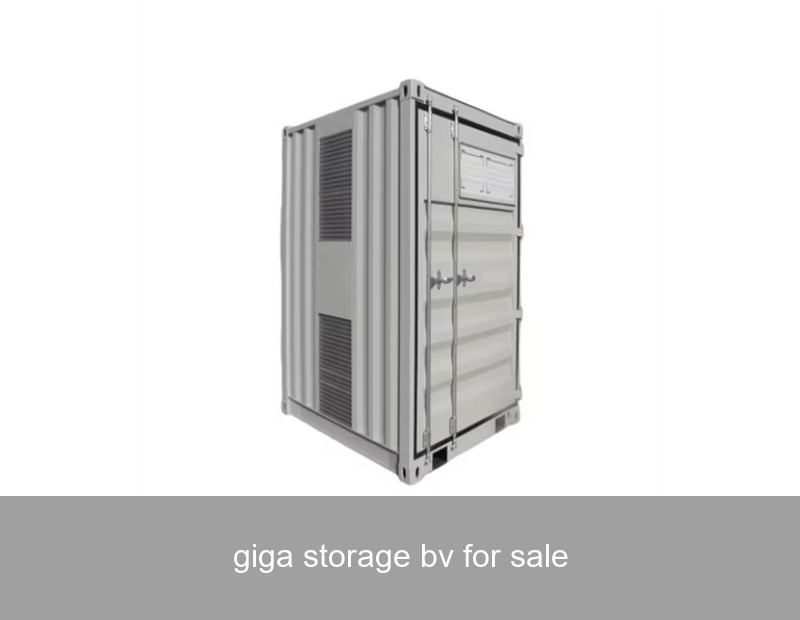
If you've been following the energy sector news, you might have seen a headline that piqued your interest: Giga Storage BV for sale. This isn't just another corporate transaction. For industry insiders, it's a significant marker, a signpost indicating the rapid evolution and immense potential of the European large-scale battery energy storage system (BESS) market. The move by this Dutch developer to seek new ownership reflects a critical juncture where visionary project development meets the need for deep industrial expertise and capital to scale. Let's unpack what this means for the future of grid stability and renewable integration.
Table of Contents
- From Niche to Necessity: The Grid-Scale Storage Phenomenon
- By the Numbers: The Data Driving the BESS Boom
- Case Study: Lessons from a European Frontrunner
- The "Giga Storage BV for Sale" Context: Project Pipeline vs. Operational Mastery
- Beyond the Battery: The Critical Role of Intelligent Power Conversion
- The Future Grid: Integrated, Intelligent, and Resilient
From Niche to Necessity: The Grid-Scale Storage Phenomenon
Remember when solar and wind were the "alternative" energy sources? Today, they are the workhorses of the new power paradigm. But this revolution brought a fundamental challenge: intermittency. The sun sets, the wind calms, yet demand for electricity continues. This mismatch creates a volatile grid, leading to frequency deviations, congestion, and even the paradoxical curtailment of renewable energy because the grid can't absorb it all. The phenomenon is clear—a renewable-rich grid is an unstable grid without a balancing mechanism.
Enter the giga-scale battery. These are not the powerwalls in your basement. We're talking about warehouse-sized systems, often connected directly to the transmission grid, with capacities measured in hundreds of Megawatt-hours (MWh). They act as giant shock absorbers, charging when there's excess green power and discharging during peak demand or renewable shortfalls. The market has shifted from viewing these assets as experimental to recognizing them as essential infrastructure, much like substations or power lines. This is the mature market that a company like Giga Storage BV helped pioneer, and its sale highlights the next phase of industrial consolidation and scaling.
By the Numbers: The Data Driving the BESS Boom
The momentum isn't based on hype; it's grounded in compelling data. According to the International Energy Agency (IEA), global grid-scale storage capacity needs to expand dramatically to meet net-zero goals, with annual additions expected to grow exponentially. In Europe, driven by the REPowerEU plan and national targets, the pipeline for energy storage projects is staggering.
| Region | Key Driver | Projected BESS Capacity Growth (2023-2030) |
|---|---|---|
| United Kingdom | Dynamic Containment & Balancing Mechanism | Over 24 GW expected by 2030 |
| Germany | Phase-out of nuclear & coal, renewable integration | Needs ~15 GW by 2030 to support grid |
| ERCOT (Texas, USA) | Market volatility, ancillary service opportunities | Over 10 GW already operational |
This data reveals a massive opportunity. However, building a project pipeline is one thing; delivering a reliable, safe, and profitable operating asset for decades is another. This is where the expertise of established technology providers becomes non-negotiable.

Credit: Photo by American Public Power Association on Unsplash. Grid-scale BESS installations are becoming a common sight alongside renewable generation.
Case Study: Lessons from a European Frontrunner
Let's look at a concrete example to understand the value at stake. In 2022, a 100 MWh battery storage system in Belgium, developed by a partner of Giga Storage, began operations. Its primary role was to provide frequency containment reserve (FCR) services, stabilizing the Continental European grid. The data from its first year was telling:
- Revenue Streams: It successfully generated income not just from FCR, but also from energy arbitrage (buying low, selling high) and peak shaving.
- Performance: The system achieved a 99% availability rate, crucial for grid service contracts that impose penalties for downtime.
- Challenge: The project's profitability was highly sensitive to the degradation rate of the batteries and the efficiency of the total system. A drop of a few percentage points in round-trip efficiency could erase millions in revenue over the asset's life.
This case underscores a critical insight: the financial success of a "giga storage" asset hinges on the underlying technology's quality, the sophistication of its energy management system (EMS), and the provider's long-term operational support. It's a complex, mission-critical engineering challenge, not just a financial investment.
The "Giga Storage BV for Sale" Context: Project Pipeline vs. Operational Mastery
This brings us back to the headline. A sale process for a developer like Giga Storage BV often represents the transition from the "development" phase to the "long-term operational" phase. Early-stage developers excel at securing grid connections, permits, and initial design. To truly build and operate a portfolio of gigawatt-hour-scale assets, however, requires a different set of muscles:
- Deep System Integration Knowledge: How do the battery cells, thermal management, fire suppression, and power conversion systems (PCS) work as one seamless unit?
- Grid Compliance & Interconnection Expertise: Navigating the stringent grid codes of different European countries.
- Lifecycle Performance Guarantees: Offering warranties and performance assurances that span 15-20 years.
This is the core of what companies like Highjoule bring to the table. Since 2005, we have evolved from a technology innovator to a global provider of complete, intelligent BESS solutions. For a utility or investor looking at an asset like those in the Giga Storage BV portfolio, partnering with an experienced technology provider mitigates immense risk. Our H-Joule GridMax series, for instance, is engineered specifically for utility-scale applications, featuring integrated PCS with advanced grid-forming capabilities, proactive safety systems, and an AI-driven EMS that optimizes for multiple revenue streams automatically.
Beyond the Battery: The Critical Role of Intelligent Power Conversion
Often overlooked in the "giga storage" discussion is the brain and the heart of the system: the power conversion system and the energy management software. The battery rack is the fuel tank; the PCS is the high-performance engine. A superior PCS, like the ones we design at Highjoule, offers higher efficiency (over 98.5%), greater reliability, and crucially, grid-forming inverters. These inverters can "create" a stable grid voltage and frequency from scratch, a feature essential for future grids with less rotational inertia from traditional generators. This isn't just storage; it's grid resilience embodied in a cabinet.

Credit: Photo by ThisisEngineering RAEng on Unsplash. Intelligent energy management systems are key to maximizing the value of storage assets.
The Future Grid: Integrated, Intelligent, and Resilient
The sale of a developer like Giga Storage BV isn't an endpoint; it's a milestone. It signals that the market is maturing, recognizing that sustainable value lies in technically excellent, reliably operated assets. The future grid will be a tapestry of distributed resources—solar farms, wind parks, EV charging hubs, and industrial microgrids—all orchestrated by storage systems.
For a commercial or industrial entity, this future is already here. Highjoule's solutions extend beyond the transmission grid. Our H-Joule C&I and Microgrid platforms allow factories, data centers, and campuses to achieve energy independence, reduce demand charges, and provide backup power, all while contributing to grid stability. The same core technology that stabilizes a national grid can optimize a factory's energy bill.
So, as you watch developments like Giga Storage BV for sale, look beyond the transaction. See it as a call for the next level of expertise. Whether you are an investor evaluating a storage portfolio, a utility planning grid upgrades, or an industrial player seeking control over your energy costs, the question remains: How will you ensure that your storage asset is built on a foundation of operational excellence, not just development potential?
 Inquiry
 Online Chat