


Grados de Inclinacion para Paneles Solares: The Secret to Unlocking Maximum Solar Yield
Let's be honest. When you think about going solar, you probably picture shiny panels on a roof. You research brands, compare wattages, and calculate system sizes. But here's a question that often gets overshadowed: at what exact angle should those panels be installed? The grados de inclinacion para paneles solares (solar panel tilt degrees) are far from a mere installation detail; they are a fundamental lever controlling the efficiency and financial return of your entire investment. Get it right, and you're harvesting every possible photon. Get it wrong, and you're leaving significant energy—and money—on the table, especially in diverse climates like those across Europe and the United States.
The Science Behind the Slope: It's All About the Sun's Path
Imagine the sun as a moving target in the sky. Its height (altitude) changes throughout the day and, more dramatically, with the seasons. In summer, the sun takes a high arc; in winter, it stays low on the horizon. The primary goal of tilting your panels is to position them perpendicular to the sun's rays as often as possible. This minimizes glare and reflection and maximizes direct exposure, allowing the photovoltaic cells to work at their peak capacity.
Think of it like sunbathing. At noon in July, you lie flat. But in the late afternoon of December, you'd tilt your body toward the low sun to catch its weak rays. Your solar panels need to do the same dance with the seasons.

Image Source: Wikimedia Commons, illustrating the change in solar altitude between summer and winter.
The Goldilocks Zone: Finding Your Perfect Tilt Angle
So, how do you find this "just right" angle? It's a blend of simple rules, smart technology, and local nuance.
Rule-of-Thumb and Latitude-Based Calculations
The most common starting point is your geographic latitude. A classic rule is to set the tilt angle equal to your latitude. This optimizes annual yield. For example:
- Los Angeles, USA (Lat. ~34°N): A good starting tilt is ~34 degrees.
- Berlin, Germany (Lat. ~52°N): An initial angle around 52 degrees is typical.
To maximize production during the sun-scarce winter months, you can increase the angle to latitude + 15°. Conversely, to capture more summer sun, you'd use latitude - 15°. This is where the first big decision comes in: are you aiming for consistent year-round production, or do you want to peak in a specific season to match your consumption patterns?
Seasonal Adjustments: The Case for Dynamic Racking
What if you didn't have to choose? This is the realm of adjustable or tracking mounting systems. Manually adjusting tilt 2-4 times a year can boost annual yield by 5-10% compared to a fixed optimal angle. For larger commercial installations, single-axis trackers that follow the sun east-to-west can increase production by 25% or more. The choice between fixed, seasonally adjustable, and tracking systems involves a cost-benefit analysis specific to your site and energy goals.
Beyond Degrees: Critical Local Factors
Your latitude is just the opening chapter. A truly optimized design must consider:
- Local Climate: Heavy snow regions may need steeper tilts (up to 60°) for snow shedding. Cloudy, diffuse-light climates (like parts of the UK) often benefit from slightly lower angles to catch more of the overall sky radiance.
- Roof Type & Constraints: A flat roof offers complete freedom for ideal tilt racks. A pitched roof often dictates the angle, requiring a calculation to see if it's acceptable or if a more complex mounting solution is warranted.
- Time-of-Use Rates: If your utility charges more in the evening, you might slightly westerly orient ("azimuth") and adjust tilt to maximize late-afternoon production, shifting the ideal angle.
From Theory to Kilowatts: A Real-World Case Study in Madrid
Let's look at a practical example. A medium-sized winery near Madrid, Spain (latitude ~40°N), installed a 100 kW solar array in 2022 to power its operations and cooling systems. The initial proposal used a simple fixed tilt at 35°, slightly lower than the latitude, aiming for a balanced annual output.
However, a detailed simulation using historical weather data revealed a key insight: the winery's energy consumption spiked over 40% during the hot summer months due to refrigeration. The initial fixed design left this seasonal demand partially unmet, forcing them to draw expensive grid power.
The solution was a seasonally adjustable racking system. The angles are now changed twice a year:
| Season | Tilt Angle | Primary Goal |
|---|---|---|
| Spring/Summer (Mar-Aug) | 25° | Maximize summer sun capture to power cooling |
| Autumn/Winter (Sep-Feb) | 55° | Optimize for lower winter sun & increase yield on shorter days |
The result? The system's summer production increased by 18% compared to the fixed 35° design, almost perfectly aligning with the winery's cooling load. The annual energy self-consumption rate rose from an estimated 68% to 82%, significantly improving the project's payback period. This case underscores that the "perfect" tilt is not a single number, but a strategy aligned with when you use energy.
Highjoule's Holistic Approach: Beyond Just Panel Placement
At Highjoule, we understand that optimizing grados de inclinacion para paneles solares is a critical step, but it's only one piece of the energy independence puzzle. True efficiency comes from integrating generation with intelligent storage and management.
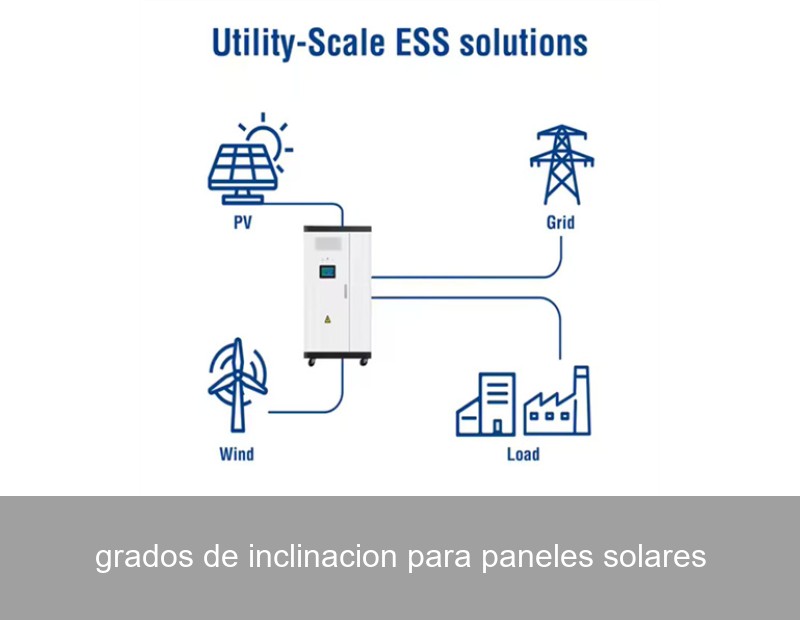
Our HPS Series (Hybrid Power Systems) for commercial and industrial applications are designed with this synergy in mind. We don't just design the solar array; we model its production at different tilts and azimuths against your specific load profile. This data then informs the sizing and control strategy of our integrated battery storage. For instance, excess summer production from an optimized low-tilt array can be stored in our IntelliBESS battery systems for use during evening peaks or transferred to less sunny periods.
For residential clients, our Home Energy Ecosystem provides a seamless solution. Our design tools automatically calculate the best tilt for your roof, considering local weather patterns, and pair it with a home battery system. This ensures you maximize solar self-consumption, protect yourself from outages, and reduce reliance on the grid, regardless of the season or the sun's position in the sky.

Image Source: Unsplash. A technician works on a modern energy storage system, a key component for maximizing solar use.
Your Solar Potential, Optimized
The journey to optimal solar yield is a fascinating mix of astronomy, geography, and economics. By giving the tilt angle the attention it deserves, you move from simply installing solar panels to engineering a high-performance energy asset. But the conversation shouldn't end at the angle. How will you store and manage that optimally harvested energy to achieve true resilience and cost savings?
What unique energy consumption pattern does your home or business have that should dictate not just *how much* solar you produce, but *when* you produce it? Exploring this question is the first step toward a genuinely customized solution.
 Inquiry
 Online Chat