


Grid Energy Storage Companies: The Architects of a Resilient, Renewable-Powered Future
Imagine this: it's a calm, sunny afternoon, and solar panels across your region are generating record-breaking clean energy. But by evening, demand peaks just as the sun sets, forcing the grid to rely on fossil-fuel plants. This daily mismatch between renewable supply and energy demand is the central challenge of our clean energy transition. This is precisely where grid energy storage companies step in, not just as equipment suppliers, but as essential architects of a new, flexible, and resilient power infrastructure. For nearly two decades, Highjoule has been at the forefront of this transformation, engineering intelligent battery energy storage systems (BESS) that turn intermittent renewable power into a reliable, dispatchable resource for grids, communities, and industries.
The Grid at a Crossroads: Why Storage is No Longer Optional
The traditional electricity grid was built on a simple principle: generate power exactly when it's needed. Coal, gas, and nuclear plants provided this steady, "baseload" power. But the explosive growth of wind and solar—inherently variable sources—has turned this model on its head. Grid operators now face a complex balancing act. The U.S. Energy Information Administration (EIA) projects that renewables will make up 44% of U.S. electricity generation by 2050, a trend mirrored in Europe. Without a buffer, this can lead to grid instability, curtailment (wasting excess renewable energy), and continued reliance on carbon-intensive "peaker" plants.
This is the critical phenomenon. The data is compelling. A study by the National Renewable Energy Laboratory (NREL) found that adding storage can increase the grid's ability to host renewable energy by up to 90% in some scenarios. The case for storage is proven, leading to the core insight: the modern grid doesn't just need more generation; it needs intelligent time-shifting of energy. This is the fundamental value proposition of leading grid energy storage companies.

Image: Solar farms paired with battery storage are becoming a common sight, enabling clean energy to be available day and night. Source: Unsplash
Defining the Modern Grid Energy Storage Company
Today's top-tier grid energy storage companies are far more than battery pack assemblers. They are technology integrators and grid service providers. Their role encompasses:
- System Design & Engineering: Creating tailored solutions that match grid-scale power (MW) and energy (MWh) requirements.
- Advanced Power Conversion: Manufacturing sophisticated inverters that manage the flow between DC batteries and the AC grid.
- Grid Integration Software: Developing the "brain" of the system—software that can autonomously respond to grid signals, perform frequency regulation, or store energy for peak shaving.
- Project Development & Financing: Navigating complex regulations, securing permits, and often offering financing models like Energy-as-a-Service (EaaS).
- Long-term Operations & Maintenance (O&M): Ensuring system health, safety, and performance over a 15-20 year lifespan.
Key Technologies Driving Change
The effectiveness of a grid energy storage company hinges on its technological stack. The landscape is dominated by lithium-ion batteries, but not all are equal.
| Technology Focus | Key Advantage | Typical Grid Application |
|---|---|---|
| Lithium Iron Phosphate (LFP) Batteries | Superior safety, long cycle life, lower cost over time | Bulk energy time-shifting (4+ hours), Renewable firming |
| Grid-Forming Inverters | Can "create" a stable grid waveform, essential for grids with high renewable penetration | Microgrids, Weak grids, Black start capabilities |
| AI-Powered Energy Management Systems (EMS) | Optimizes revenue by stacking multiple value streams (arbitrage, frequency response, capacity) | Merchant storage projects, Commercial & Industrial sites |
At Highjoule, our H-Series BESS platform is built around LFP chemistry for maximum safety and longevity. Its integrated, grid-forming capable inverter allows it to not just follow the grid's lead but actively support its stability—a critical feature as we move toward a decentralized power system.
A Real-World Case Study: Stability in Southern Europe
Let's move from theory to practice. A compelling example comes from a project Highjoule completed in Southern Europe, on the island of Crete. The island's grid, somewhat isolated from the mainland, faced significant frequency instability due to a high share of wind power and seasonal tourism demand spikes. The local grid operator needed a solution that could react within milliseconds to balance supply and demand.
Highjoule deployed a 20 MW / 40 MWh battery storage system at a key substation. The system's primary function is frequency regulation, but it's also programmed to provide peak shaving during the busy summer months. Here's the impact, measured over its first 18 months of operation:
- Frequency Response Time: < 100 milliseconds, far faster than any traditional generator.
- Renewable Curtailment Reduced: By over 15%, allowing more local wind energy to be used.
- CO2 Emissions Avoided: An estimated 12,000 tonnes annually by displacing diesel peaker plant use.
This project exemplifies how a forward-thinking grid energy storage company delivers tangible reliability and decarbonization benefits. It's a replicable model for island grids, remote communities, and any network seeking to integrate more renewables securely. You can explore more on the importance of grid-scale storage from the International Renewable Energy Agency (IRENA).
Choosing the Right Grid Energy Storage Partner
With many players entering the market, selecting a grid energy storage company is a strategic decision. Key criteria should include:
- Proven Track Record: Look for a portfolio of operational, utility-scale projects, not just announcements.
- Technology Depth: Do they control their core IP, especially in software and system integration?
- Safety Philosophy: Insist on certifications (UL, IEC) and a design-first safety approach encompassing battery chemistry, thermal management, and fire suppression.
- Financial Stability & Long-term View: Your storage asset will operate for decades. The provider should be a partner for the long haul.
Highjoule: Your Strategic Storage Partner
Since 2005, Highjoule has grown from a pioneering startup into a global leader by focusing on these very principles. We understand that every grid, business, and community has unique needs. That's why our approach is consultative first. Our team of engineers works with you to model your energy profile, identify the optimal use cases, and design a system that maximizes your return—whether your goal is energy cost savings, resilience, or grid services revenue.
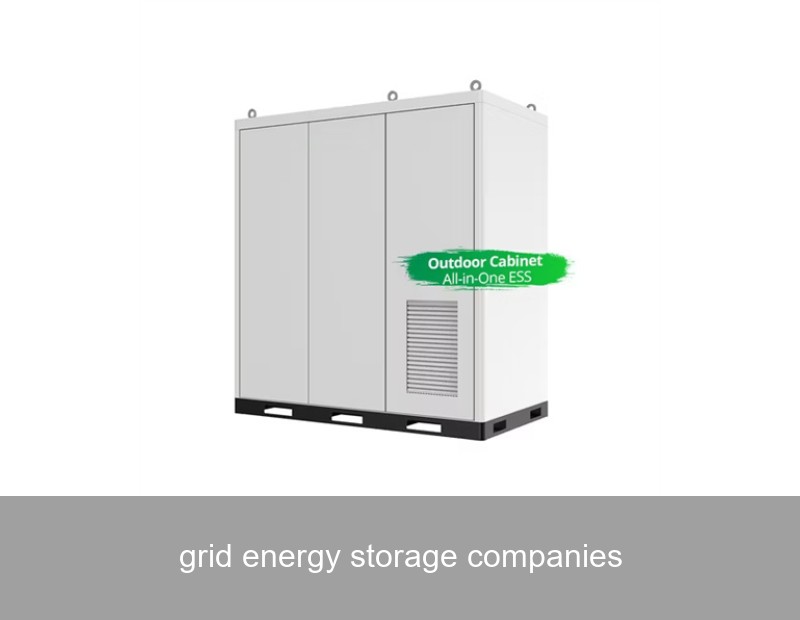
Our flagship product, the Highjoule H-Series, is a containerized, all-in-one BESS solution designed for simplicity and scalability. It's complemented by our JouleOS™ software platform, which enables remote monitoring, advanced grid service participation, and predictive maintenance. For commercial and industrial clients, our EnerLogic™ suite provides tools for demand charge reduction and backup power assurance. From a 500 kWh factory to a 500 MWh grid-side project, we provide the intelligence and hardware to make storage work hard for you.

Image: Advanced control systems are crucial for managing the complex functions of grid-scale storage. Source: Unsplash
The Future is Integrated and Intelligent
The trajectory is clear. The grid of the future will be a dynamic network of distributed resources: rooftop solar, community wind, electric vehicles, and of course, storage. The most successful grid energy storage companies will be those that can seamlessly orchestrate these assets into a cohesive, reliable whole. We're already moving toward virtual power plants (VPPs), where thousands of decentralized storage systems are aggregated to act like a single, large power plant.
The question for grid operators, utilities, and large energy consumers is no longer if they need storage, but how to implement it most effectively. What specific grid constraint or business energy challenge could a strategically placed storage system solve for you in the next 24 months?
 Inquiry
 Online Chat