


What Makes a Truly Great High Energy Batteries Company? Beyond the Spec Sheet
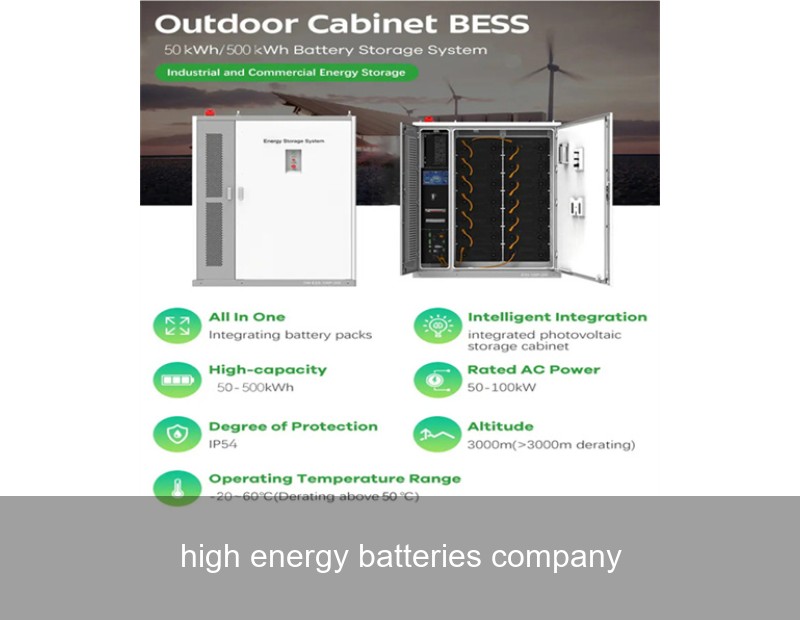
You've seen the headlines: "Grid Strain Worsens," "Energy Prices Volatile," "Renewables Integration Challenge." For businesses, municipalities, and homeowners, the promise of energy independence is clear, but the path is often clouded by technical jargon and flashy marketing. At the heart of this transition lies a critical component: the high-energy battery. But not all batteries—or the companies behind them—are created equal. So, what should you look for when choosing a high energy batteries company? It's not just about the highest kilowatt-hour rating. It's about intelligence, durability, safety, and a deep understanding of how energy is truly used. This is where the industry's leaders separate themselves from the pack.
Table of Contents
- The Phenomenon: Why We Need More Than Just Energy Density
- The Data: Quantifying the Value of a Smart, High-Energy System
- Case Study: A German Industrial Park's Journey to Resilience
- The Expert View: Key Differentiators in Advanced Battery Systems
- Highjoule's Approach: Engineering Sustainable Power Solutions
- Looking Ahead: What's Next for Energy Storage?
The Phenomenon: Why We Need More Than Just Energy Density
Imagine two electric vehicles with identical battery capacity. One consistently achieves 20% more range and maintains its performance for years longer. The difference isn't the raw energy stored; it's the sophisticated Battery Management System (BMS), thermal controls, and integration software that intelligently manages every charge and discharge cycle. This same principle applies exponentially to stationary storage for a factory, a hospital, or a neighborhood microgrid.
The market is flooded with companies offering "high-energy" cells. However, a leading high energy batteries company focuses on the system. They deliver not just a container of batteries, but a fully integrated, software-driven power asset. This shift from commodity to intelligent solution is crucial for tackling real-world problems like peak shaving, backup during outages, and maximizing self-consumption of solar power.
The Data: Quantifying the Value of a Smart, High-Energy System
Let's move beyond theory. Consider the financial and operational impact:
| Metric | Basic Battery Pack | Advanced, Intelligent BESS* |
|---|---|---|
| Cycle Life (to 80% capacity) | 4,000 - 6,000 cycles | 8,000+ cycles |
| Round-Trip Efficiency | 85-90% | 94-96% |
| Peak Shaving Capability | Basic, fixed schedule | AI-predictive, dynamic based on load & tariffs |
| System Degradation | Uneven, faster | Actively balanced, minimized |
*BESS: Battery Energy Storage System. Source: Compiled from industry whitepapers including the U.S. Department of Energy.
The right-hand column represents the standard for a top-tier provider. That few percent increase in efficiency and doubled cycle life translates directly into tens of thousands in saved energy costs and deferred capital expenditures over a 15-20 year system life.
Case Study: A German Industrial Park's Journey to Resilience
Let's examine a real-world application in Bavaria, Germany. A mid-sized manufacturing park, housing three precision engineering firms, faced two major challenges: skyrocketing Netzentgelte (grid fees) based on their peak power draw and unreliable grid power causing costly production halts.
Their solution was a 1.2 MWh / 750 kW DC-coupled battery storage system, integrated with their existing 500 kWp rooftop solar array. The system was designed not merely to store energy, but to act as a dynamic power manager.
- Objective 1: Peak Shaving. The system's AI software learns the facility's load patterns and proactively discharges the battery to "shave" peaks, reducing the maximum power drawn from the grid.
- Objective 2: Backup Power. Critical production lines are islanded to run on solar + storage during grid outages.
- Results After 18 Months:
- 22% Reduction in annual grid fee costs.
- 68% Increase in on-site solar consumption.
- Elimination of two potential production stoppages thanks to seamless backup transition.
- Projected ROI period: Under 7 years, thanks to Germany's favorable regulatory environment for self-consumption.
This case underscores that the value of a modern high energy batteries company lies in its software intelligence and application engineering as much as its electrochemical expertise.

Image Source: Unsplash (Representative image of industrial solar and storage)
The Expert View: Key Differentiators in Advanced Battery Systems
Based on two decades of industry evolution, here are the non-negotiable features to demand from your storage partner:
1. Chemistry-Agnostic, Application-Focused Design
The best companies, like Highjoule, engineer platforms that can optimally utilize various cell chemistries (e.g., LFP - Lithium Iron Phosphate) based on the client's priority: maximum cycle life, extreme energy density, or wide temperature performance. They don't force-fit one chemistry into every scenario.
2. The "Digital Brain": Advanced Energy Management System (EMS)
This is the core differentiator. A true EMS goes beyond simple set-points. It uses weather forecasts, electricity price signals (critical in EU and US markets), and load predictions to autonomously optimize the system for economic return or carbon reduction. You can see this in action through a transparent user portal.
3. Safety by Architecture, Not Just Certification
Safety isn't a checkbox. It's designed in from the cell level up. This includes passive safety of LFP chemistry, active thermal runaway propagation prevention between modules, and granular, millisecond-level monitoring at the cell level. Look for designs that exceed local standards like UL 9540 in the US or IEC 62619 in Europe.
Highjoule's Approach: Engineering Sustainable Power Solutions
Since 2005, Highjoule has operated on a simple but powerful premise: energy storage should be an intelligent, resilient, and profitable asset. As a global provider, we don't just sell batteries; we deliver tailored power solutions for commercial, industrial, residential, and microgrid applications.
Our flagship product line, the H-Series Modular Energy Storage System, embodies this philosophy. Built with our proprietary Sentinel BMS and JouleMind AI-EMS, the H-Series is designed for scalability and longevity. A commercial building in California uses it for demand charge reduction, while a remote microgrid in Scandinavia relies on it for 24/7 renewable power, all powered by the same adaptable platform.
Our services extend beyond installation. We offer comprehensive Energy Analytics as a Service, where our experts continuously analyze your system's performance and energy markets, recommending operational adjustments to maximize your savings. Think of us as a long-term partner in your energy resilience, not just a supplier.

Image Source: Unsplash (Representative image of technician and battery system)
Looking Ahead: What's Next for Energy Storage?
The frontier is shifting from single-system optimization to grid interactivity. The next-generation high energy batteries company will provide systems that can seamlessly aggregate to form Virtual Power Plants (VPPs), providing critical grid services like frequency regulation. This turns distributed storage assets into a stabilizing force for the entire electricity network, creating new revenue streams for owners. The technology exists today; widespread adoption hinges on regulatory evolution and interoperable standards, areas where industry leaders are actively engaged. For a deeper dive on VPPs and grid services, the National Renewable Energy Laboratory (NREL) provides excellent resources.
Is your organization currently evaluating storage primarily for backup power, without fully modeling its potential for daily cost savings and potential future grid revenue?
 Inquiry
 Online Chat