


Finding the Highest Rating Solar Panel: Your Guide to Maximum Energy Independence
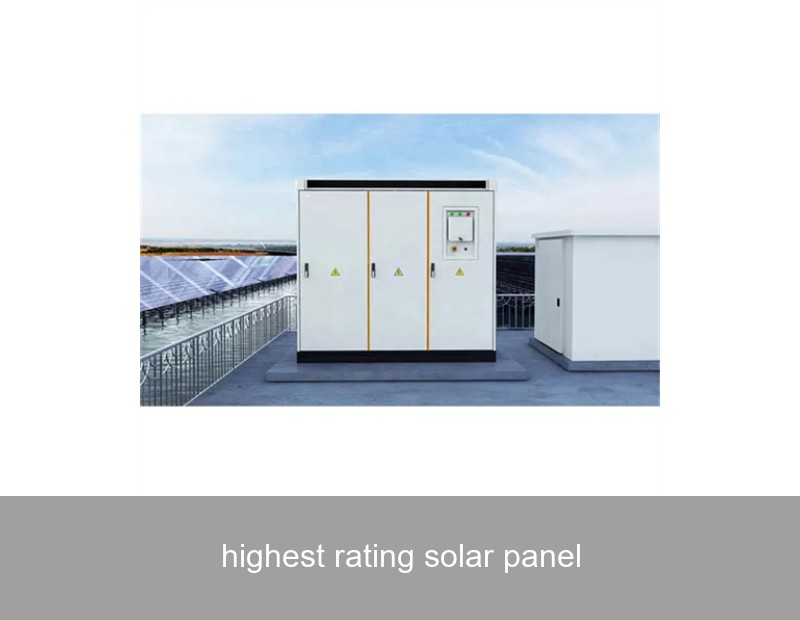
You've decided to go solar. It's a smart move for your wallet and the planet. But as you start researching, you're immediately faced with a crucial question: How do I choose the highest rating solar panel for my home or business? It's not just about picking the shiniest one or the biggest brand. The "highest rating" encompasses efficiency, durability, real-world performance, and the intelligence of the system that supports it. In today's energy landscape, a panel is only as good as the ecosystem it's part of. This article will guide you through what "highest rating" truly means in 2024 and how to ensure your investment delivers peak performance for decades.
Table of Contents
- The Efficiency Obsession: Beyond the Lab Sheet
- The Durability Factor: What Ratings Like IEC 61215 Really Mean
- Bridging the Real-World Performance Gap
- Case Study: A Bavarian Dairy Farm's Success with High-Performance Solar
- The Intelligent System: Where the Highest Rating is Truly Earned
- Highjoule's Integrated Approach to Solar & Storage
- Your Next Step Towards a Smarter Energy Future
The Efficiency Obsession: Beyond the Lab Sheet
When most people search for the "highest rating solar panel," they're initially drawn to conversion efficiency. This percentage (e.g., 22.8%) tells you how much sunlight hitting the panel is converted into usable electricity. Top-tier manufacturers like LONGi, REC, and SunPower consistently push these boundaries with technologies like N-type TOPCon and HJT cells. It's a vital metric—higher efficiency means you can generate more power in the same roof space, a key factor for residential installations with limited area.
However, here's the professional insight: efficiency alone is a snapshot, not the full movie. The National Renewable Energy Laboratory (NREL) efficiency chart showcases remarkable lab achievements. But your roof isn't a controlled lab. Temperature coefficients, low-light performance, and degradation rates are equally critical "ratings" that determine lifetime yield. A panel with a slightly lower peak efficiency but a superior temperature coefficient (meaning it loses less power on a hot day) can often outperform a "peak champion" in real-world conditions, especially in sun-drenched markets like Southern Europe or California.
The Durability Factor: What Ratings Like IEC 61215 Really Mean
Your solar array is a 25+ year investment. The highest rating must also be for resilience. This is where international certification standards become your best friend. The IEC 61215 (for performance) and IEC 61730 (for safety) are the global benchmarks. These rigorous tests simulate decades of environmental stress—from hail impact and wind load to humidity freeze and UV exposure.
When evaluating panels, look for:
- Performance Warranty: A 25-year linear warranty guaranteeing 92% output after 25 years is now industry-leading.
- Material Warranty: A 25-year product warranty against defects and environmental wear.
- Third-Party Validation: Ratings from independent bodies like TÜV Rheinland add a layer of trust beyond manufacturer claims.

Image: A high-efficiency solar installation requires both top-tier panels and professional integration. (Source: Unsplash, representative image)
Bridging the Real-World Performance Gap
This is the crux of modern solar success. You can have the world's highest-rated panels, but if they're connected to a subpar inverter, poorly configured, or lack energy management, you're leaving significant value on the table. The "performance gap" between theoretical DC panel output and usable AC power in your home is where system intelligence makes all the difference.
Think of it this way: a Formula 1 car (your premium panels) needs an elite driver and pit crew (your power conversion and management system) to win the race. Micro-inverters or DC optimizers can mitigate shading issues on a panel-by-panel level, boosting overall system yield. But the next level of performance comes from integration with storage.
Case Study: A Bavarian Dairy Farm's Success with High-Performance Solar
Consider a real-world example from our target market. A medium-sized dairy farm in Bavaria, Germany, installed a 50 kWp rooftop system using high-efficiency bifacial panels in 2022. The panels were top-rated, but the farm's goal was energy autonomy to power milking machines, cooling, and lighting 24/7.
The challenge? High daytime solar production didn't match evening energy peaks. By pairing the system with a Highjoule HI Series Commercial Battery Storage System (120 kWh capacity), the farm achieved a remarkable result:
| Metric | Before Storage | After Storage Integration |
|---|---|---|
| Self-Consumption of Solar | 35% | Over 85% |
| Grid Energy Purchased (Monthly) | ~4,200 kWh | ~650 kWh |
| Grid Feed-in Revenue (Annual) | €5,200 | €1,100 (lower, but vastly reduced purchase costs) |
| Energy Cost Savings (Annual) | - | €8,400+ |
The data shows the transformative impact. The "highest rating" was achieved not by the panels alone, but by creating an intelligent, integrated system that captured and time-shifted solar energy. The farm now enjoys predictable energy costs and operational resilience, crucial for agribusiness.
The Intelligent System: Where the Highest Rating is Truly Earned
So, we must redefine "highest rating." It's no longer a singular product metric. It's the System Performance Rating. This encompasses:
- Panel Efficiency & Durability: The foundation.
- Power Electronics Intelligence: Inverters that maximize harvest and provide grid services. Storage Integration: The ability to store surplus energy for when you need it most. Energy Management Software (EMS): The brain that optimizes flow between solar, storage, grid, and loads, often using AI for predictive energy shifting.
This holistic approach is what turns a capital expenditure into a strategic energy asset. It's what allows a homeowner in Texas to power through grid outages or a factory in Italy to participate in demand response programs profitably.

Image: A modern battery storage system, like Highjoule's residential solutions, is key to maximizing solar self-consumption. (Source: Unsplash, representative image)
Highjoule's Integrated Approach to Solar & Storage
At Highjoule, with nearly two decades of experience since 2005, we've always believed the highest rating belongs to the complete energy solution. We partner with leading panel manufacturers to source top-tier modules, but our core expertise lies in integrating them into resilient, intelligent systems.
Our product ecosystem is designed to close the performance gap:
- Highjoule HI Series & HES Series Battery Systems: Scalable lithium iron phosphate (LFP) storage solutions for residential, commercial, and industrial applications. Renowned for safety, longevity (over 6,000 cycles), and high round-trip efficiency.
- Highjoule Energy Management Platform: Cloud-based AI software that provides real-time monitoring, predictive energy scheduling, and remote system optimization. It's the command center for your personal microgrid.
- Highjoule Power Conversion Systems: Bi-directional inverters that seamlessly manage energy flow between all sources and loads, ensuring stability and efficiency.
For a homeowner, this means our systems automatically charge batteries with excess solar, power your home at night, and even provide backup power during outages. For a business, it means peak shaving, demand charge reduction, and enhanced sustainability reporting—all managed autonomously.
Your Next Step Towards a Smarter Energy Future
Choosing the highest rating solar panel is an excellent starting point. But I invite you to think bigger. Ask yourself and potential providers: "How will this system not just generate power, but intelligently manage and store it to maximize my energy independence and financial return over its entire lifespan?"
The future of energy is not singular components, but integrated, adaptive ecosystems. What specific energy challenge—be it rising utility bills, grid reliability concerns, or sustainability goals—are you hoping your solar investment will solve?
 Inquiry
 Online Chat