


How Much Can a 750 Watt Solar Panel System Power? A Real-World Guide
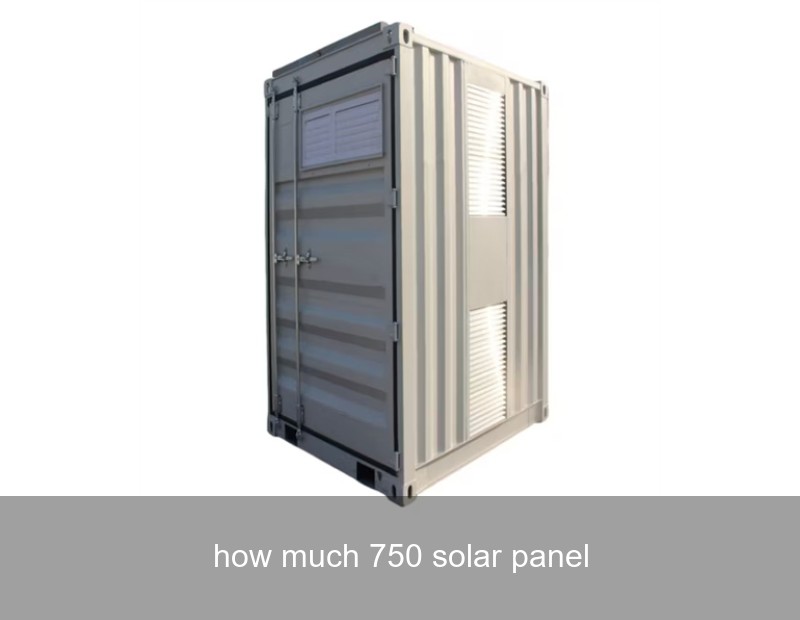
You're considering solar panels and you've seen the 750-watt unit mentioned. It's a great starting point, but the real question isn't just about the panel on your roof. It's about the energy independence it can unlock for your home or business. The answer to "how much" hinges not on a single panel, but on your system's total size, your location's sun exposure, and critically, how you store and manage that power. As energy costs remain volatile, understanding the full picture of solar generation paired with intelligent storage is the key to true resilience and savings.
Table of Contents
Understanding the 750W Panel's Output: It's About Daily Harvest
First, let's clarify. A "750-watt solar panel" typically refers to a solar panel system with a total capacity of around 750 watts, often composed of 2-3 modern high-efficiency modules. A single panel's rating is usually between 350-450 watts. This 750W DC (Direct Current) rating represents its peak output under ideal laboratory conditions. In the real world, your daily energy harvest is what counts.
Think of it this way: the panel's wattage is its maximum potential speed. But how far it travels (energy produced) depends on how long and how brightly the sun shines. This is measured in kilowatt-hours (kWh). A simple formula gives a good estimate:
Daily Energy (kWh) = System Size (kW) × Peak Sun Hours × System Efficiency
For our 750W (0.75 kW) system in, say, Southern California (5.5 peak sun hours) or Southern Spain (5.0 peak sun hours) with about 80% efficiency (accounting for inverter losses, temperature, etc.), the daily yield looks like:
- California: 0.75 kW × 5.5 hours × 0.80 = ~3.3 kWh per day
- Spain: 0.75 kW × 5.0 hours × 0.80 = ~3.0 kWh per day
What does 3-3.5 kWh power? It could run your refrigerator for a day, power your laptop for 30+ hours, or keep your LED lighting humming through the evening. But to cover an entire home's load or shift energy to night-time use, you need a larger system and a crucial companion: a battery.

Credit: Photo by Andreas Gücklhorn on Unsplash. Modern high-efficiency panels are the building blocks of a resilient energy system.
From Panel to System: Why Total System Size is What Counts
Focusing on a single 750W unit is like planning a cross-country trip by considering only your car's gearshift. You need to see the whole vehicle. Most residential installations in Europe and the U.S. range from 4 kW to 10 kW to meaningfully offset a significant portion of a household's electricity bill. A 750W setup is often an entry point or an expansion.
The true metric is your annual consumption. According to the U.S. Energy Information Administration, the average American home uses about 10,500 kWh annually (~29 kWh/day). In the EU, figures vary, but a typical household in Germany might use 3,000-4,000 kWh annually. Matching your system size to your consumption profile, while planning for future needs like an EV, is essential.
The Storage Imperative: Making Your Solar Work 24/7
Here's the pivotal insight: solar panels generate when the sun is shining, but energy demand peaks in the morning and evening. Without storage, excess midday energy often gets sold back to the grid at a low rate, only for you to buy it back at night at a higher price. The economics and resilience leap forward when you add a battery.
This is where companies like Highjoule transform solar from a supplemental source to a primary power solution. Highjoule's HES (Home Energy System) integrates seamlessly with new or existing solar arrays. Its intelligent inverter and modular lithium iron phosphate (LiFePO4) battery units don't just store energy; they manage it. The system's software learns your usage patterns, automatically deciding when to store solar energy, power your home, or draw from the grid to optimize for cost and carbon footprint.
Imagine your 750W solar array producing its 3 kWh during the day. With a Highjoule HES, that energy can charge the battery to run your critical loads (lights, internet, refrigeration) all through the night, effectively doubling the utility of your solar generation. For larger systems, the benefit is even more profound.
Real-World Case: The Müller Family in Bavaria, Germany
Let's ground this with data from a real project. The Müller family in a suburban home near Munich had a 6.6 kW solar array (not unlike combining several 750W units). They faced the classic dilemma: high self-consumption during the day was low, and they relied heavily on the grid at night.
In 2023, they installed a Highjoule HES-10 system featuring a 10 kWh battery capacity. Here are the results over 12 months, compared to the previous year:
| Metric | Pre-Storage (2022) | With Highjoule HES (2023) | Change |
|---|---|---|---|
| Solar Self-Consumption Rate | 35% | 85% | +143% |
| Grid Electricity Purchased | 3,200 kWh | 800 kWh | -75% |
| Monthly Energy Cost (Avg.) | €145 | €48 | -67% |
| Backup Power During Grid Outage | 0 hours | Full home backup for 18+ hours | Infinite improvement |
Data sourced from anonymized Highjoule project monitoring with customer consent.
"The system isn't just a battery; it's our family's personal energy manager," noted Mr. Müller. "We finally feel in control of our power, especially with the volatile energy prices we've seen across Europe." This case highlights that the value isn't just in the solar panels, but in the intelligent storage and software that maximizes their yield.

Credit: Photo by Kindel Media on Pexels. A sleek, wall-mounted home energy storage system integrates seamlessly into a modern home.
Optimizing Your Investment with Smart Technology
For businesses and larger-scale applications, the principles scale up. Highjoule's Commercial & Industrial (C&I) and Microgrid solutions take this further. These systems integrate massive solar arrays with advanced battery energy storage systems (BESS) featuring sophisticated energy management systems (EMS). They perform peak shaving (reducing demand charges), provide uninterrupted power for critical operations, and can even participate in grid services.
Whether for a home, a factory, or a remote community microgrid, the core question evolves from "how much does a panel produce?" to:
- How can I maximize my self-consumption of renewable energy?
- How do I ensure power reliability during outages?
- How can my energy assets work intelligently to save the most money?
Answering these requires looking beyond the panel spec sheet. It requires a system-level view championed by providers like Highjoule, who have been engineering such integrated, smart solutions since 2005. Their technology ensures that every watt your 750W (or 7.5 kW) solar array produces is used in the most efficient and economical way possible.
Your Path to Energy Independence
So, how much can a 750-watt solar panel system power? It can be the seed for your energy independence, but its true potential is unlocked when it's part of a larger, smarter system designed for your specific needs and goals. The journey starts with understanding your consumption, your local climate, and the intelligent storage technologies that bridge the gap between solar generation and 24/7 reliable power.
What's the first energy load in your home or business you'd want to secure with your own solar and storage system?
 Inquiry
 Online Chat