


How Much Does an Axpert Inverter Cost? A Complete Value Guide for Homeowners
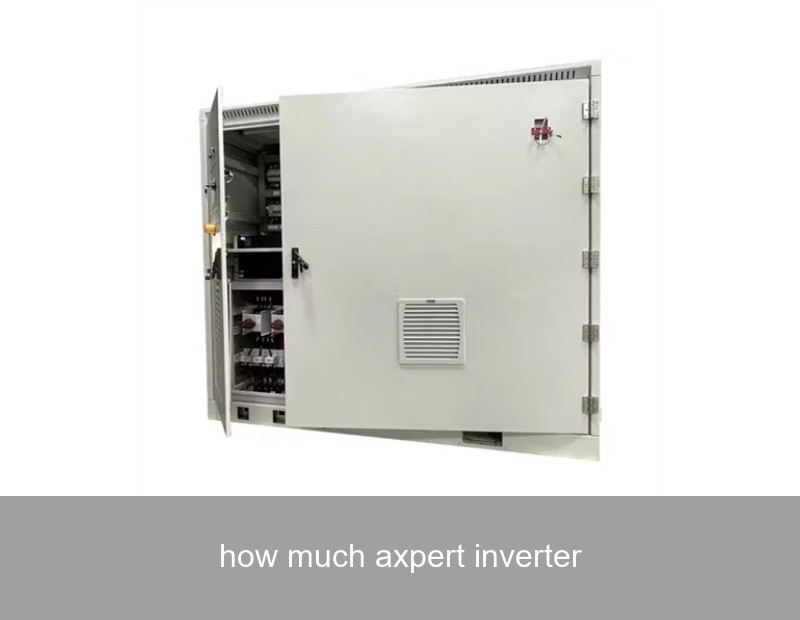
So, you're looking into an Axpert inverter, likely for your solar or backup power setup. The first question that pops up is almost always: "How much?" It's a great starting point, but as any seasoned energy pro will tell you, the true cost of an inverter goes far beyond its initial price tag. In this guide, we'll unpack the factors that determine how much an Axpert inverter truly costs, from purchase price to long-term value, and explore how modern alternatives are redefining what a smart energy investment looks like.
Table of Contents
Key Factors That Determine Axpert Inverter Pricing
Think of an inverter as the brain and central nervous system of your power setup. Its price isn't arbitrary; it's a direct reflection of its capabilities. When you see a range for how much an Axpert inverter might cost (typically from a few hundred to over two thousand dollars or euros), here's what's driving that variation:
- Power Rating (kW): This is the biggest driver. A 3kW model for a small cabin will cost significantly less than a 10kW model designed to run an entire home.
- Waveform: Pure Sine Wave inverters, which produce clean, grid-like power safe for sensitive electronics, are more expensive than Modified Sine Wave models.
- Voltage Configuration: Systems designed for 48V battery banks are generally for larger, more robust setups and command a higher price than 12V or 24V models.
- Features: Integrated solar charge controllers (MPPT), grid-charging capabilities, parallelability for stacking units, and software monitoring all add to the cost.
It's crucial to match the inverter's specs not just to your immediate needs, but to your future plans. Under-sizing can lead to overloads and failures, making that cheaper initial price a very costly mistake.
Beyond the Sticker Price: The Hidden Costs of Ownership
Now, let's talk about the part of the Axpert inverter cost that often gets overlooked: the total cost of ownership over 10-15 years. This is where the real financial picture comes into focus.
| Cost Factor | Description | Potential Long-Term Impact |
|---|---|---|
| Efficiency Losses | No inverter is 100% efficient. Losses of 5-10% mean wasted solar energy and higher electricity draw from batteries. | Reduces overall system yield, requiring more solar panels or battery capacity to compensate. |
| Limited Smart Features | Basic inverters may lack advanced energy management, like time-based load shifting or demand response capabilities. | Missed savings by not optimizing energy use against variable utility rates (like time-of-use tariffs common in Europe and the US). |
| Battery Compatibility & Integration | Not all inverters communicate optimally with modern lithium batteries (like LiFePO4) for advanced management. | Can shorten premium battery lifespan and prevent you from accessing their full performance and cycle life. |
| Scalability & Future-Proofing | A standalone inverter might not easily integrate with additional power sources (e.g., a second solar array, a wind turbine). | May necessitate a complete system overhaul to expand, rather than a simple, modular addition. |
As energy systems evolve, the value is shifting from standalone components to integrated, intelligent ecosystems. This is where companies like Highjoule are leading the charge. For over 18 years, Highjoule has moved beyond simply providing inverters to delivering complete, smart energy storage solutions. Our systems are built on the principle that every component—inverter, battery management, solar charging, and grid interaction—must be designed to communicate seamlessly. This holistic approach maximizes efficiency, extends hardware lifespan, and ultimately delivers a lower total cost of ownership, even if the initial investment is different from a basic component-based setup.
A Real-World Case Study: The German Household Energy Shift
Let's look at real data from a market that's at the forefront of residential renewable adoption. A 2022 study by the Fraunhofer Institute for Solar Energy Systems (ISE) analyzed the performance of various home energy systems in Germany. They found that systems with advanced, integrated energy management—where the inverter, battery, and software are co-engineered—achieved up to 30% higher self-consumption of solar power compared to systems assembled from disparate, albeit individually cheaper, components.
Consider the Müller family near Munich. They initially installed a mid-range off-the-shelf inverter with a 5kW solar array. After a year, their self-consumption rate (the percentage of solar energy they used directly) was around 35%. The rest was exported to the grid at a low feed-in tariff. By upgrading to a Highjoule H-Series Home Energy Hub—an all-in-one system with intelligent forecasting and load management—they increased their self-consumption to over 60%. This was achieved by the system automatically scheduling high-energy appliances (like their heat pump water heater) to run during peak solar production and optimizing battery charge/discharge cycles against their dynamic electricity tariff. The result? Their annual electricity bill was reduced by an additional 40%, dramatically shortening the payback period for their entire system investment.

Image Source: Unsplash - Representative image of a modern home with solar integration.
Modern Alternatives: Integrated Systems for Smarter Energy Management
The journey from asking "how much is an Axpert inverter" often leads to a more profound question: "What is the most cost-effective path to true energy resilience and savings?" The market is rapidly moving towards solutions that offer more than just conversion from DC to AC.
For homeowners and businesses in Europe and North America, key desirable features now include:
- Grid Services Readiness: The ability for the system to participate in virtual power plants (VPPs) or provide grid stabilization, potentially creating revenue streams.
- Seamless Backup: Automatic, sub-20ms switchover during a grid outage, keeping critical loads running without interruption.
- AI-Driven Optimization: Software that learns your consumption patterns and weather forecasts to make daily energy decisions that save you the most money.
Highjoule's product philosophy is built for this modern energy landscape. Our H-Series for Residential and M-Series for Commercial & Industrial applications are not just inverters or battery packs. They are unified energy platforms. They combine ultra-high-efficiency multi-mode inverters, scalable LiFePO4 battery modules, and our proprietary JouleMind AI software into a single, manageable system. This means our customers aren't buying and integrating pieces; they are adopting a guaranteed performance outcome: maximum self-sufficiency and the lowest possible energy cost.

Image Source: Unsplash - Example of a sleek, modern home energy storage unit.
Making the Right Choice for Your Energy Independence
So, where does this leave you? The initial purchase price of a component is one data point in a complex equation. The ultimate metric is Levelized Cost of Energy (LCOE) for your property—the average net cost of each kilowatt-hour you consume over the system's lifetime.
A system with a slightly higher upfront cost but intelligent features that squeeze 30% more value from your solar production, protect your battery investment for thousands more cycles, and adapt to future energy tariffs will have a far lower LCOE. It delivers greater financial and environmental returns.
What specific energy goal is driving your search for an inverter—is it pure backup security, maximizing solar ROI, or preparing for future electric vehicle integration?
We invite you to explore how Highjoule's integrated approach can be tailored to meet that precise goal. Our solutions are designed not just for today's energy needs, but for the evolving grid of tomorrow. What does your ideal energy-independent home look like, and what's the first load you'd want to secure during an outage?
 Inquiry
 Online Chat