


AshaPower Lithium Battery Inverter: The Heart of a Modern Energy Storage System
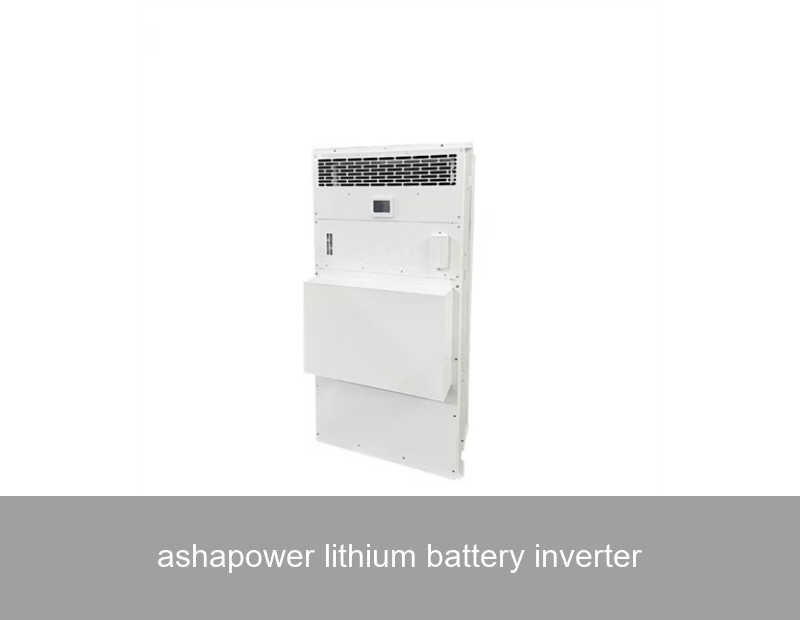
Have you ever wondered what truly unlocks the full potential of your solar panels or backup power system? It's not just the battery itself. The critical component, the brain and the brawn, is the AshaPower lithium battery inverter. This sophisticated piece of technology is the essential gateway that manages energy flow, ensures safety, and maximizes the return on your investment in renewable energy. For homeowners and businesses across Europe and the US, choosing the right inverter is as crucial as choosing the right battery.
Table of Contents
What is an AshaPower Lithium Battery Inverter?
Let's break it down. An AshaPower lithium battery inverter is a specialized power conversion device designed to work seamlessly with lithium-ion battery banks, like those using Lithium Iron Phosphate (LFP) chemistry. Its primary job is twofold: converting the direct current (DC) electricity stored in your batteries into the alternating current (AC) that powers your home or business, and managing the charging of the batteries from AC sources like the grid or solar panels.
Think of it as a highly intelligent traffic controller and translator for your energy:
- DC to AC Conversion (Inverting): Powers your appliances from the battery.
- AC to DC Conversion (Rectifying): Charges the battery from the grid or a generator.
- Solar Integration: In hybrid or solar-storage inverters, it also manages the DC input from photovoltaic (PV) panels, prioritizing solar for immediate use, then battery charging, and finally exporting excess.
- System Brain: Continuously monitors battery voltage, temperature, and state of charge to ensure optimal performance and safety.

Image Source: Unsplash (Representative image of inverter technology)
Why the Inverter is the Critical Component
You might have the best lithium batteries on the market, but with a subpar inverter, you'll never see their true value. The inverter dictates system efficiency, reliability, and functionality.
The Problem: Inefficiency and Lack of Control
Many early or low-cost storage systems suffered from "clunky" communication between the battery and inverter. This led to inefficient cycling, inaccurate state-of-charge readings, and even premature battery degradation. You'd have the energy stored, but lose a significant chunk (sometimes 10% or more) in the conversion process, and have little insight or control over how it was used.
The Data: Efficiency Gains Matter
Modern, high-quality AshaPower lithium battery inverters boast peak conversion efficiencies of over 97-98%. This means for every 100 kWh of DC energy your battery provides, 97+ kWh becomes usable AC power in your home. Over a system's 15+ year lifespan, that few percent difference translates to thousands of kilowatt-hours of saved—and paid for—energy. According to a report by the National Renewable Energy Laboratory (NREL), inverter efficiency and advanced software controls are among the top factors influencing the economic value of residential storage.
The Insight: It's About Intelligence, Not Just Power
Today's leading inverters are software-defined energy managers. They can:
- Perform time-based control to use cheap, off-peak grid power for charging and discharge during expensive peak hours (peak shaving).
- Enable grid-forming capabilities for backup power during outages, creating a stable "microgrid" for your property.
- Integrate with utility demand-response programs, allowing you to contribute to grid stability and earn incentives.
This intelligence is what transforms a simple battery backup into a smart, revenue-enhancing or cost-optimizing asset.
Case Study: A German Bakery's Resilience and Savings
Let's look at a real-world example from Bavaria, Germany. Schmidt's Family Bakery faced two challenges: rising electricity costs that squeezed their margins, and the risk of power outages that could spoil inventory and halt production.
Their Solution: They installed a 50 kWh lithium-ion (LFP) battery storage system centered on a high-power, three-phase AshaPower lithium battery inverter with advanced energy management software.
The Data-Driven Results (after 12 months):
| Metric | Result |
|---|---|
| Self-consumption of solar PV | Increased from 35% to over 80% |
| Peak grid demand charge | Reduced by 40% |
| Energy cost savings | €4,200 annually |
| Outage protection | Full operational capability for 8+ hours |
The inverter's smart logic schedules the bakery's large ovens and chillers to run primarily on solar and battery power, minimizing draw from the grid during high-tariff periods. The owner, Frau Schmidt, noted: "The system pays for itself. But more than that, the peace of mind knowing our cold storage stays on during a storm is priceless. The inverter is the maestro that makes it all work in harmony."
Choosing the Right Inverter for Your System
Not all inverters are created equal. Here are key considerations when selecting an AshaPower lithium battery inverter:
- Power Rating (kW): Can it handle the simultaneous load of your essential circuits or entire property?
- Waveform: For backup, a pure sine wave output is essential for sensitive electronics.
- Topology: Hybrid inverters (for new solar+storage) vs. AC-coupled or DC-coupled storage inverters (for retrofits).
- Communication Protocol: Must be fully compatible with your chosen battery brand (e.g., CAN bus, Modbus). Seamless communication is non-negotiable for safety and performance.
- Grid Services Ready: Does it have features like frequency-watt response or remote dispatch capability for future utility programs?

Image Source: Unsplash (Representative image of system monitoring)
Highjoule's Integrated Approach to Smart Storage
This is where Highjoule's expertise becomes pivotal. Since 2005, we've understood that the magic isn't in individual components, but in their flawless integration. Our EnerSync Smart Storage Systems for commercial, industrial, and residential applications are built around this core principle.
We don't just source batteries and inverters; we engineer the complete system. Our EnerSync Core Inverter is specifically designed and rigorously tested to work in perfect unison with our high-cycle LFP battery modules. This proprietary integration ensures:
- Maximum Efficiency: Optimized communication eliminates guesswork, delivering the 97%+ efficiency we promise.
- Enhanced Safety: Continuous, granular data exchange allows for predictive protection and thermal management.
- Scalable Power: Our modular design allows businesses to scale storage capacity and inverter power independently to match evolving needs.
- Intelligent Control: The Highjoule Energy Management Platform (HEMP) gives users and installers unparalleled control, from simple self-consumption modes to complex, tariff-driven optimization schedules.
For a homeowner in California or a factory in Germany, this means a storage solution that works as a single, reliable, and intelligent unit from day one, backed by a single point of responsibility: Highjoule.
Future Trends and Your Next Step
The future of the AshaPower lithium battery inverter is moving towards even greater grid interactivity and autonomy. We're talking about inverters that can autonomously island and re-synchronize, participate in peer-to-peer energy trading, and provide critical grid stability services as outlined by research from the U.S. Department of Energy's Solar Energy Technologies Office. The inverter is becoming the key node in the decentralized energy grid.
This leads to a crucial question for anyone considering energy storage: Is your system being designed with components that merely work together, or with an intelligently engineered solution where the inverter and battery are a unified force for efficiency and control?
What specific energy challenge—be it unpredictable bills, frequent outages, or a desire for true energy independence—is motivating you to look at storage solutions today?
 Inquiry
 Online Chat