


How Much Frontier Energy Can We Really Harness? The Future of Power
You've likely heard the ambitious goals: a carbon-neutral grid by 2040 or 2050. The vision is powered by vast amounts of wind, solar, and other frontier energy sources. But a critical question remains for grid operators, energy managers, and policymakers alike: how much frontier energy can we practically integrate into our existing systems before we hit a wall? The answer isn't just about building more solar farms or wind turbines. It's about what happens when the sun doesn't shine and the wind doesn't blow. The true frontier isn't just generation; it's intelligent storage and management.
Table of Contents
- The Integration Challenge: More Than Just Megawatts
- The Data Reality: Curtailment and the Need for Flexibility
- Case Study: California's Duck Curve and the Storage Solution
- The Key Enabler: Advanced Battery Energy Storage Systems (BESS)
- How Highjoule Enables the True Frontier
- The Future Horizon: Microgrids and Energy Independence
The Integration Challenge: More Than Just Megawatts
Think of the electrical grid as a vast, constantly balancing scale. On one side, you have demand—homes, factories, cities turning lights on and off. On the other, you have supply—power plants ramping up and down to meet that demand in real-time. Traditional fossil fuel plants, for all their drawbacks, provided a stable, dispatchable supply. You could turn them up when needed.
Now, enter frontier energy like solar and wind. They are variable, or intermittent. They generate power when nature allows, not necessarily when demand is highest. This creates a fundamental mismatch. Simply adding more solar panels doesn't solve the evening peak demand when the sun sets. In fact, without a way to store that midday solar bounty, it can become a grid management headache. So, when we ask "how much frontier energy," we're really asking: "How much can we add while keeping the grid stable, reliable, and cost-effective?"
The Data Reality: Curtailment and the Need for Flexibility
The problem isn't theoretical. In regions leading the renewable charge, we see a phenomenon called "curtailment." This is when grid operators deliberately reduce the output of renewable generators to prevent grid overload. It's wasted, clean energy.
- In California (CAISO), curtailment of solar and wind has risen sharply, from 0.5% of total generation in 2019 to over 2.4% in 2023. On some spring days, over 3,000 MWh can be curtailed—enough to power hundreds of thousands of homes for an hour.
- The European Union faces similar issues. A 2023 report by Ember highlighted that grid constraints are becoming a significant bottleneck for further renewable expansion, particularly in wind-rich northern regions.
This data tells a clear story: the physical capacity to generate frontier energy is outstripping the grid's ability to absorb and deliver it when and where it's needed. The missing link is flexibility.

Credit: Unsplash - Solar and wind farms represent frontier energy generation.
Case Study: California's Duck Curve and the Storage Solution
Let's make this concrete with the famous "Duck Curve," a visual representation of net load (total demand minus solar and wind generation) in California. It shows a deep midday dip (high solar output) followed by a steep evening ramp (as solar drops and demand peaks). This ramp is becoming steeper and more challenging each year.
California's response? A massive push for energy storage. The state has a mandate to deploy 52,000 MW of storage by 2045. And it's working. In July 2023, during a severe heatwave, battery storage systems set a record by discharging over 5,600 MW to the grid—essentially acting as the state's largest power plant during the critical evening hours, preventing blackouts. This wasn't just backup power; it was a fundamental reshaping of the grid's supply curve in real-time. The case answers part of our question: how much frontier energy you can use is directly proportional to your storage capacity.
The Key Enabler: Advanced Battery Energy Storage Systems (BESS)
This is where technology like Advanced Battery Energy Storage Systems (BESS) becomes the unsung hero. A modern BESS is far more than a big battery. It's an intelligent energy asset that can:
| Function | Impact on Frontier Energy |
|---|---|
| Energy Time-Shifting (Arbitrage) | Stores cheap, abundant midday solar for expensive, high-demand evening peaks, maximizing renewable ROI. |
| Frequency Regulation | Responds in milliseconds to grid fluctuations caused by variable renewable input, maintaining stability. |
| Capacity Firming | Makes a solar or wind farm behave more like a traditional plant, delivering a predictable output. |
| Voltage Support | Improves power quality on local grids, allowing for higher penetration of distributed renewables. |
How Highjoule Enables the True Frontier
At Highjoule, we've been tackling this exact challenge since 2005. Our mission is to unlock the full potential of frontier energy by providing the intelligence and storage needed to make it reliable and grid-friendly.
For a commercial or industrial facility, this means our Highjoule Quantum BESS does more than just reduce demand charges. It actively integrates with on-site solar, storing excess generation and creating a predictable, optimized energy consumption profile. You can increase your solar self-consumption from maybe 30-40% to over 80%, dramatically improving the economics and sustainability of your investment.
On a larger scale, our GridMax Utility-Scale Systems are designed for grid operators and large renewable project developers. They feature industry-leading safety with integrated fire suppression, superior cycle life, and, crucially, our Adaptive Energy Operating System (AEOS). AEOS uses AI-driven forecasting to decide the most profitable and grid-supportive moments to charge or discharge, whether for energy arbitrage, frequency response, or capacity services. This intelligent software layer is what transforms a battery from a simple storage device into a dynamic grid asset.

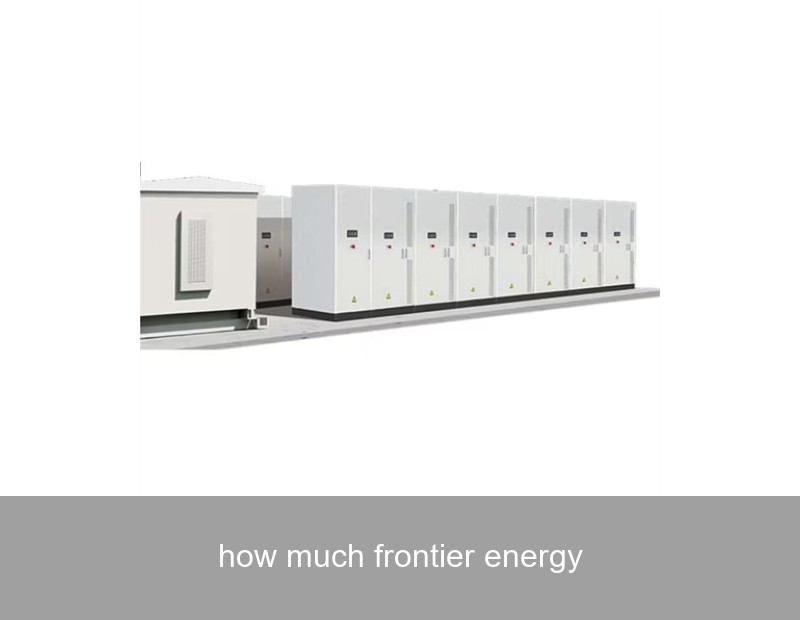
Credit: Unsplash - Modern Battery Energy Storage System (BESS) container.
The Future Horizon: Microgrids and Energy Independence
The ultimate expression of "how much frontier energy" may be answered not by the macro-grid, but by localized microgrids. Imagine a university campus, a hospital, or an industrial park powered primarily by its own solar canopies, with a Highjoule BESS as its beating heart. This microgrid can operate connected to the main grid, importing or exporting power as needed, or it can "island" itself during an outage, maintaining critical operations with 100% renewable power.
This model is gaining tremendous traction in the US and Europe, driven by desires for resilience, sustainability, and long-term cost control. The U.S. Department of Energy, for instance, is heavily investing in microgrid research, recognizing their role in national energy security. In this context, the amount of frontier energy you can harness approaches 100% of your needs, because you've built a smart, self-contained system designed around it.
Beyond Lithium: A Glimpse at the Storage Horizon
While lithium-ion dominates today, the frontier of storage itself is expanding. Technologies like flow batteries, which offer very long duration storage (10+ hours), are crucial for managing multi-day weather patterns. Compressed air and advanced thermal storage are also in development. The future grid will likely feature a mix of storage technologies, each optimized for different services—from second-to-second stability to week-to-week seasonal shifting. Companies like Highjoule are actively involved in piloting and integrating these next-generation technologies to prepare for an even higher renewable future.
So, we return to our initial, daunting question: How much frontier energy can we really harness? The limit is no longer our ability to capture sun and wind, but our collective ingenuity in storing, managing, and intelligently dispatching that power. With the right combination of advanced battery systems, smart software, and forward-thinking policy, the answer is: "Far more than we thought possible yesterday." The frontier is no longer just the energy source; it's the intelligence behind it.
Is your organization ready to assess its own frontier energy potential and build a resilient, cost-effective power strategy? What would achieving 80% or more renewable self-sufficiency mean for your operations and sustainability goals?
 Inquiry
 Online Chat