


The Renew Power Jaipur Plant and the Critical Role of Advanced Energy Storage
a sprawling solar farm in Jaipur, India, its panels glinting under the relentless sun, generating enough clean power for thousands of homes. It's an inspiring image of renewable progress. But here's a question that might not immediately come to mind: what happens when the sun sets, or when a sudden cloud bank passes over? This very challenge, faced by facilities like the Renew Power Jaipur plant, underscores the most pivotal conversation in energy today. It's not just about generation anymore; it's about intelligent management and storage. For grid operators in Europe and the US watching such projects, the lesson is clear: the reliability of our renewable future hinges on a sophisticated, behind-the-scenes player—the Battery Energy Storage System (BESS).
The Storage Imperative: Why Solar Alone Isn't Enough
The phenomenon is called intermittency. Renewable sources like solar and wind are fantastic, but they don't follow our daily energy demand curves. The Renew Power Jaipur solar plant contributes significantly to regional power, yet its output is inherently variable. This creates a fundamental mismatch for the grid, which requires a precise balance between supply and demand every second to maintain a stable frequency (typically 50 Hz in Europe, 60 Hz in the US).
Let's look at the data. According to the International Energy Agency (IEA), to effectively integrate high shares of variable renewables, global grid-scale storage capacity needs to expand dramatically. Unmanaged, this variability can lead to grid instability, curtailment (wasting excess renewable energy), and a continued reliance on fossil-fueled "peaker" plants to fill the gaps. This isn't just a technical hiccup; it's an economic and environmental hurdle.

Image Source: Unsplash - Large-scale solar farms require intelligent storage for grid stability.
Case Study: The Renew Power Jaipur Plant - A Lesson in Modern Energy
The Renew Power Jaipur plant is more than a solar installation; it's a real-world node in the global energy transition. While specific operational data is proprietary, we can analyze the public profile and common challenges of such a facility to draw powerful insights.
- Scale & Context: Located in Rajasthan, one of India's sunniest states, this plant is part of a massive renewable push. Its output feeds into a grid serving millions.
- The Challenge: Evening peak demand in the region rises just as solar generation plummets. Without storage, the grid must source power from other, often carbon-intensive, generation to meet this "duck curve" neck.
- The Implication: The full value of the solar asset isn't realized. Energy generated at noon might be underutilized, while its unavailability at peak times keeps operational costs high.
This scenario is directly analogous to challenges in California, Texas, or Germany, where solar penetration is high. The Jaipur plant exemplifies the universal truth: megawatts of generation need megawatts of intelligent storage to become truly dependable power.
The Role of Advanced Battery Energy Storage Systems (BESS)
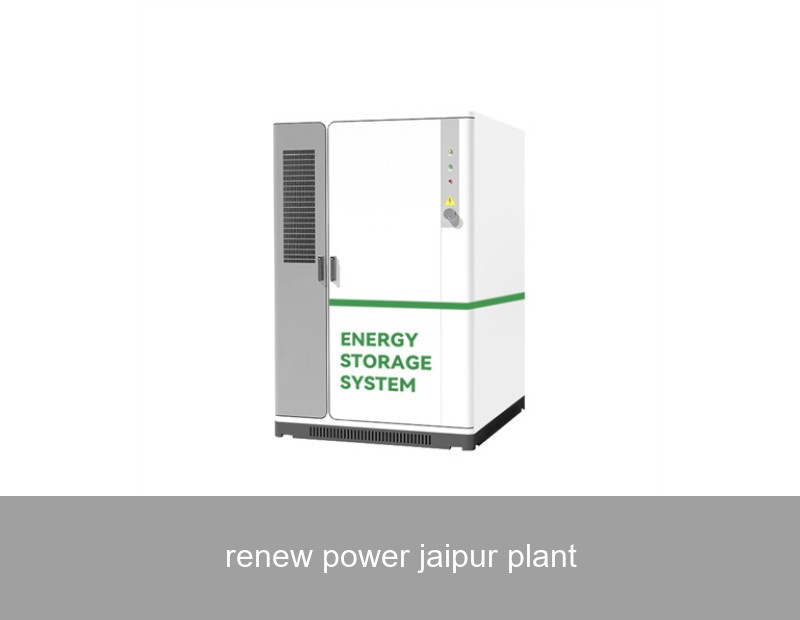
So, how do we turn variable renewable energy into a firm, dispatchable resource? Enter the advanced Battery Energy Storage System. Think of a BESS not just as a big battery, but as a high-speed, automated shock absorber and power bank for the entire grid. For a facility like the hypothetical future upgrade of the Renew Power Jaipur plant, a BESS would provide critical services:
| Service | Function | Benefit |
|---|---|---|
| Energy Time-Shifting (Arbitrage) | Store excess solar energy at midday, discharge during evening peak. | Maximizes solar revenue, displaces fossil-fuel peaker plants. |
| Frequency Regulation | Inject or absorb power in milliseconds to maintain grid frequency. | Essential for grid stability, especially with high renewable penetration. |
| Ramp Rate Control | Smooth out sudden drops in solar output (e.g., from clouds). | Prevents voltage fluctuations and potential grid disturbances. |
| Capacity Firming | Guarantee a "firm" amount of power output from a solar plant. | Makes renewable energy a reliable product for power purchasers. |
Highjoule's Intelligent Solutions for Grid Stability
This is where Highjoule's expertise becomes pivotal. Since 2005, we've been at the forefront of designing BESS solutions that solve precisely these challenges. Our systems are engineered not just for storage, but for intelligent grid interaction.
For a large-scale solar plant like the one in Jaipur, Highjoule would provide a containerized, utility-scale BESS featuring:
- High-Density Lithium-Ion or LFP Technology: Offering the optimal balance of energy density, cycle life, and safety for daily cycling applications.
- Advanced Energy Management System (EMS): The true brain of the operation. Our AI-driven EMS can forecast solar generation and grid demand, autonomously deciding when to charge, discharge, or hold to maximize economic and grid-support value.
- Grid-Forming Inverter Capability: A cutting-edge feature that allows our BESS to not just follow the grid but actively stabilize it, helping to "form" the grid's voltage and frequency—a critical function as traditional generators retire.
- Modular & Scalable Design: Systems can be scaled from a few megawatt-hours to hundreds, allowing for phased deployment alongside growing solar capacity.
Imagine the Renew Power Jaipur plant coupled with a Highjoule BESS. Solar energy would be captured, stored, and released on command, transforming the plant from an intermittent generator into a predictable, grid-supporting asset. This model is already proving successful in markets like the UK, where Highjoule systems are providing frequency response services to the National Grid, and in California, where we help integrate gigawatts of solar power.

Image Source: Unsplash - A technician overseeing a modern battery storage installation.
Building the Future Grid: Your Next Step
The story of the Renew Power Jaipur plant is a microcosm of the global energy shift. It highlights that our journey to net-zero isn't complete with solar panels and wind turbines alone. The enabling technology—the intelligent, grid-savvy storage system—is what will unlock the full potential of renewables, ensuring lights stay on, industries keep running, and the transition is both smooth and secure.
Whether you're a utility planner in Europe, a commercial energy manager in the US, or a developer of the next major renewable project, the question is no longer if storage is needed, but how to integrate it most effectively. What specific grid challenge or renewable integration hurdle is your organization looking to solve with intelligent energy storage?
 Inquiry
 Online Chat